Quick takeaways
The idea: Emotional stability usually helps people recover from being hurt. The paper argues it can sometimes carry a hidden cost. Feeling better can quietly end the work of figuring out what the hurt means for the relationship.
The mechanism: Relief is a signal about your feelings. The risk is treating it as a signal that the problem is solved. For example, you feel fine after a friend shares your secret, so you never decide how much to trust them next time.
It’s conditional: The cost applies only when a real question is still open, such as whether it will happen again or whether it was repaired. If you’ve already worked it through, moving on is healthy.
Calm isn’t the problem: Nobody has to suffer, confront anyone, forgive, or reconcile. Resolution can mean rebuilt trust, calibrated caution, a boundary, or leaving.
What to ask yourself: Besides “do I feel better?”, ask “do I know what this means for how I act with this person from here?”
Partners matter too: If you look composed, the other person may assume repair is complete and never offer an explanation or accountability.
It’s a testable theory, not a finding: The paper proposes experiments and long-term studies, and spells out what results would show it’s wrong.
Disclaimer: This is a theoretical proposal, not an established finding or advice on handling a specific situation, would keep the post consistent with the paper.
Abstract
Emotional stability usually supports recovery from interpersonal hurt. This article proposes that its benefits can sometimes carry a conditional cost: earlier emotional improvement may end engagement before an injury's relational implications have been evaluated. The proposed stability paradox concerns opposing pathways, with restored capacity supporting resolution and relief-based completion judgments potentially undermining it. The model distinguishes trait stability, affective recovery, felt relief, and relational resolution. Three sequential propositions link stability to recovery and relief timing, relief to premature disengagement through completion judgments, and disengagement to incomplete updating. A separable interpersonal extension explains how visible composure may lead partners to underestimate unfinished repair. Independently established evaluative need distinguishes efficient stopping from premature disengagement. Integrating personality, affect-as-feedback, avoidance-learning, forgiveness, resilience, and trust-repair research, the article specifies competing explanations and disconfirming outcomes. A staged empirical program combines measure validation, incentivized experiments testing the attribution of relief, and intensive event-linked observation. The contribution is a testable account of how a generally adaptive personality resource can permit emotional recovery to outpace relational resolution under identifiable conditions.
Keywords: emotional stability, interpersonal hurt, felt relief, premature disengagement, emotion beliefs, relational resolution
1. The Puzzle: Feeling Better Before the Relationship Is Understood
An injury can stop hurting before its implications have been worked out. A friend discloses a confidence, a partner humiliates someone in public, or a colleague unexpectedly rejects a valued collaboration. The injured person regains equilibrium and resumes ordinary activity. That recovery may reflect excellent regulation. It may also remove the immediate reason to consider a question that remains consequential: What does this event mean for future trust, dependence, or vulnerability?
The distinction is especially interesting for emotional stability. Low neuroticism is generally associated with favorable psychological adjustment, including more favorable responses to everyday negative events (Wenzel et al., 2026). The present article proposes that this resource can carry a conditional indirect cost. When emotional recovery occurs before a consequential relational question has been evaluated, and felt relief is treated as evidence that the matter is finished, an early emotional success may contribute to premature disengagement. The result can be delayed resolution of the injury's relational implications despite an initially favorable emotional trajectory.
This is the stability paradox: the disposition that helps an emotional episode end may sometimes help engagement end too soon. The proposed liability is conditional on both unfinished evaluative demands and the interpretation of relief. It can coexist with substantial overall benefits of emotional stability. A positive total association with adjustment would therefore not rule out the hypothesized adverse pathway; equally, showing that avoidance predicts difficulties would not establish a paradox involving stability.
The account connects personality to a decision about completion. It asks when the emotional system's signal of improvement becomes an inadequate criterion for ending a different task: evaluating what a significant offense means and deciding what to do. Existing theories address affective dynamics, mood-dependent persistence, avoidance, and forgiveness. Their integration yields a specific prediction about the timing of recovery relative to unfinished relational demands, together with a second prediction about how another person interprets visible composure.
The scope is adult interpersonal hurt, including breaches of confidence, humiliation, betrayal, and rejection. Resolution can involve repaired trust, calibrated caution, a boundary, or ending a relationship. It requires neither reconciliation nor sustained emotional expression. The article is an integrative theoretical review; the complete causal sequence remains a proposal. Established findings, theoretical extensions, and new measurement tasks are distinguished where they enter the argument, rather than through repeated qualifications throughout the paper.
2. Defining the Processes and the Unfinished Task
Trait stability, affective recovery, and felt relief
Emotional stability is the low pole of neuroticism or negative emotionality. It describes a disposition, not a specific strategy or an absence of interpersonal vulnerability. Facet assessment matters because low anxiety, low depression, and low emotional volatility may contribute differently to event responses (Soto & John, 2017). Defensive self-presentation and attachment-related deactivation must be assessed separately.
Affective recovery is a decline in event-related negative affect toward a relevant baseline following an identifiable response. Recovery is distinct from initial reactivity and from a low average level of distress. Dynamic models distinguish affective equilibrium, variability, and resistance to change (Kuppens et al., 2010). Autocorrelation is not itself a time-to-recovery measure after a known offense, and dynamic indices should demonstrate value beyond mean affect and variability (Dejonckheere et al., 2019; Houben et al., 2015).
Felt relief is the subjective experience of improvement relative to a preceding aversive state or anticipated aversive outcome. Here the focal experience is perceived improvement after interpersonal distress. It is a change-sensitive experience, whereas calm is a current state and composure is an outward presentation. Someone may be calm without having experienced much relief, or may feel considerable relief while still distressed. The model therefore requires separate measurement of the negative-affect trajectory, the experience of relief, and visible behavior. It does not infer relief from a low distress score.
Emotionally stable people may react less strongly, leaving little distress to decline and little relief to notice. The model therefore separates the probability and magnitude of initial distress, the rate of subsequent recovery, and the onset of felt relief. Recovery can be estimated only where a response occurs, but sampling must include all eligible offenses rather than selecting participants on observed distress. A joint model should estimate these processes together, allow shared person and event influences, and examine sensitivity to unmeasured causes of both reactivity and recovery. A hurdle component can describe whether a response occurs; it does not by itself remove selection bias.
The proposed link to relief timing depends on noticing improvement. Faster decline may bring a person earlier to a personally meaningful sense of improvement, even when the total decline is smaller. That bridge is an empirical prediction: subtle or rapidly terminated distress may produce no reportable relief. The theory predicts neither larger relief nor more relief episodes among stable people. Analyses must estimate the incidence and timing of felt relief separately and allow no-relief episodes to remain in the risk set or observation model, as appropriate.
Resolution and need for evaluation
Relational resolution is an adequately evaluated understanding of the offense's implications that supports evidence-sensitive expectations and workable action. It can coexist with anger, sadness, forgiveness, or continuing distance. Incomplete updating means that available consequential information has not been incorporated into that understanding. Premature disengagement is the primary process term: engagement ends while relevant evaluative demands remain unmet. Completion judgments are the proposed decision mechanism. Insufficient engagement relative to independently specified need is the observable indicator of premature disengagement; missed updating is its proposed consequence. In a one-decision task, that indicator is a behavioral signature rather than a direct observation of when sustained engagement ended.
Need for evaluation must be established independently of distress, recovery, and eventual symptoms. It concerns a decision-relevant question left open by an event, not how upset an observer believes a person ought to be. In a breach-of-confidence task, need is present when future disclosure is consequential and the available record does not establish whether the breach was intentional, repeated, or credibly repaired. Once those questions have been considered and a workable decision reached, low engagement may be appropriate even if the relationship remains painful.
Controlled studies can specify need through scenario contingencies before any emotion is measured: an explicit norm violation, unresolved information about recurrence, future dependence, and accessible evidence capable of changing a decision. Independent raters can verify these features while blinded to participants' emotional responses. Repetition and dependence raise potential relevance but are not automatically additive severity points. A complete explanation already supplied can reduce need even after a serious offense; a small event can require evaluation if it reveals important uncertainty.
Naturalistic studies require more modest inference. Baseline relationship expectations, an early event description, existing repair information, and pending decisions can be coded by raters blinded to later recovery and outcomes. Participants can identify which unresolved questions matter to their goals, while raters assess whether those questions have available informational answers. Disagreement between participant and rater assessments should be retained and analyzed, not erased by assuming either has privileged access to the relationship.
The focal outcome is insufficient engagement relative to these demands. A concrete indicator is making a consequential trust decision while leaving accessible, materially relevant evidence unexamined. Need and engagement are not presumed to share a scale; their raw scores should not simply be subtracted. Experimental contrasts between fixed high-need and already-resolved scenarios provide a cleaner initial test than an unrestricted three-way interaction across noisy naturalistic measures.
3. Theoretical Foundations and Competing Explanations
Affect as feedback and beliefs about completion
Emotion regulation includes decisions about initiating, maintaining, and ending regulatory efforts (Gross, 2015). Control-process theory treats affect as feedback concerning progress toward goals (Carver & Scheier, 1990). Feelings-as-information research shows that affective experience can inform judgments and that its interpretation depends on attribution (Schwarz & Clore, 1983). Mood-as-input experiments further show that the effect of mood on persistence depends on the criterion used to decide whether to continue: positive mood can accompany earlier stopping under sufficiency criteria but greater persistence under enjoyment criteria (Martin et al., 1993).
These accounts explain why improvement need not carry a fixed behavioral instruction. They do not equate positive mood with relief. The present extension concerns attribution of a perceived decline in distress: improvement in the goal of feeling better is taken to indicate completion of the goal of understanding the relationship. The mechanism is a proposed transfer of a progress signal between tasks. If felt relief fails to influence completion judgments independently of current affect and positive mood, that transfer account is not supported.
Beliefs about emotion provide a basis for individual differences in this interpretation. Ford and Gross (2019) distinguish beliefs about the goodness and controllability of emotions, while the Emotion Beliefs Questionnaire assesses usefulness and controllability beliefs (Becerra et al., 2020). A relief-based completion belief is a narrower proposed construct: perceived emotional improvement is considered sufficient evidence that a relational matter needs no further evaluation. Existing emotion-belief measures can test convergent and discriminant validity, but they do not already measure this rule. The new measure must distinguish it from emotional avoidance, need to appear untroubled, and ordinary judgments that enough relevant information has been considered.
Relief, avoidance, and corrective learning
Avoidance learning supplies a complementary mechanism. If turning away from an upsetting issue produces relief, that consequence can strengthen subsequent avoidance. Research directly examining relief during avoidance conditioning and extinction makes this route more relevant than a generic analogy with positive mood (Vervliet et al., 2017). Safety-behavior accounts also explain how protective responses can prevent corrective learning (Salkovskis, 1991), complementing emotional-processing theory's emphasis on access to relevant structures and corrective information (Foa & Kozak, 1986).
The order of events distinguishes this route from the main completion account. In the proposed completion route, recovery and felt relief precede a judgment that further engagement is unnecessary. In the reinforcement route, disengagement precedes relief, which increases later disengagement. Both may occur within a relationship, but they are not interchangeable mediators. A finding that avoidance produces relief would support reinforcement, not by itself demonstrate that earlier trait-linked recovery caused premature disengagement.
An additional motivational possibility requires no consciously endorsed belief: decreasing distress may reduce the urgency of further attention. Automatic and controlled regulation need not align with explicit and implicit goals (Braunstein et al., 2017). This possibility is retained as a separately testable extension, assessed through temporal behavior and changes in urgency. It is not used to explain away failure of the explicit completion-belief prediction. Experiential avoidance, expressive suppression, and repressive coping likewise require distinct measures (Gross & John, 2003; Hayes et al., 1996; Myers, 2010). Their associations with symptoms or memory access establish adjacent evidence, not the personality mechanism proposed here (Aldao et al., 2010; Myers & Brewin, 1994; Weinberger et al., 1979).
Relational meanings, forgiveness, and two contrasting cases
Interpersonal hurt often concerns perceived devaluation by another person (Leary et al., 1998). Such events can change the balance between dependence and self-protection described by risk-regulation theory (Murray et al., 2006). Resolution accordingly concerns what the event implies for future interaction, not simply whether its immediate affective impact has diminished.
Forgiveness research offers important temporal and conceptual distinctions. Transgression-related avoidance and revenge can change over time, and temporary favorable shifts differ from enduring trajectories (McCullough et al., 1998, 2003). Forgiveness can reduce transgression-related stress (Worthington & Scherer, 2004), yet its consequences depend on the offender's conduct: reconciliation without adequate assurance can carry costs to self-respect or permit continuing aggression (Luchies et al., 2010; McNulty, 2011). Forgiveness is therefore an adjacent motivational outcome, not a sufficient indicator that trust has been adequately evaluated.
Trust-repair research makes the informational task more specific. Kim et al. (2004) showed that the relative effectiveness of apology and denial depended on whether the suspected violation concerned competence or integrity. Repair therefore cannot be scored simply by the presence of an apology or an increase in trust. Bilateral models place the injured person's interpretations and the other person's responses in a developing exchange (Kim et al., 2009). Lewicki and Brinsfield (2017) further distinguish verbal responses, compensation, and longer-term changes to the relationship. These distinctions motivate tests of whether people use diagnostic evidence about the violation, recurrence, and credible corrective action.
In the confidence-breach case, a person can recover quickly, review an accountable explanation, establish conditions for future disclosure, and appropriately stop revisiting the matter. Another person may recover equally quickly and treat that improvement as a reason not to examine available evidence about repeated disclosure. Only the latter illustrates insufficient engagement, and the difference is established by information use rather than emotional duration.
A contrasting case involves public humiliation. After a partner mocks a personal ambition at a gathering, the injured person feels better following a supportive conversation with a friend. The improvement may restore capacity to decide whether the remark was an isolated misjudgment or part of a recurring pattern. Under the proposed adverse pathway, the person instead concludes that feeling better settles the issue and never considers evidence relevant to future vulnerability. A later invitation to share a goal may then expose an unresolved decision. Continued humiliation would be new harm, however, and should be analyzed separately from reactivation by a benign reminder.
Meaning-making research distinguishes attempts to understand an event from meaning actually achieved (Park, 2010), while repetitive thought can be constructive or unconstructive (Watkins, 2008). These distinctions prevent equating more engagement with better recovery. The relevant gain is an adequate, revisable understanding; lengthy rumination can fail to provide it.
Successful adaptation and personality rivals
Rapid recovery ordinarily supports adaptation. Positive-emotion research links positive affect with cardiovascular recovery and broader resources, offering a strong account of how improvement can support subsequent functioning (Fredrickson, 2001; Fredrickson & Levenson, 1998; Tugade & Fredrickson, 2004). Regulatory-flexibility accounts emphasize context sensitivity, available strategies, and responsiveness to feedback (Aldao et al., 2015; Bonanno & Burton, 2013). The ability both to express and suppress emotion can predict adjustment (Bonanno et al., 2004). These accounts predict preserved or improved information use after recovery, including efficient stopping once relevant demands are met.
Resilience findings place a further limit on a universal hidden-injury explanation. Healthy functioning after adversity is a legitimate trajectory (Bonanno, 2004), and an affective-autonomic discrepancy interpreted as repressive coping has been associated with better adjustment, including friend reports (Coifman et al., 2007). Neither autonomic arousal nor limited elaboration establishes nonresolution; meaning making is not universally necessary (Bonanno, 2013). Strategy effectiveness depends on context rather than a simple hierarchy of engagement over disengagement (Ford & Troy, 2019; Sheppes et al., 2014). Temporary disengagement can support later engagement, as illustrated by oscillation in bereavement models (Stroebe & Schut, 1999).
Personality alternatives must be tested directly. Attachment-related deactivation can connect reduced displayed distress with restricted relational engagement, especially under stress (Simpson & Rholes, 2017). Agreeableness is relevant to forgiving responses, while vengefulness has documented associations with both agreeableness and neuroticism (McCullough et al., 2001). The proposed contribution of emotional stability concerns recovery timing, not dispositional benevolence, attachment security, or low conflict expression. Analyses should compare these explanatory pathways rather than rely solely on adding correlated covariates to one regression.
Recent dynamic findings support precise temporal measurement. Wenzel et al. (2026) linked neuroticism with negative-event processes including poorer recovery. Schreuder et al. (2025), studying 68 adults, found associations for daily resilience but not trait resilience, so their results cannot establish a trait-stability effect. Schneider et al. (2026) modeled state-dependent affective persistence in 485 participants across 25 days. Together these studies motivate separating traits, states, and trajectories; the interpersonal completion mechanism remains the new bridge.
4. Three Sequential Propositions and an Interpersonal Extension
Figure 1 separates a three-stage personal pathway from a partner-feedback extension. The adaptive route links emotional recovery to renewed capacity for evaluation and evidence-sensitive resolution. The adverse route begins when felt relief substitutes for completion of an independently identified task. Propositions 1–3 specify successive links; the full indirect association is an integrative prediction rather than a repeated proposition.
Completion beliefs are person-level moderators of the second stage: the link from felt relief to completion judgments and disengagement. The model assumes no independence between those beliefs and emotional stability. Their association should be estimated before the focal event, and trait associations with beliefs should be distinguished from trait associations with recovery. Positive, negative, or negligible covariance could change who enters the adverse pathway. Correlation permits statistical estimation when variation and overlap are sufficient, but neither covariate adjustment nor a moderated-mediation coefficient establishes causal identification. Figure 1 locates the hypothesized moderation without asserting that stability causes the belief.
At the integrative level, the model allows opposing indirect effects, often termed inconsistent mediation: recovery may improve resolution through restored capacity while earlier felt relief may impair it through premature disengagement under high completion belief and unmet need. The adverse path can be present even when the total association is beneficial. Each path requires its own uncertainty estimate and sensitivity analysis; a positive total effect establishes neither pathway.
Figure 1
Proposed personal pathways and separable partner extension
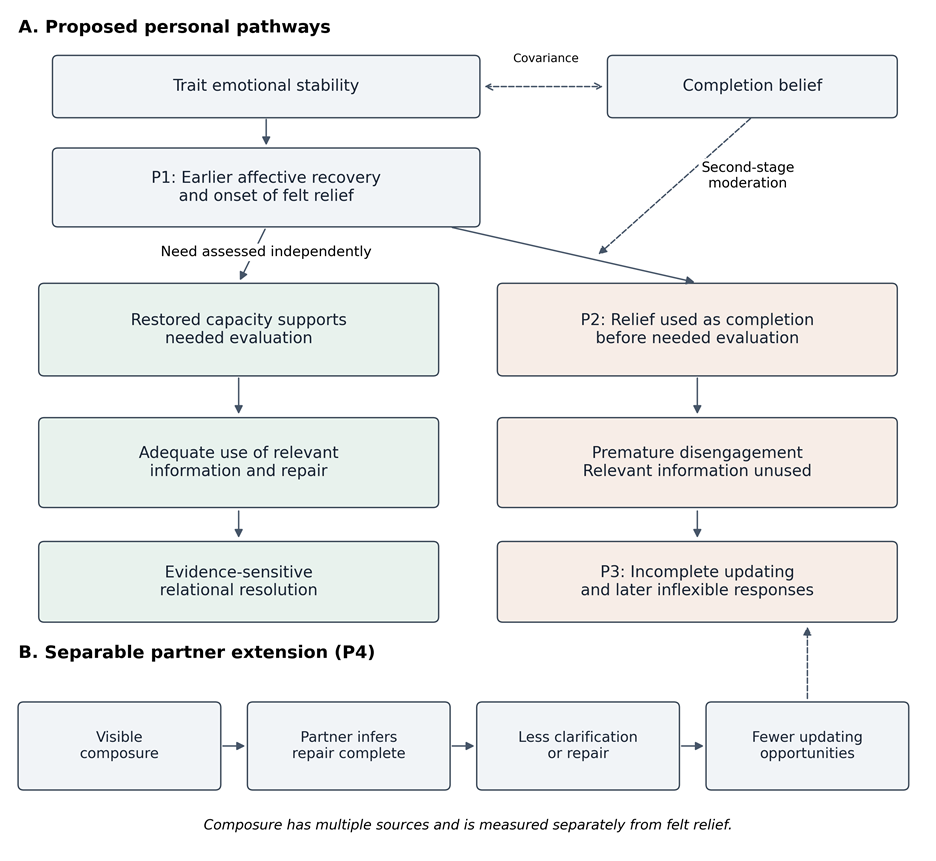
Note. The diagram specifies theoretical pathways, not estimated effects. P1–P3 are sequential personal links; P4 is a separable interpersonal extension. Trait stability and completion belief may covary. The dashed moderation arrow concerns the use of relief as completion evidence, not the stability-to-recovery link. The adverse route is conditional on independently established unmet evaluative need and relief-based completion beliefs. Alternative sources of adequate updating interrupt it.
Proposition 1: Greater emotional stability will predict earlier affective recovery and, where improvement is subjectively noticed, earlier onset of felt relief. This timing prediction will be evaluated jointly with the incidence and magnitude of initial reactivity and the incidence of felt relief across all eligible offenses.
The proposition concerns the first stage only. Adjacent personality evidence supports a recovery association; its extension to felt-relief timing after interpersonal hurt remains a prediction. Lower reactivity alone cannot confirm it. Joint trajectory and time-to-relief models should distinguish response onset, peak intensity, subsequent decline, and reportable improvement, including episodes without distress or relief in their respective observation components. Estimates among responders should be identified as conditional and tested for sensitivity to shared causes of response selection and recovery. If the apparent timing advantage disappears under plausible selection assumptions, the personality claim is weakened; if precise estimates show no earlier recovery or relief, the corresponding first-stage link fails. A recovery advantage without earlier felt relief leaves the trait-to-completion bridge unsupported.
Proposition 2: At a fixed, independently established need for evaluation, felt relief will predict insufficient subsequent engagement through completion judgments more strongly among people who prospectively endorse relief-based completion beliefs.
Here insufficient engagement is the measured indicator of premature disengagement used in Proposition 3. The prediction concerns engagement relative to the task, not a general reduction in thinking. In already-resolved or low-need scenarios, early stopping is appropriate and should not be classified as a cost. Current distress, improvement, positive affect, and experienced relief must be distinguished. Completion belief is measured before the focal episode and independently of observed disengagement. The critical comparison is whether relief predicts unexamined consequential information before a decision, over and above generic avoidance or a preference to stop. More information use after relief favors the adaptive account; a well-estimated negligible association contradicts the specified completion pathway.
Proposition 3: Premature disengagement will predict incomplete updating and later inflexible responses to relevant cues when consequential information remains available and no alternative route supplies adequate resolution.
Updating can occur through credible repair, independent reflection, a clear boundary, or changing circumstances. The model predicts a cost only where an informational opportunity is missed. In controlled tasks, this means less evidence-sensitive trust decisions, followed by responses to relevant reminders that fail to track known risk or repair. In natural relationships, judgments must be qualified by uncertainty and personal goals. The outcome is not any recurrence of hurt, and delayed clinical symptoms are not required. Research on delayed posttraumatic presentations cautions against inferring a previously symptom-free hidden injury from later distress (Andrews et al., 2007). If new harm accounts for subsequent difficulty, the reactivation claim is unsupported.
Proposition 4: When the injured person's composure is visible but evaluative need remains unmet, partners who interpret composure as completion will provide less clarification or repair than partners who accurately recognize the unfinished task, thereby reducing opportunities for updating.
This is a separable interpersonal extension, not a fourth stage of the felt-relief sequence. Composure may arise from genuine recovery, deliberate suppression, or social convention, so neither emotional stability nor felt relief is required for this prediction. Expressive suppression can affect interaction partners (Butler et al., 2003), while bilateral trust-repair theory emphasizes exchanges between the parties (Kim et al., 2009). The specific inference from composure to completed repair is proposed here. Both the partner's inference and the amount or quality of repair should be measured. A calm person may explicitly request clarification, interrupting the pathway; a responsive partner may provide it without a request. Conversely, visible upset may attract reassurance without producing accountable repair. Cultural conventions about expression must inform interpretation (Butler et al., 2007). If matched displays change neither perceived completion nor repair, or if repair differences do not affect updating, the corresponding partner-feedback link fails.
The account succeeds only if its links are separated empirically: avoidance producing relief, calm eliciting reassurance, and trait stability predicting well-being are not substitutes for the proposed sequence.
5. Measurement: Assessing What Remains Unfinished
Table 1 specifies the principal assessments. Emotional stability should be measured independently of the episode, preferably with facet information and complementary informant reports. Attachment avoidance and anxiety, agreeableness, defensive responding, habitual avoidance, prior relationship functioning, and current partner behavior belong in the competing-model analysis. Temporal measures should separate initial response, subsequent affective decline, felt relief, completion judgment, and engagement; their sequence is itself evidence relevant to mechanism.
Table 1
Measurement of the proposed processes and adjacent constructs
Construct | Assessment | Interpretation |
Personality | Pre-event BFI-2 negative emotionality facets; attachment avoidance/anxiety, agreeableness, defensive responding, and prior functioning as competing explanations. | Trait stability is separate from low displayed distress or a defensive coping classification. |
Recovery and relief | Repeated event-linked negative affect, initial reactivity, direct felt-improvement ratings, current calm, positive affect, and arousal. | Measure relief directly; infer neither recovery nor relief from a low endpoint alone. |
Evaluative need | Preregistered scenario contingencies; blinded coding of unresolved questions, pending dependence, and available decision-relevant evidence. | Establish need independently of distress, later disengagement, and eventual symptoms. |
Completion belief | Separate pre-event scenarios: emotional improvement as sufficient completion versus informational sufficiency; compare EBQ beliefs. | Proposed measure requiring validation; EBQ does not already measure this rule. |
Engagement | Uptake of materially relevant information before a consequential decision; clarification and concrete evaluation. | Score adequacy relative to need, not time spent or amount disclosed. |
Updating | Repeated recurrence estimates and dependence decisions under credible repair, ambiguity, or continuing risk. | Proposed tasks; direction of adaptive trust change depends on known evidence. |
Adjacent outcomes | Repeated TRIM avoidance/revenge; Narrative Coherence Coding Scheme for context, chronology, and theme. | Existing measures of motivation or coherence; neither is a global resolution score. |
Partner feedback | Separate outward-display assessment; perceived completion; coded acknowledgment, clarification, and accountable repair. | Proposed dyadic assessment; reassurance quantity is not repair quality. |
Note. BFI-2 = Big Five Inventory–2 (Soto & John, 2017); EBQ = Emotion Beliefs Questionnaire (Becerra et al., 2020); TRIM = Transgression-Related Interpersonal Motivations (McCullough et al., 1998, 2003). Narrative coding follows Reese et al. (2011). Proposed measures require reliability and validity studies.
The proposed completion-belief measure should use situations separate from the focal injury. Items would assess whether emotional improvement is considered sufficient evidence of completion, contrasted with whether relevant questions have been answered. Validation should examine stability across situations, overlap with the Emotion Beliefs Questionnaire, and discriminant validity from avoidance and attachment deactivation (Becerra et al., 2020). A belief measure cannot establish an implicit motivational process, which requires its own behavioral evidence.
Resolution should initially be assessed through separate components rather than an unvalidated composite. Repeated TRIM avoidance and revenge scores describe motivations toward the offender (McCullough et al., 1998, 2003); maintaining distance from continuing risk can be adaptive. Narrative coherence can be coded for context, chronology, and theme (Reese et al., 2011), but coherence is not accuracy, and concise or culturally restrained accounts can express adequate understanding. Neither instrument is a validated global measure of relational resolution.
Evidence-sensitive adjustment is most directly tested through decisions. Before receiving new information, participants estimate recurrence risk and specify conditions for future dependence. They then evaluate accountable repair, ambiguous reassurance, or evidence of continuing risk. Controlled contingencies permit preregistered scoring of information use and calibrated revision. Naturalistic work should combine independently coded evidence, participant goals, and uncertainty ratings. A decision to end contact may demonstrate resolution; an increase in trust may demonstrate poor calibration. Scoring must allow either direction when warranted by the evidence.
Table 2 summarizes the contrasting predictions, disconfirming outcomes, and tests for each proposition.
Table 2
Predictions, rival outcomes, and critical tests
Claim | Distinctive prediction | Competing or disconfirming result | Primary test |
P1 | Stability predicts earlier recovery and, when noticed, earlier felt relief; jointly estimate reactivity and relief occurrence. | Only lower reactivity; no recovery/relief path; or the sequence is explained by attachment deactivation. | Stage 3 prospective joint process model. |
P2 | At fixed unmet need, relief precedes completion judgments and insufficient uptake, especially under stronger completion belief; source attribution attenuates this link. | Relief supports adequate engagement, or precise estimates exclude a meaningful conditional cost. | Stages 1–2: validated belief measure; distress-then-improvement task. |
P3 | Missed relevant information predicts poor calibration and later inflexible responding without new harm. | Equalized information removes no relevant deficit; updating predicts no later response; or new harm explains recurrence. | Stage 2 fixed-information contrast; Stage 3 relevant-cue follow-up. |
P4 | Composure prompts an inference of completed repair, reducing useful clarification and updating opportunities. | Display changes neither completion inference nor repair, or repair does not affect updating. | Stage 2 dyadic display × communicated-need task. |
Note. Failure of one link constrains that link and the complete sequence. A failed explicit-belief test cannot be rescued post hoc by substituting an unmeasured implicit process. Experiments address narrower causal links than the full prospective personality model.
6. A Staged Empirical Program
Stage 1: Validate the constructs and the need manipulation
Scenario studies should first validate the completion-belief assessment and test whether participants distinguish felt relief from current calm and induced positivity. Scenarios can cross unfinished versus already-resolved informational demands while holding the offense and available time constant. Independent raters, blinded to emotional outcomes, verify the violation, pending decision, and relevance of information. Engagement is scored against preregistered opportunities, such as whether the participant examines evidence that can materially change the next disclosure decision.
This stage avoids building a rare, poorly measured subgroup into the first test. Completion beliefs remain continuous, and need can be fixed at a high level for the primary analysis, with an already-resolved condition as a boundary comparison. A response-surface model becomes useful only if need and engagement can be assigned defensible, interpretable scales; the theoretical concept of mismatch alone does not supply that measurement. Low engagement after sufficient evaluation supports efficiency rather than premature disengagement.
Stage 2: Identify completion inferences and their behavioral costs
A faithful experiment requires distress followed by improvement. Adults could complete an interpersonal allocation or disclosure task with a mild norm breach and a pending decision about reliance on the same counterpart. An accessible record would contain evidence that changes the expected payoff of the next decision. Inspecting that record should be easy and advantageous under the preregistered task contingencies, with comprehension checks confirming that participants understand the opportunity. A bonus tied to decision quality makes evidence consequential within the task. Information cost, privacy preference, or distrust of the task must not be silently scored as premature disengagement.
After an initial response, a noninformational recovery activity or duration-matched control would precede the inspection choice. Neither changes the breach's facts or supplies repair evidence. Checks separately assess distress decline, felt relief, current calm, positive affect, arousal, completion judgments, and demand awareness. An additional pleasant-affect comparison can distinguish relief from positivity. Convergent manipulations are needed because attention, expectancy, and distraction can accompany any recovery activity.
Cross the improvement manipulation with a credible attribution cue identifying an external source of improvement, such as the break or music, versus matched neutral information. Feelings-as-information research motivates this contrast (Schwarz & Clore, 1983). The proposed transfer mechanism predicts that making the nonrelational source salient will reduce completion judgments and preserve evidence uptake, especially under stronger pre-event completion beliefs. The crucial pattern is reduced use of improvement as completion evidence while felt relief remains comparable within a preregistered equivalence margin. A cue that simply eliminates relief or increases general vigilance is ambiguous. An attention-matched cue, assessment of cue credibility, and demand checks help evaluate these alternatives. Complete elimination of the cost is a strong possible result; a directional attenuation is the core prediction.
A fixed-information condition, presenting the same evidence with comprehension checked, tests whether missed access explains later updating. Preserved or improved learning after relief when information is equalized supports an access-based account over a broad cognitive-impairment account. This laboratory task isolates a decision mechanism with real but limited payoffs. It does not reproduce betrayal in an enduring relationship, personal humiliation, or long-term dependence; the prospective stage must establish that the same sequence operates in consequential interpersonal hurt. Procedures should avoid lasting relational harm.
A separate dyadic task tests Proposition 4. Hold the offense and unmet informational need constant, vary the injured person's outward composure using standardized displays, and assess the other person's inference before measuring offered clarification and repair. Cross display with explicit communication that a question remains unanswered. This separates visible affect from communicated need. If a clear request eliminates the display effect, the proposed interpersonal inference is supported more specifically than a broad suppression account. Repair quality should be coded for acknowledgment, explanation, and accountable action rather than the volume of reassurance.
Stage 3: Establish temporal ordering and personality relevance in daily life
Event-contingent diary work with adults reporting recent everyday transgressions should precede a large prospective cohort. It can establish how often sufficiently informative episodes occur, when felt relief is noticed, and whether proposed items are sensitive to within-person change. The subsequent cohort measures traits and completion beliefs before new injuries, collects early event descriptions for blinded need coding, and follows recovery, engagement, repair, updating, and later relevant demands. Within the early event window, brief event-triggered bursts should record distress, relief, urgency, completion judgments, and engagement at intervals of minutes to hours, with timestamps for communication and evidence uptake. An initial pilot could compare 15–30-minute prompts during the first two hours with hourly prompts thereafter, adapting burden and duration to observed event dynamics. These intervals are design candidates, not established optimal schedules. Daily reports alone cannot distinguish relief preceding disengagement from relief following it. Repeated offenses and partner responsiveness are recorded explicitly. Multiple episodes per person permit separation of trait differences from event-specific conditions, but episodes must not be treated as independent participants.
The personality test jointly estimates reactivity, recovery, and relief occurrence and timing, and distinguishes the adverse indirect path from beneficial paths through flexibility or restored attention. It retains the pre-event stability–belief covariance and compares a separate trait-to-belief route with the proposed recovery route. It also tests whether any first-stage moderation by beliefs is present; such a finding would extend, rather than silently confirm, the specified second-stage model. Selecting only people who are both calm and later distressed would manufacture the very trajectory the study is intended to explain. Attachment deactivation, agreeableness, and defensive reporting should be compared as alternative mechanisms, with sensitivity analyses addressing their overlap rather than assuming covariate adjustment resolves identification. Joint models and temporal mediation remain subject to observational confounding; the experimental stages identify narrower causal links.
Design sensitivity and disconfirmation
Appendix A examines the felt-relief-by-completion-belief interaction with unmet need fixed. It varies measurement reliability, predictor correlation, and continuous versus binary engagement outcomes, using hypothetical coefficients rather than an evidence-derived prior. Separate simulations are required for time to relief, each signed indirect path, the attribution manipulation, and the dyadic extension. Power for one interaction cannot stand in for power for the full theory.
For an initial incentivized task, a five-percentage-point difference between relief-associated changes in evidence uptake at mean completion belief and one standard deviation above it is a defensible provisional smallest effect of interest. Felt relief would increase from its mean to one standard deviation above it in each comparison. At the illustrative baseline probability of .50, a log-odds coefficient near −.20 gives a change of approximately that size. This is a planning choice to debate and preregister, not a population estimate or a universal threshold of practical importance. Prospective indirect effects need separate thresholds on interpretable outcomes, such as calibrated decision quality, and simulation of both beneficial and adverse paths.
Before confirmatory testing, investigators should specify the operational need criterion, the completion-belief measure, the smallest theoretically consequential effect, and the expected temporal order. A precise result excluding that conditional cost and favoring equivalent or better engagement after relief falsifies the tested completion account within that scope. It cannot be rescued by retrospectively positing an unmeasured defensive subtype. The personality pathway is separately contradicted if stability predicts no earlier recovery or felt relief, or if its apparent contribution is attributable entirely to a rival trait process. Partner feedback and learning-based reinforcement likewise stand or fall on their own predictions.
7. Implications for Personality and Relational Recovery
The model explains how a generally useful disposition could have an adverse indirect pathway without becoming globally maladaptive. Emotional stability can reduce the emotional burden of an offense and restore resources. The proposed cost arises when the timing and interpretation of that improvement terminate useful engagement. This is a personality-by-process account: the trait changes the opportunity for a completion decision, and the decision's consequences depend on what remains to be evaluated.
The model also distinguishes persistence from progress. Continuing to think can be rumination; stopping can reflect adequate understanding. What matters is whether accessible consequential information has been used in a workable decision. This focus avoids prescribing emotional intensity, narrative elaboration, forgiveness, or continued contact as universal standards. It permits rapid, quiet, and durable recovery, while identifying a process that could explain some instances of initial calm followed by unresolved relational difficulty.
The separable partner-feedback proposition extends the explanation beyond private processing. Early composure can influence whether an offender recognizes an unfinished task and supplies repair information. Accurate understanding can coexist with an absent accountable response; that relational difficulty reflects the conditions for repair. Conversely, responsive repair may allow substantial resolution with little distress. Recovery therefore depends on both personal regulation and the informational conditions of the relationship.
8. Conclusion
Emotional stability helps people regain equilibrium. The stability paradox proposes that, when consequential relational questions remain open, earlier improvement can sometimes become a misleading signal that the matter is finished. The decisive issue is insufficient engagement relative to independently established need, followed by missed updating, rather than calm itself. By linking personality, felt relief, completion beliefs, and partner feedback, the framework offers a testable explanation of how emotional recovery can outpace relational resolution while preserving the substantial advantages of emotional stability.
References
Aldao, A., Nolen-Hoeksema, S., & Schweizer, S. (2010). Emotion-regulation strategies across psychopathology: A meta-analytic review. Clinical Psychology Review, 30(2), 217–237. https://doi.org/10.1016/j.cpr.2009.11.004
Aldao, A., Sheppes, G., & Gross, J. J. (2015). Emotion regulation flexibility. Cognitive Therapy and Research, 39(3), 263–278. https://doi.org/10.1007/s10608-014-9662-4
Andrews, B., Brewin, C. R., Philpott, R., & Stewart, L. (2007). Delayed-onset posttraumatic stress disorder: A systematic review of the evidence. American Journal of Psychiatry, 164(9), 1319–1326. https://doi.org/10.1176/appi.ajp.2007.06091491
Becerra, R., Preece, D. A., & Gross, J. J. (2020). Assessing beliefs about emotions: Development and validation of the Emotion Beliefs Questionnaire. PLOS ONE, 15(4), Article e0231395. https://doi.org/10.1371/journal.pone.0231395
Bonanno, G. A. (2004). Loss, trauma, and human resilience: Have we underestimated the human capacity to thrive after extremely aversive events? American Psychologist, 59(1), 20–28. https://doi.org/10.1037/0003-066X.59.1.20
Bonanno, G. A. (2013). Meaning making, adversity, and regulatory flexibility. Memory, 21(1), 150–156. https://doi.org/10.1080/09658211.2012.745572
Bonanno, G. A., & Burton, C. L. (2013). Regulatory flexibility: An individual differences perspective on coping and emotion regulation. Perspectives on Psychological Science, 8(6), 591–612. https://doi.org/10.1177/1745691613504116
Bonanno, G. A., Papa, A., Lalande, K., Westphal, M., & Coifman, K. (2004). The importance of being flexible: The ability to both enhance and suppress emotional expression predicts long-term adjustment. Psychological Science, 15(7), 482–487. https://doi.org/10.1111/j.0956-7976.2004.00705.x
Braunstein, L. M., Gross, J. J., & Ochsner, K. N. (2017). Explicit and implicit emotion regulation: A multi-level framework. Social Cognitive and Affective Neuroscience, 12(10), 1545–1557. https://doi.org/10.1093/scan/nsx096
Butler, E. A., Egloff, B., Wilhelm, F. H., Smith, N. C., Erickson, E. A., & Gross, J. J. (2003). The social consequences of expressive suppression. Emotion, 3(1), 48–67. https://doi.org/10.1037/1528-3542.3.1.48
Butler, E. A., Lee, T. L., & Gross, J. J. (2007). Emotion regulation and culture: Are the social consequences of emotion suppression culture-specific? Emotion, 7(1), 30–48. https://doi.org/10.1037/1528-3542.7.1.30
Carver, C. S., & Scheier, M. F. (1990). Origins and functions of positive and negative affect: A control-process view. Psychological Review, 97(1), 19–35. https://doi.org/10.1037/0033-295X.97.1.19
Coifman, K. G., Bonanno, G. A., Ray, R. D., & Gross, J. J. (2007). Does repressive coping promote resilience? Affective-autonomic response discrepancy during bereavement. Journal of Personality and Social Psychology, 92(4), 745–758. https://doi.org/10.1037/0022-3514.92.4.745
Dejonckheere, E., Mestdagh, M., Houben, M., Rutten, I., Sels, L., Kuppens, P., & Tuerlinckx, F. (2019). Complex affect dynamics add limited information to the prediction of psychological well-being. Nature Human Behaviour, 3(5), 478–491. https://doi.org/10.1038/s41562-019-0555-0
Foa, E. B., & Kozak, M. J. (1986). Emotional processing of fear: Exposure to corrective information. Psychological Bulletin, 99(1), 20–35. https://doi.org/10.1037/0033-2909.99.1.20
Ford, B. Q., & Gross, J. J. (2019). Why beliefs about emotion matter: An emotion-regulation perspective. Current Directions in Psychological Science, 28(1), 74–81. https://doi.org/10.1177/0963721418806697
Ford, B. Q., & Troy, A. S. (2019). Reappraisal reconsidered: A closer look at the costs of an acclaimed emotion-regulation strategy. Current Directions in Psychological Science, 28(2), 195–203. https://doi.org/10.1177/0963721419827526
Fredrickson, B. L. (2001). The role of positive emotions in positive psychology: The broaden-and-build theory of positive emotions. American Psychologist, 56(3), 218–226. https://doi.org/10.1037/0003-066X.56.3.218
Fredrickson, B. L., & Levenson, R. W. (1998). Positive emotions speed recovery from the cardiovascular sequelae of negative emotions. Cognition and Emotion, 12(2), 191–220. https://doi.org/10.1080/026999398379718
Gross, J. J. (2015). Emotion regulation: Current status and future prospects. Psychological Inquiry, 26(1), 1–26. https://doi.org/10.1080/1047840X.2014.940781
Gross, J. J., & John, O. P. (2003). Individual differences in two emotion regulation processes: Implications for affect, relationships, and well-being. Journal of Personality and Social Psychology, 85(2), 348–362. https://doi.org/10.1037/0022-3514.85.2.348
Hayes, S. C., Wilson, K. G., Gifford, E. V., Follette, V. M., & Strosahl, K. (1996). Experiential avoidance and behavioral disorders: A functional dimensional approach to diagnosis and treatment. Journal of Consulting and Clinical Psychology, 64(6), 1152–1168. https://doi.org/10.1037/0022-006X.64.6.1152
Houben, M., Van Den Noortgate, W., & Kuppens, P. (2015). The relation between short-term emotion dynamics and psychological well-being: A meta-analysis. Psychological Bulletin, 141(4), 901–930. https://doi.org/10.1037/a0038822
Kim, P. H., Dirks, K. T., & Cooper, C. D. (2009). The repair of trust: A dynamic bilateral perspective and multilevel conceptualization. Academy of Management Review, 34(3), 401–422. https://doi.org/10.5465/amr.2009.40631887
Kim, P. H., Ferrin, D. L., Cooper, C. D., & Dirks, K. T. (2004). Removing the shadow of suspicion: The effects of apology versus denial for repairing competence- versus integrity-based trust violations. Journal of Applied Psychology, 89(1), 104–118. https://doi.org/10.1037/0021-9010.89.1.104
Kuppens, P., Oravecz, Z., & Tuerlinckx, F. (2010). Feelings change: Accounting for individual differences in the temporal dynamics of affect. Journal of Personality and Social Psychology, 99(6), 1042–1060. https://doi.org/10.1037/a0020962
Leary, M. R., Springer, C., Negel, L., Ansell, E., & Evans, K. (1998). The causes, phenomenology, and consequences of hurt feelings. Journal of Personality and Social Psychology, 74(5), 1225–1237. https://doi.org/10.1037/0022-3514.74.5.1225
Lewicki, R. J., & Brinsfield, C. (2017). Trust repair. Annual Review of Organizational Psychology and Organizational Behavior, 4, 287–313. https://doi.org/10.1146/annurev-orgpsych-032516-113147
Luchies, L. B., Finkel, E. J., McNulty, J. K., & Kumashiro, M. (2010). The doormat effect: When forgiving erodes self-respect and self-concept clarity. Journal of Personality and Social Psychology, 98(5), 734–749. https://doi.org/10.1037/a0017838
Martin, L. L., Ward, D. W., Achee, J. W., & Wyer, R. S. (1993). Mood as input: People have to interpret the motivational implications of their moods. Journal of Personality and Social Psychology, 64(3), 317–326. https://doi.org/10.1037/0022-3514.64.3.317
McCullough, M. E., Bellah, C. G., Kilpatrick, S. D., & Johnson, J. L. (2001). Vengefulness: Relationships with forgiveness, rumination, well-being, and the Big Five. Personality and Social Psychology Bulletin, 27(5), 601–610. https://doi.org/10.1177/0146167201275008
McCullough, M. E., Fincham, F. D., & Tsang, J.-A. (2003). Forgiveness, forbearance, and time: The temporal unfolding of transgression-related interpersonal motivations. Journal of Personality and Social Psychology, 84(3), 540–557. https://doi.org/10.1037/0022-3514.84.3.540
McCullough, M. E., Rachal, K. C., Sandage, S. J., Worthington, E. L., Jr., Brown, S. W., & Hight, T. L. (1998). Interpersonal forgiving in close relationships: II. Theoretical elaboration and measurement. Journal of Personality and Social Psychology, 75(6), 1586–1603. https://doi.org/10.1037/0022-3514.75.6.1586
McNulty, J. K. (2011). The dark side of forgiveness: The tendency to forgive predicts continued psychological and physical aggression in marriage. Personality and Social Psychology Bulletin, 37(6), 770–783. https://doi.org/10.1177/0146167211407077
Murray, S. L., Holmes, J. G., & Collins, N. L. (2006). Optimizing assurance: The risk regulation system in relationships. Psychological Bulletin, 132(5), 641–666. https://doi.org/10.1037/0033-2909.132.5.641
Myers, L. B. (2010). The importance of the repressive coping style: Findings from 30 years of research. Anxiety, Stress, & Coping, 23(1), 3–17. https://doi.org/10.1080/10615800903366945
Myers, L. B., & Brewin, C. R. (1994). Recall of early experience and the repressive coping style. Journal of Abnormal Psychology, 103(2), 288–292. https://doi.org/10.1037/0021-843X.103.2.288
Park, C. L. (2010). Making sense of the meaning literature: An integrative review of meaning making and its effects on adjustment to stressful life events. Psychological Bulletin, 136(2), 257–301. https://doi.org/10.1037/a0018301
Reese, E., Haden, C. A., Baker-Ward, L., Bauer, P., Fivush, R., & Ornstein, P. A. (2011). Coherence of personal narratives across the lifespan: A multidimensional model and coding method. Journal of Cognition and Development, 12(4), 424–462. https://doi.org/10.1080/15248372.2011.587854
Salkovskis, P. M. (1991). The importance of behaviour in the maintenance of anxiety and panic: A cognitive account. Behavioural Psychotherapy, 19(1), 6–19. https://doi.org/10.1017/S0141347300011472
Schneider, S., Junghaenel, D. U., Hernandez, R., & Stone, A. A. (2026). Emotional inertia is state-dependent: Capturing asymmetry in resistance to change. Emotion. Advance online publication. https://doi.org/10.1037/emo0001749
Schreuder, M. J., Ariens, S., Lafit, G., & Ceulemans, E. (2025). Bouncing back from emotional ups and downs: Insights in emotional recovery using survival analyses of burst ESM data. Cognition and Emotion, 39(4), 910–919. https://doi.org/10.1080/02699931.2024.2423706
Schwarz, N., & Clore, G. L. (1983). Mood, misattribution, and judgments of well-being: Informative and directive functions of affective states. Journal of Personality and Social Psychology, 45(3), 513–523. https://doi.org/10.1037/0022-3514.45.3.513
Sheppes, G., Scheibe, S., Suri, G., Radu, P., Blechert, J., & Gross, J. J. (2014). Emotion regulation choice: A conceptual framework and supporting evidence. Journal of Experimental Psychology: General, 143(1), 163–181. https://doi.org/10.1037/a0030831
Simpson, J. A., & Rholes, W. S. (2017). Adult attachment, stress, and romantic relationships. Current Opinion in Psychology, 13, 19–24. https://doi.org/10.1016/j.copsyc.2016.04.006
Soto, C. J., & John, O. P. (2017). The next Big Five Inventory (BFI-2): Developing and assessing a hierarchical model with 15 facets to enhance bandwidth, fidelity, and predictive power. Journal of Personality and Social Psychology, 113(1), 117–143. https://doi.org/10.1037/pspp0000096
Stroebe, M., & Schut, H. (1999). The dual process model of coping with bereavement: Rationale and description. Death Studies, 23(3), 197–224. https://doi.org/10.1080/074811899201046
Tugade, M. M., & Fredrickson, B. L. (2004). Resilient individuals use positive emotions to bounce back from negative emotional experiences. Journal of Personality and Social Psychology, 86(2), 320–333. https://doi.org/10.1037/0022-3514.86.2.320
Vervliet, B., Lange, I., & Milad, M. R. (2017). Temporal dynamics of relief in avoidance conditioning and fear extinction: Experimental validation and clinical relevance. Behaviour Research and Therapy, 96, 66–78. https://doi.org/10.1016/j.brat.2017.04.011
Watkins, E. R. (2008). Constructive and unconstructive repetitive thought. Psychological Bulletin, 134(2), 163–206. https://doi.org/10.1037/0033-2909.134.2.163
Weinberger, D. A., Schwartz, G. E., & Davidson, R. J. (1979). Low-anxious, high-anxious, and repressive coping styles: Psychometric patterns and behavioral and physiological responses to stress. Journal of Abnormal Psychology, 88(4), 369–380. https://doi.org/10.1037/0021-843X.88.4.369
Wenzel, M., Kaurin, A., Ringwald, W. R., Tüscher, O., Kubiak, T., & Wright, A. G. C. (2026). Unraveling the link between neuroticism and well-being in daily life: The role of event occurrence, event appraisals, affective reactivity, and affective recovery. Journal of Personality and Social Psychology, 130(1), 93–108. https://doi.org/10.1037/pspp0000584
Worthington, E. L., Jr., & Scherer, M. (2004). Forgiveness is an emotion-focused coping strategy that can reduce health risks and promote health resilience: Theory, review, and hypotheses. Psychology & Health, 19(3), 385–405. https://doi.org/10.1080/0887044042000196674
Appendix A. Illustrative Design Sensitivity
These simulations examine Proposition 2's felt-relief-by-completion-belief interaction under fixed unmet evaluative need. L denotes standardized felt relief measured within a fixed predecision window, not affective recovery or time to relief. The normal predictor distribution is a benchmark for standardized scores, not an assertion that raw relief ratings are normally distributed. The exercise evaluates sensitivity to hypothetical effects, not the prevalence or empirical magnitude of the mechanism. Each cell uses 2,000 independent samples; seed = 20261026. All tests are two-sided at alpha = .05, and Monte Carlo standard errors are at most .011. Sample sizes count independent analyzable participants with one decision each.
Latent felt relief (L) and completion belief (B) have standard-normal distributions with correlation ρ. Observed scores are Lₒ = √r L + √(1 − r) eL and Bₒ = √r B + √(1 − r) eB, where both errors are independent standard-normal variables independent of L and B. Thus r = 1.00 or .70 is each observed measure's population reliability, and the observed correlation is rρ. This classical-error model is illustrative; the reliability of the new belief measure is unknown. It does not impose a universal product-of-reliabilities attenuation rule.
For a continuous engagement score, Y = −b(LB − ρ) + ε, with independent standard-normal ε. Ordinary least squares uses an intercept, the two observed scores, and their product centered at rρ. The interaction is tested with the conventional residual-based standard error and t reference distribution with N − 4 degrees of freedom. Coefficients b = .05, .10, and .15 are changes in the latent-relief slope per standard-deviation increase in latent belief, in units of residual outcome standard deviation. They are hypothetical sensitivity values, not standardized interaction correlations or literature-derived priors. Table A1 varies the latent relief–belief correlation, which differs from the stability–belief association discussed in the main model.
Table A1
Detection probability for a continuous engagement score
Latent ρ | Reliability | N | b = .05 | b = .10 | b = .15 |
0.00 | 1.00 | 800 | 0.304 | 0.808 | 0.985 |
0.00 | 1.00 | 1600 | 0.520 | 0.980 | 1.000 |
0.00 | 0.70 | 800 | 0.168 | 0.508 | 0.819 |
0.00 | 0.70 | 1600 | 0.279 | 0.795 | 0.985 |
0.30 | 1.00 | 800 | 0.297 | 0.815 | 0.991 |
0.30 | 1.00 | 1600 | 0.544 | 0.985 | 1.000 |
0.30 | 0.70 | 800 | 0.174 | 0.548 | 0.874 |
0.30 | 0.70 | 1600 | 0.324 | 0.851 | 0.994 |
0.60 | 1.00 | 800 | 0.385 | 0.894 | 0.997 |
0.60 | 1.00 | 1600 | 0.654 | 0.996 | 1.000 |
0.60 | 0.70 | 800 | 0.239 | 0.685 | 0.950 |
0.60 | 0.70 | 1600 | 0.426 | 0.934 | 1.000 |
Note. Reliability applies to each predictor. Latent ρ is the felt-relief–belief correlation. Entries are detection proportions across 2,000 replications. Unmet need is fixed.
At N = 800 and ρ = .30, detection for b = .10 falls from approximately .81 with perfect measurement to .55 with reliability .70 for each measure. At N = 1,600, the corresponding estimates are .99 and .85. Correlation changes the distribution and variance of the interaction under this generating model; the table therefore varies ρ rather than treating .30 as established. No predictor main effects or outcome measurement error are generated in this minimal benchmark.
For binary evidence uptake, D = 1 indicates examining the relevant record. The generating model is logit Pr(D = 1) = logit(p₀) − γ(LB − ρ), with ρ = .30, p₀ = .50 or .20, and γ = .20 or .40. Here p₀ is the probability when the centered latent product equals zero, not the marginal uptake rate. Logistic regressions use the observed-score main effects and centered product; detection uses the interaction's model-based Wald z test. All fitted replications converged under the specified tolerance of 10⁻⁷ and a maximum of 35 iterations. Table A2 reports these separate log-odds scenarios; its coefficients are not numerically interchangeable with the continuous-outcome coefficients.
Table A2
Detection probability for binary evidence uptake
p₀ | Reliability | N | γ = .20 | γ = .40 |
0.50 | 1.00 | 800 | 0.797 | 1.000 |
0.50 | 1.00 | 1600 | 0.984 | 1.000 |
0.50 | 0.70 | 800 | 0.501 | 0.969 |
0.50 | 0.70 | 1600 | 0.813 | 1.000 |
0.20 | 1.00 | 800 | 0.577 | 0.987 |
0.20 | 1.00 | 1600 | 0.888 | 1.000 |
0.20 | 0.70 | 800 | 0.334 | 0.816 |
0.20 | 0.70 | 1600 | 0.585 | 0.985 |
Note. Latent felt-relief–belief correlation = .30. p₀ is uptake probability at a centered latent product of zero; γ is a log-odds interaction magnitude. Reliability applies to each predictor. Each cell uses 2,000 replications.
For γ = .20 at N = 800, detection is approximately .80 with p₀ = .50 and perfect measurement, but .33 with p₀ = .20 and reliability .70. Neither outcome scale alone determines power: baseline uptake, coefficient scale, reliability, and design all matter. These results support improving measures and calibrating tasks before choosing a final sample. They do not establish that N = 800 is sufficient for the paper's full theory.
The simulations omit attrition, event clustering, person-level heterogeneity, time-to-relief censoring, and the full opposing indirect effects. They also do not power the randomized attribution contrast, which requires its own manipulation-specific assumptions. Final planning should simulate the chosen primary estimand, include realistic main effects and measurement structure, examine null calibration and robust or latent-variable estimators where appropriate, and estimate uncertainty for each signed indirect path.
Event yield is a separate constraint. If a hypothetical 20%–40% of a cohort contributes one qualifying offense and 80% of those episodes retain usable follow-up, 1,000 recruits yield approximately 160–320 analyzable participants. Reaching 800 would require approximately 2,500–5,000 recruits under those assumptions. Offenses qualify by independently specified event features, not by observed distress or eventual relief. Joint models must retain no-response episodes and document any additional effective-sample limitation for the recovery and felt-relief components. These percentages describe assumed ascertainment and retention, not observed prevalence of premature disengagement or high completion belief. Pilot data should replace them before a definitive study.