Quick Takeaways
Calm isn’t the same as good temper. Someone can look composed while holding a grudge. Someone else can be furious, hear a credible explanation, and change course.
The key idea is “revisability.” Does your anger change when credible evidence changes? Clarification can lower it. Confirmed wrongdoing can fairly sustain or raise it.
The problem isn’t strong anger. It’s anger that won’t listen to evidence. Being angry after a real wrong isn’t bad temper.
Slow recovery isn’t failure. Your body can stay worked up after your beliefs have been corrected. Recovering from anger also doesn’t mean forgiving or reconciling.
Two separate questions matter. Does the anger respond to evidence? And is the person’s conduct fair? Someone can be calm, open to evidence, and still coercive.
Beware pressure to “stay pleasant.” In families and workplaces, “good temper” can become an expectation that the calmest person absorbs everything.
It’s a proposal, not a proven trait. The article lays out studies to test whether anger updating predicts behavior beyond existing personality traits and general open-mindedness.
A better everyday question: instead of “How calm are they?”, ask “What does their anger respond to, and can it change?”
Abstract
One important component of good temper is whether anger remains responsive to changing grounds. This article develops revisability as one component of good temper within contextual calibration: judgments, feelings, and actions should update when credible evidence changes the interpretation of harm, responsibility, or continuing threat. Updating may reduce anger after clarification or sustain it when wrongdoing is confirmed. The framework separates descriptive features of anger episodes from normative judgments about purposes and conduct. Behavioral choice supports revisability by preserving alternatives during arousal; recovery concerns how emotional engagement changes after resolution. Attribution, certainty, tolerance, rumination, and regulation goals explain why revisability may differ across people and situations. Family and workplace examples show both the value of good temper and the risks of equating it with compliance. The empirical test is whether reliable individual differences in anger-related updating predict conduct beyond established personality traits, emotion dysregulation, regulatory flexibility, and general evidence updating.
Keywords: good temper, anger revisability, contextual calibration, emotion regulation, hostile attribution, distress tolerance, angry rumination
1 The contribution of a revisability account
A person may remain visibly calm while treating every explanation as an excuse. Another may become intensely angry, listen to credible clarification, and change course. The difference is not adequately described by average anger, quiet speech, or the ability to inhibit an outburst. It concerns whether anger remains responsive to what makes it warranted in the first place.
Good temper ordinarily includes being slow to anger, avoiding disproportionate intensity, and exercising restraint. This article retains that broader meaning. Revisability is a component of good temper, not its complete definition: it concerns how judgments, feelings, and actions change once anger is activated. A person with low reactivity may rarely become angry yet remain rigidly resentful when they do. Another may revise accusations readily while reacting too intensely to minor frustrations. Neither strength cancels the other weakness. Conditioning analyses on initial anger isolates revisability’s contribution; it does not make initial reactivity irrelevant to good temper.
This article proposes revisability as a central component for understanding good temper. Revisability is the tendency for anger-related judgments, emotional experience, and action to update when credible evidence changes their grounds. Those grounds include whether harm occurred, who was responsible, whether conduct was intentional, and whether a threat continues. Updating need not occur immediately or equally across feeling and action. A person may correct an accusation before physiological arousal subsides. What matters is a capacity to change course rather than an obligation to become calm on demand.
The broader framework is contextual calibration: the relation of an anger response to relevant evidence, available actions, and legitimate interests. Revisability makes one part of that relation empirically tractable. Rather than requiring observers to agree on the correct amount of anger, researchers can examine how the same person responds when information changes. The framework also recognizes that skillful emotional updating alone does not make conduct ethically acceptable. A second, explicitly normative layer evaluates the purposes and consequences of action.
The contribution is a focused criterion within established models, not an alternative architecture of emotion. Gross’s (2015) process model already explains how regulation operates across an episode. Wilkowski and Robinson (2010) already integrate interpretation, rumination, and effortful control in explaining trait anger and reactive aggression. Bonanno and Burton’s (2013) regulatory flexibility includes context sensitivity and feedback responsiveness as well as a repertoire of strategies. Revisability is therefore compatible with, and partly nested within, these accounts. Its specific emphasis is whether anger changes in the direction warranted by changed grounds, even when a person’s strategy does not change. Conversely, switching strategies repeatedly may leave an accusation untouched.
The framework also overlaps substantially with HEXACO Agreeableness, especially patience, forgiveness, and flexibility (Ashton & Lee, 2007; Lee & Ashton, n.d.). Its proposed added value is a way to distinguish people with comparable average anger or agreeable demeanor by their responses to clarification, confirmation, and resolution. This claim requires direct comparison with existing constructs. The article develops the criterion and its implications before setting out those comparisons.
2 Scope and selection of literature
This targeted integrative review used scholarly web searches and checks of PubMed and PubMed Central records, publisher pages, and author-hosted papers through October 25, 2026. Search phrases included “anger mitigating information meta-analysis,” “anger attribution responsibility,” “anger certainty appraisal,” “distress tolerance anger,” “anger rumination,” “regulatory flexibility,” “actively open-minded thinking evidence updating,” and “culture emotion regulation.” Titles and author names were also searched to verify bibliographic records. PubMed records were consulted through web retrieval; this was not a comprehensive native search of PubMed, PsycINFO, Scopus, or Web of Science.
Sources were selected for their relevance to elicitation, choice, updating, and recovery. Foundational theories establish precedents, measurement papers identify comparators, and research syntheses constrain the interpretation of mechanisms. Philosophical work supplies competing evaluations of anger. The review is selective, without preregistered screening or a formal risk-of-bias assessment. Generative AI assisted literature discovery and drafting. Bibliographic records and key quantitative claims were checked against retrieved sources.
3 Contextual calibration across an anger episode
The framework organizes good temper around three features. Evidence sensitivity concerns whether appraisals and anger respond to information about harm and responsibility. Preserved behavioral choice concerns whether a person retains access to useful actions while upset. Resolution-sensitive recovery concerns whether attention and emotional engagement can loosen when relevant grounds diminish. Revisability is expressed through evidence-sensitive change in judgments, feelings, and intended actions. Preserved behavioral choice is a supporting capacity: retaining alternatives makes action revision possible, but having alternatives does not ensure they will be used well. Resolution-sensitive recovery concerns the later emotional course rather than a separate demand for immediate calm.
These features interact. An interpretation of deliberate disrespect can intensify anger; heightened anger can narrow the range of explanations considered. Acting aggressively can provoke a further injury, extending the episode. A pause may instead allow information to be checked. Repetitive mental rehearsal can sustain the initial interpretation after the external situation changes. Figure 1 represents these relationships as feedback rather than a fixed sequence of separate systems.
Figure 1
Feedback within an anger episode
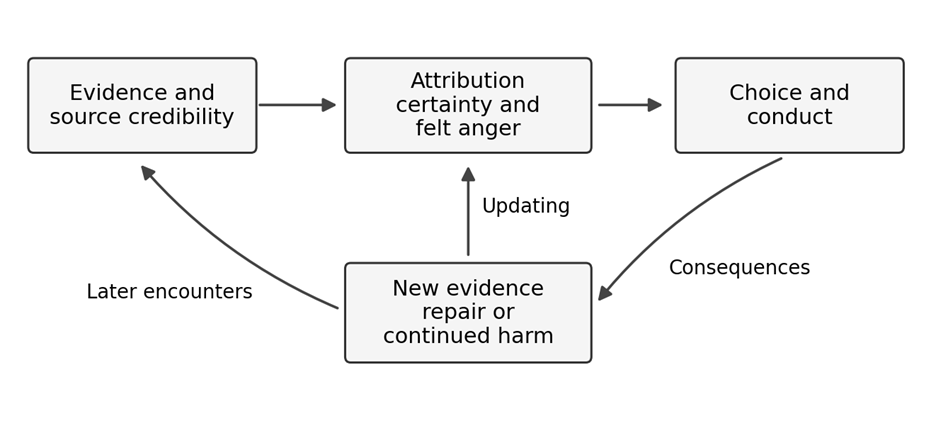
Note. Attribution, certainty, and credibility evaluation shape evidence updating; tolerance, control, goals, and rumination influence choice and recovery. The diagram specifies proposed relationships, not an empirically established causal model.
The framework separates descriptive markers from normative judgment. Descriptive assessment asks whether an accusation is revised after corroborated disconfirmation, whether conduct remains selectable at comparable arousal, and whether anger persists differently after repair and after continuing harm. These questions can be investigated without assigning a universally correct intensity to each event.
Normative assessment asks whether the person’s purposes and actions respect legitimate interests, recognize relevant harm, and avoid unjustified coercion or retaliation. This assessment must consider repeated exposure, power, practical alternatives, and the information available at the time. A supervisor’s preference for quiet does not establish that an employee’s objection is excessive. Nor does an understandable grievance justify every means of pursuing it.
The layers constrain different errors. A composed intimidator may update evidence accurately and regulate expression efficiently while pursuing a harmful goal; the descriptive competence does not establish good temper in the full evaluative sense. Conversely, an individual confronting ongoing abuse may remain angry while acting carefully and revising particular beliefs. Continued anger is then consistent with changing circumstances that have not yet provided grounds for reassurance.
4 Mechanisms of anger revision
Interpretation determines what an event initially means. An unanswered message can be experienced as rejection, distraction, or uncertainty. Hostile attribution makes deliberate harm more readily available as an explanation. In Wilkowski and Robinson’s (2010) model, interpretation interacts with rumination and control rather than operating as an isolated cause. For contextual calibration, the important extension is to follow the interpretation after new evidence arrives: does the person revise responsibility, or merely seek a different argument for the same accusation?
Attribution theory explains why perceived control and responsibility matter for emotional responses, including anger (Weiner, 1985). Crick and Dodge’s (1994) social information-processing model connects cue interpretation with goals, response construction, and evaluation in children’s social adjustment. These are precedents for locating action within an interpretation process, not evidence of a new adult trait. Lerner and Tiedens (2006) add a more specific obstacle to revision: anger-related certainty can influence information processing and judgment. The proposed difficulty is that confidence in an accusation may outlast the evidence that initially supported it.
Research on mitigating information is closer to this issue than a general association between dysregulation and aggression. Barlett’s (2013) meta-analysis found that information about mitigating circumstances reduced aggression after provocation, with effects depending on factors including information quality, the nature of the communication, and provocation severity. The findings support treating the content and credibility of an explanation as consequential. The moderation findings caution against treating every mitigating message as equally effective in reducing aggression. Because the outcome was aggression, this synthesis informs the proposed mechanism rather than directly demonstrating emotional revisability.
Revisability is bidirectional. Credible evidence of accident should generally reduce attributed intent; credible evidence of deliberate targeting should generally increase it. A person who accepts every reassuring account despite contradictory evidence is suggestible rather than well calibrated. Likewise, a person who rejects every explanation may be rigid, but may also be responding to a history of deception that makes the present source unreliable. Credibility must be measured and, where possible, manipulated independently of whether the message is comforting.
Temperament and effortful control influence the demands under which updating occurs. Rothbart (2007) explains individual differences in reactivity and self-regulation as developing through constitutional and experiential influences. Silver et al. (2024), following children from ages 3 to 15, linked irritability with negative affectivity and aspects of effortful control. These developmental findings help explain different starting levels of reactivity. Adult revisability, however, concerns what happens conditional on those starting levels: people with equally intense initial anger may differ in their willingness and ability to use later evidence.
Tolerance contributes by reducing the pressure to obtain immediate relief. Harrington’s (2005) work distinguishes several forms of frustration intolerance, including entitlement and intolerance of discomfort. The demand that a situation must be different can become joined to the demand that its emotional consequences must end immediately. That combination makes retaliation, withdrawal, or premature certainty more attractive. Distress tolerance concerns the ability to remain with aversive experience long enough to preserve alternatives. Perceived tolerance, measured by the Distress Tolerance Scale, and persistence on behavioral tasks represent different assessment approaches (Leyro et al., 2010; Simons & Gaher, 2005).
In this account, tolerance serves judgment rather than passive endurance. A person can tolerate anger while leaving an unsafe interaction or making a firm complaint. The relevant achievement is retaining choice during discomfort. Tolerating a feeling and tolerating another person’s conduct are separate decisions.
5 Regulation goals and recovery
Anger is often associated with approach motivation: it can energize confrontation with an obstacle rather than withdrawal from it (Carver & Harmon-Jones, 2009). This helps explain why minimizing anger is an inadequate definition of good temper. The motivational direction can support needed action, although approach motivation provides no assurance that the action is wise or just.
Regulation is also motivated. Tamir (2016) distinguishes reasons for regulating emotions that extend beyond feeling better, including instrumental aims. A person may cultivate anger to negotiate forcefully, maintain a grievance, or signal commitment. Another may suppress expression to avoid punishment or preserve an opportunity to retaliate. The capacity to influence emotion must therefore be distinguished from the purposes for which that capacity is used. Composed intimidation is a central counterexample to any account that equates successful regulation with good temper.
Strategies matter through their timing, goals, and fit with circumstances. Gross and John (2003) identified different correlates of habitual reappraisal and expressive suppression. Aldao et al. (2010) synthesized associations between regulation strategies and psychopathology, supplying broader evidence that habitual strategy use matters. Neither literature provides a universal rule that one strategy is always beneficial. In the present framework, temporary suppression can preserve safety while a grievance is addressed later; reappraisal can clarify a misunderstanding or become a way to excuse persistent harm. Bonanno and Burton’s (2013) flexibility account supports attending to this relation between context, strategy, and feedback.
Recovery adds a temporal test. Angry rumination involves recurrent thought about provocations, causes, and possible responses (Sukhodolsky et al., 2001). Revisiting a conflict may support clarification and planning. It may instead continually reinstate an interpretation that has ceased to fit the evidence. The framework predicts particular difficulty when the person intellectually acknowledges a correction but repeatedly rehearses the earlier accusation as if it were still established.
Emotional recovery, forgiveness, and reconciliation should be distinguished. Worthington et al. (2007) separate decisional forgiveness, concerning intentions toward a transgressor, from emotional forgiveness, involving changes in unforgiving emotion and positive other-oriented feeling. A decision against retaliation can precede emotional change. The present concept of recovery is less demanding than emotional forgiveness: reduced anger and restored attention need not involve positive feelings toward the offender. Reconciliation additionally concerns the relationship and renewed trust; it is not implied by either composure or recovery.
These distinctions explain why a person can stop rehearsing a wrong while pursuing a complaint, declining renewed contact, or maintaining a consequence. They also prevent a short recovery time from becoming a moral requirement. The duration of an emotional response depends partly on what remains unresolved, including material loss, continuing exposure, and credible danger.
6 Culture and the moral status of anger
Display rules affect what observers recognize as good temper. Ford and Mauss (2015) review how culture shapes regulation and its consequences, including the contextual meaning of suppression. A recent review distinguishes cultural priorities concerning emotional expression from priorities concerning internal experience (Tamir et al., 2026). Quiet expression can reflect shared norms and relationship obligations rather than little anger. Equally, direct expression may be accepted in one setting and judged threatening in another. Researchers should measure these norms rather than infer internal regulation from visible demeanor or treat national averages as descriptions of every individual.
Contextual calibration therefore uses a modest cross-context starting point: changes in credible information should be relevant to judgments, and felt emotion should be distinguished from conduct. The preferred style of objection, the meaning of a public display, and the weight assigned to relationship obligations require local interpretation. Normative evaluation should include the perspectives of affected people, especially those with less power. Agreement with a dominant local norm is evidence about social expectations, not proof that the norm is just.
Aristotle’s praotēs provides a historical formulation of an appropriate disposition regarding anger. His account includes both irascibility and deficiency in anger, sometimes termed inirascibility, rather than praising all absence of anger (Aristotle, ca. 350 B.C.E./n.d., Book IV, chapter 5). This informs the present concern with legitimate resistance, without making the Greek account an empirical standard or implying that people must feel anger whenever they confront wrongdoing.
Nussbaum’s (2016) Anger and Forgiveness challenges the project more deeply. Her objection is that anger involving a wish for payback is normatively problematic, even when a wrong has been accurately identified; she favors a transition toward forward-looking concern. This challenges the idea that anger becomes good merely by being proportionate to an offense. The present framework accepts the force of that challenge against calibrated revenge. It distinguishes recognition and protest from the aim of making another suffer. Whether nonretaliatory outrage should still be called anger is a substantive philosophical disagreement. Psychological studies can distinguish those motivations without deciding the entire dispute by terminology.
7 Contrasting cases
Consider an employee publicly blamed for a missed deadline. Their anger rises sharply, but records subsequently show that an automated failure delayed delivery and that the accusing colleague lacked access to the relevant information. The employee corrects the accusation, asks for a public clarification, and revises the belief that the colleague deliberately sabotaged them. Emotional arousal fades more slowly. Zillmann’s (1971) excitation-transfer work supplies a theoretical reason to distinguish persisting arousal from a persisting attribution, although it does not directly test this case. The framework treats this lag as compatible with revisability because judgment and action have already changed in response to evidence.
Now consider an employee subjected to repeated exclusion. A supervisor offers a calm assurance that no exclusion occurred, but access logs corroborate a deliberate pattern. The employee’s anger increases, and they submit a documented complaint while declining an informal reconciliation. An account based on rapid calming or apparent agreeableness could misclassify the response. Contextual calibration instead distinguishes the credibility of the reassurance from its soothing tone: greater anger can be consistent with better evidence, while a maintained boundary can coexist with responsible action.
A third case reveals the limit of descriptive skill. A manager learns that a subordinate’s error was accidental, quietly revises that belief, and stops feeling angry. The manager nevertheless excludes the subordinate from opportunities to discourage others from challenging authority. Emotional updating has occurred, but the conduct remains coercive. This case shows why the normative layer cannot be replaced by a measure of recovery speed, low arousal, or successful strategy use.
A less decisive case is a partner who misses an agreed family responsibility and cites an urgent work demand. Some messages support that account, but parts of the timeline remain unclear and similar lapses have occurred before. Good temper here need not mean accepting the explanation or maintaining the strongest accusation. A revisable response can lower confidence in deliberate disregard, retain concern about reliability, and negotiate a practical boundary while seeking further information. The person with less access to evidence may reasonably remain uncertain longer. Observers should assess responsiveness to what is available rather than reward whichever account sounds calmer.
8 Good temper in family and workplace
In family life, good temper can support disagreement without humiliation and repair without denying the problem. Morris et al. (2007) identify modeling, parenting practices, and emotional climate as pathways in children’s emotion-regulation development. The present framework suggests attending to an adult’s willingness to correct an accusation while maintaining a necessary limit. Quiet obedience alone cannot distinguish understanding from suppressed distress. The risk is that a family defines good temper by convenience, expecting one member to absorb anger, forgive prematurely, or keep everyone comfortable. These are risks of how the label is used, rather than demonstrated effects of good temper itself. Preserving voice and shared responsibility for repair is essential.
At work, good temper can support the reception of criticism and error reports without retaliation. Edmondson’s (1999) association between psychological safety and team learning supplies a relevant organizational context. A manager’s willingness to revise an unfair judgment is a proposed behavioral expression, not an established cause of safety. Grandey’s (2000) account of emotional labor also distinguishes organizational display requirements from internal emotional experience. Continual pleasantness may conceal strain; calm delivery may conceal coercion. Firm objections to unfair treatment can be compatible with good temper. Across both settings, its value lies in supporting truthful disagreement, responsible action, and repair rather than assigning all emotional work to the calmest person.
9 Evidence boundaries and measurement
The existing evidence supports mechanisms more strongly than it supports a distinct good-temper construct. Smith et al. (2026) synthesized 137 articles, representing 171 studies, 918 effect sizes, and 252,605 participants. Maladaptive strategy use correlated with greater aggression (r = .329), as did emotion-regulation difficulties (r = .248, 95% CI [.225, .274]). Adaptive strategy use showed a smaller inverse association (r = −.090, 95% CI [−.150, −.030]); its bias-adjusted PET estimate was nonsignificant (r = −.106, 95% CI [−.210, .002]). The authors used precision-effect testing and precision-effect estimation with standard error (PET–PEESE), retaining the PET estimate for adaptive strategies. Substantial heterogeneity and reliance on self-report constrain causal interpretation.
These findings motivate comparison with broad regulation difficulties rather than establish revisability. Aggression is behavior intended to harm; anger is an emotional state; neither is interchangeable with a normative judgment of good temper. The framework’s empirical task is to determine whether evidence-sensitive changes in appraisals, emotion, and action add information beyond their average levels. Table 1 maps the proposed features to mechanisms, available measures, and predictions.
Table 1
Features and predictions
Feature | Candidate mechanisms | Existing measures or tasks | Individual-differences prediction |
Evidence sensitivity | Attribution; certainty; credibility evaluation | STAXI-2 and HEXACO comparators; repeated evidence trials | Person-specific updating slopes generalize across scenarios and sessions and predict conduct beyond baseline anger. |
Preserved choice as a supporting capacity | Tolerance; attentional and inhibitory control; goals | Distress Tolerance Scale; Frustration Discomfort Scale; DERS; observed choices | Higher distress tolerance predicts stronger evidence-sensitive action-update slopes at comparable initial anger; mediation by available alternatives is tested separately. |
Resolution-sensitive recovery | Rumination; attention disengagement; threat updating | Anger Rumination Scale; repeated follow-ups | Individual recovery trajectories after verified resolution predict spillover beyond initial anger and elapsed time. |
Note. Predictions are proposals. Established questionnaires measure related constructs; none is a validated measure of anger revisability.
Existing instruments supply comparators rather than a ready-made score for revisability. The STAXI-2 distinguishes anger experience, expression, and control (Spielberger, 1999). HEXACO Agreeableness captures substantial relevant trait content. The Difficulties in Emotion Regulation Scale, or DERS, assesses several regulation difficulties, including impulse control and goal-directed behavior under distress (Gratz & Roemer, 2004). Because preserved choice overlaps with DERS content, incremental validity should not be assumed. Evidence updating and recovery need episode-based assessment in addition to these questionnaires.
No physiological index is required by this account. The empirical focus is the relation between information and response, assessed through repeated reports, observed conduct, and informed judgments. The framework also does not require that every marker load onto one latent trait. Evidence sensitivity, choice, and recovery may form a useful profile rather than a single dimension.
10 Testing individual differences in revisability
The primary target is reliable variation between people in how anger-related responses change with evidence. Average effects of accident versus deliberate-harm information are manipulation checks and process evidence, not validation of an individual-differences construct. Repeated scenarios and sessions should estimate person-specific updating slopes, their uncertainty, cross-scenario generalization, and test–retest stability. Models should account for measurement error and avoid interpreting noisy rankings as stable dispositions. For group-level research, a preregistered planning target could be a generalizability coefficient of at least .70 for the intended person-level updating score, with its uncertainty interval reported. This is a proposed adequacy target, not a validated cutoff for good temper or permission for individual diagnosis. Pilot generalizability analysis should determine the number of scenarios and occasions required, with at least two sessions to assess stability. If the target cannot be reached within a feasible design, person-level predictive claims should be withheld or reformulated using an explicitly modeled latent score with uncertainty. Disconfirmation and confirmation slopes require separate reliability evaluation. Evidence sensitivity need not be one slope: responsiveness to disconfirmation and confirmation may differ.
Table 2 outlines three complementary designs. Diary reports distinguish perceived credibility from independently assessable corroboration. With consent, redacted records or separately obtained accounts could be coded by raters blind to anger outcomes; absence of such evidence remains unverified, not false. Partner reports add perspective but do not independently establish truth. Analyses should retain disagreement and account for prior deception, unequal evidence access, continuing loss, and new provocations.
Timing should be modeled rather than moralized. Laboratory assessments could occur immediately before information, immediately afterward, and at 5 and 15 minutes; diary follow-ups could occur around 30 minutes and the next waking morning. These are sampling windows, not thresholds for acceptable anger. “Beyond ordinary decay” means the difference between modeled trajectories after relevant evidence and a matched no-new-information condition, controlling elapsed time and initial response. Separate trajectories for responsibility judgments, felt anger, and intended action allow arousal to lag behind corrected beliefs.
Table 2
Complementary designs for testing revisability
Design | Measures or manipulation | Primary test | Inference and limits |
Experience sampling | Adult diary over 21 days; event reports and random prompts; independent evidence coding where available; informants | Within-person evidence-linked trajectories; reliability of between-person variation across episodes | Everyday temporal patterns; reporting bias and incomplete verification remain. |
Repeated laboratory task | Accident or deliberate-harm evidence, corroborated or unsupported; neutral-information control; multiple scenarios and sessions | Between-person variance in updating slopes, cross-scenario reliability, and stability; average effects check the manipulation | Randomization identifies information effects; stable individual scores require repeated reliable measurement. |
Predictive validation | Episode indicators; STAXI-2; HEXACO; DERS; flexibility; neutral updating task; open-mindedness questionnaire | Held-out predictive gain for later conduct and informant reports beyond competing measures | Tests added value; does not establish a separate trait or moral correctness by itself. |
Note. Designs are complementary proposals. Behavioral outcomes and normative evaluations are scored separately; repeated measurement is required for reliable person-level inference.
Predictive validation should preregister concrete outcomes. In a later standardized disagreement task, independent observers blind to updating scores would count personal insults, interruptions that prevent the other speaker completing a turn, and explicit repair attempts such as correcting an accusation or proposing a specific remedy. Counts would be adjusted for interaction duration and reported separately rather than collapsed into an assumed moral score. A second outcome would be the proportion of available low-stakes opportunities in which participants choose costly retaliation, and the proportion in which they offer a concrete repair; task rules would define and automatically record these distinct choices. A third outcome would be an informant’s frequency rating of specified behaviors over a fixed two-week period, such as returning to an unresolved issue at an agreed time or imposing a later unrelated penalty after disagreement. Informants would rate behaviors rather than global “good temper,” and agreement with self-report would not be presumed.
Separate normative raters would evaluate purposes and conduct using a stated rubric covering recognition of harm, available alternatives, coercion, and effects on affected people. They would be blind to updating scores and behavioral-coder summaries. Interrater agreement and uncertainty would be reported, with divergent cultural or contextual judgments retained. Behavioral counts, task choices, informant ratings, and normative evaluations would remain distinct outcomes, reducing halo and avoiding validation of the predictor through its own definition.
General evidence updating is a central competitor. Actively open-minded thinking concerns consideration of alternatives and contradictory evidence, but its questionnaires are not equivalent to demonstrated updating (Stanovich & Toplak, 2023). A neutral task should therefore match the anger task’s evidence strength, source credibility, reading demands, and response format while minimizing personal provocation. Intellectual humility and need for closure may be secondary correlates rather than interchangeable controls. The key question is whether anger-related updating adds prediction beyond this general task, established traits, and regulatory flexibility. If it does not, revisability may remain a useful application of broader epistemic competence rather than a distinct anger disposition.
Preserved choice should be assessed at comparable initial anger through observed options such as clarification, objection, delay, and retaliation, not inferred from low anger alone. Normative ratings of purposes and conduct should remain separate and include relevant cultural and power contexts. Studies require consent, proportionate provocation, withdrawal options, distress safeguards, and prompt debriefing where deception is used. Sample sizes should follow simulation or precision analysis incorporating slope reliability, clustering, attrition, and plausible small incremental effects. Unreliable slopes or no held-out predictive gain would weaken the individual-differences claim without invalidating the core question of whether anger remains responsive to its grounds.
11 Conclusion
Good temper becomes clearer when anger is examined in relation to changing grounds. A person can feel strongly, resist a wrong, and still revise an accusation. Another can look calm while remaining closed to evidence or using composure for coercion. Revisability identifies a candidate difference between these patterns, while contextual calibration retains the separate question of whether conduct is fair and responsible.
The central proposal is that anger should remain answerable to evidence and changing circumstances. Clarification may reduce it; confirmed wrongdoing may sustain it; effective repair may support recovery without renewed trust. This account preserves the everyday significance of good temper and gives research a focused task: determine whether those patterns of updating explain conduct beyond the traits and regulatory abilities already known.
References
Aldao, A., Nolen-Hoeksema, S., & Schweizer, S. (2010). Emotion-regulation strategies across psychopathology: A meta-analytic review. Clinical Psychology Review, 30(2), 217–237. https://doi.org/10.1016/j.cpr.2009.11.004
Aristotle. (n.d.). Nicomachean ethics (W. D. Ross, Trans.), Book IV, chapter 5. The Internet Classics Archive. https://classics.mit.edu/Aristotle/nicomachaen.4.iv.html (Original work published ca. 350 B.C.E.)
Ashton, M. C., & Lee, K. (2007). Empirical, theoretical, and practical advantages of the HEXACO model of personality structure. Personality and Social Psychology Review, 11(2), 150–166. https://doi.org/10.1177/1088868306294907
Barlett, C. P. (2013). Excuses, excuses: A meta-analytic review of how mitigating information can change aggression and an exploration of moderating variables. Aggressive Behavior, 39(6), 472–481. https://doi.org/10.1002/ab.21491
Bonanno, G. A., & Burton, C. L. (2013). Regulatory flexibility: An individual differences perspective on coping and emotion regulation. Perspectives on Psychological Science, 8(6), 591–612. https://doi.org/10.1177/1745691613504116
Carver, C. S., & Harmon-Jones, E. (2009). Anger is an approach-related affect: Evidence and implications. Psychological Bulletin, 135(2), 183–204. https://doi.org/10.1037/a0013965
Crick, N. R., & Dodge, K. A. (1994). A review and reformulation of social information-processing mechanisms in children’s social adjustment. Psychological Bulletin, 115(1), 74–101. https://doi.org/10.1037/0033-2909.115.1.74
Edmondson, A. (1999). Psychological safety and learning behavior in work teams. Administrative Science Quarterly, 44(2), 350–383. https://doi.org/10.2307/2666999
Ford, B. Q., & Mauss, I. B. (2015). Culture and emotion regulation. Current Opinion in Psychology, 3, 1–5. https://doi.org/10.1016/j.copsyc.2014.12.004
Grandey, A. A. (2000). Emotion regulation in the workplace: A new way to conceptualize emotional labor. Journal of Occupational Health Psychology, 5(1), 95–110. https://doi.org/10.1037/1076-8998.5.1.95
Gratz, K. L., & Roemer, L. (2004). Multidimensional assessment of emotion regulation and dysregulation: Development, factor structure, and initial validation of the Difficulties in Emotion Regulation Scale. Journal of Psychopathology and Behavioral Assessment, 26(1), 41–54. https://doi.org/10.1023/B:JOBA.0000007455.08539.94
Gross, J. J. (2015). Emotion regulation: Current status and future prospects. Psychological Inquiry, 26(1), 1–26. https://doi.org/10.1080/1047840X.2014.940781
Gross, J. J., & John, O. P. (2003). Individual differences in two emotion regulation processes: Implications for affect, relationships, and well-being. Journal of Personality and Social Psychology, 85(2), 348–362. https://doi.org/10.1037/0022-3514.85.2.348
Harrington, N. (2005). The Frustration Discomfort Scale: Development and psychometric properties. Clinical Psychology & Psychotherapy, 12(5), 374–387. https://doi.org/10.1002/cpp.465
Lee, K., & Ashton, M. C. (n.d.). Scale descriptions. The HEXACO Personality Inventory–Revised. https://hexaco.org/scaledescriptions
Lerner, J. S., & Tiedens, L. Z. (2006). Portrait of the angry decision maker: How appraisal tendencies shape anger’s influence on cognition. Journal of Behavioral Decision Making, 19(2), 115–137. https://doi.org/10.1002/bdm.515
Leyro, T. M., Zvolensky, M. J., & Bernstein, A. (2010). Distress tolerance and psychopathological symptoms and disorders: A review of the empirical literature among adults. Psychological Bulletin, 136(4), 576–600. https://doi.org/10.1037/a0019712
Morris, A. S., Silk, J. S., Steinberg, L., Myers, S. S., & Robinson, L. R. (2007). The role of the family context in the development of emotion regulation. Social Development, 16(2), 361–388. https://doi.org/10.1111/j.1467-9507.2007.00389.x
Nussbaum, M. C. (2016). Anger and forgiveness: Resentment, generosity, justice. Oxford University Press.
Rothbart, M. K. (2007). Temperament, development, and personality. Current Directions in Psychological Science, 16(4), 207–212. https://doi.org/10.1111/j.1467-8721.2007.00505.x
Silver, J., Hawes, M. T., Dougherty, L. R., Bufferd, S. J., Kessel, E. M., Olino, T. M., Carlson, G. A., & Klein, D. N. (2024). Irritability and temperament: Concurrent and prospective relationships in childhood and adolescence. Journal of Clinical Child & Adolescent Psychology, 53(2), 156–168. https://doi.org/10.1080/15374416.2023.2286586
Simons, J. S., & Gaher, R. M. (2005). The Distress Tolerance Scale: Development and validation of a self-report measure. Motivation and Emotion, 29(2), 83–102. https://doi.org/10.1007/s11031-005-7955-3
Smith, K., Jones, A., Daly, N., Widdrington, H., Garofalo, C., & Gillespie, S. M. (2026). Emotion regulation and aggression: A systematic review and meta-analysis. Aggressive Behavior, 52(1), Article e70055. https://doi.org/10.1002/ab.70055
Spielberger, C. D. (1999). State-Trait Anger Expression Inventory–2: Professional manual. Psychological Assessment Resources.
Stanovich, K. E., & Toplak, M. E. (2023). Actively open-minded thinking and its measurement. Journal of Intelligence, 11(2), Article 27. https://doi.org/10.3390/jintelligence11020027
Sukhodolsky, D. G., Golub, A., & Cromwell, E. N. (2001). Development and validation of the anger rumination scale. Personality and Individual Differences, 31(5), 689–700. https://doi.org/10.1016/S0191-8869(00)00171-9
Tamir, M. (2016). Why do people regulate their emotions? A taxonomy of motives in emotion regulation. Personality and Social Psychology Review, 20(3), 199–222. https://doi.org/10.1177/1088868315586325
Tamir, M., Chentsova-Dutton, Y., & Miyamoto, Y. (2026). Culture and emotion regulation. Annual Review of Psychology. Advance online publication. https://doi.org/10.1146/annurev-psych-110625-121512
Weiner, B. (1985). An attributional theory of achievement motivation and emotion. Psychological Review, 92(4), 548–573. https://doi.org/10.1037/0033-295X.92.4.548
Wilkowski, B. M., & Robinson, M. D. (2010). The anatomy of anger: An integrative cognitive model of trait anger and reactive aggression. Journal of Personality, 78(1), 9–38. https://doi.org/10.1111/j.1467-6494.2009.00607.x
Worthington, E. L., Jr., Witvliet, C. V. O., Pietrini, P., & Miller, A. J. (2007). Forgiveness, health, and well-being: A review of evidence for emotional versus decisional forgiveness, dispositional forgivingness, and reduced unforgiveness. Journal of Behavioral Medicine, 30(4), 291–302. https://doi.org/10.1007/s10865-007-9105-8
Zillmann, D. (1971). Excitation transfer in communication-mediated aggressive behavior. Journal of Experimental Social Psychology, 7(4), 419–434. https://doi.org/10.1016/0022-1031(71)90075-8