Quick takeaways
The core problem: AI-written performance reviews read as complete, so managers stop asking what’s missing. Employees who rarely overlap with their manager can’t easily fill the gap.
Why hybrid matters: It isn’t how many days people are in the office but whether their days overlap with the evaluator’s. Two people with identical attendance can have very different chances to mention unrecorded work like mentoring.
Why errors stick: The article calls it an “accountability vacuum”: the checking and correcting a decision demands exceeds the review capacity actually available. Someone is named as answerable, but no one can realistically investigate or fix the error.
A surprising twist: When no one can get errors corrected, differences between groups can shrink while overall harm gets worse. A small gap doesn’t prove the system works.
It could go the other way: Valid shared records can reduce bias, and time saved by AI drafting can be reinvested in asking employees for missing evidence.
What organizations can do:
Have managers record what evidence they checked and what might be missing.
Give employees a way to submit evidence and reach someone with the power to fix the record.
Offer every employee the same submission route, regardless of office days.
A caveat: This is a conceptual paper. It offers testable predictions, not proven findings.
Abstract
AI-generated assessments can discourage managers from asking what the record leaves out. In hybrid teams, employees with less office overlap may lose a corrective opportunity on which they depend more heavily. This conceptual article explains that interaction and its consequences for unequal error persistence. The accountability vacuum is defined as a shortfall between demanded and available review capacity under assigned answerability. Six propositions connect schedule overlap, narrative-induced perceived completeness, evaluator prompting, review shortfalls, throughput incentives, and employee voice. Error disparities are predicted to peak where review is deficient but accessible through informal exceptions; uniform blockage can produce greater overall harm while compressing group differences. Two competing pathways identify benefits from valid shared records and reinvestment of AI drafting savings in outreach. Integrating research on dispersed teams, judgment, accountability, and voice, the framework specifies observable mechanisms and boundary conditions. Visible judgment, contestable systems, and relational anchoring connect managerial obligations to evidentiary quality, equitable access, and workable correction.
Keywords: hybrid work; AI-mediated management; accountability; performance evaluation; managerial judgment; employee voice
1 Introduction
Two employees each work three days a week in the office. One regularly overlaps with the manager; the other follows different days. Both mentor colleagues and resolve project dependencies, but these contributions are missing from the records used to generate their performance assessments. An AI system produces a fluent evaluation for each employee. If those evaluations appear comprehensive, the manager has less reason to ask what is absent. The first employee can still raise omitted contributions during routine contact. The second depends more heavily on being asked or on gaining access to a formal review.
This hypothetical episode identifies an interaction between work arrangements and AI-mediated management. Narrative assessments can reduce the active inquiry through which managers would otherwise recover missing information. Unequal schedule overlap then matters more because informal opportunities to supply that information remain uneven. Whether the resulting errors persist depends on the capacity of the review process to investigate and correct them. The accountability problem is consequential when the manager remains answerable while the review demands exceed the capacity available to meet them.
Hybrid work combines remote and colocated work within a unit. AI-mediated management uses AI to inform or execute decisions about allocation, evaluation, and coordination. We focus on generated performance assessments in knowledge work, where relevant contribution frequently exceeds recorded output. The unit of analysis is an employee-related decision episode; schedule arrangements and review institutions shape that episode, and repeated episodes influence subsequent employee responses.
The institutional stakes are explicit. The EU AI Act includes specified employment uses within its high-risk framework and requires effective oversight and adequately supported overseers (European Parliament & Council, 2024). The Court of Justice’s SCHUFA judgment also shows why a formally downstream human decision does not necessarily prevent an automated score from falling within GDPR Article 22 when that score plays a determining role (Court of Justice of the European Union, 2023). The organizational question is how nominal human involvement becomes substantive inquiry and correction. Section 5 examines the legal context and current application timetable.
Our contribution is a process explanation of unequal error persistence. We connect schedule overlap to evidence admission, perceived completeness to managerial prompting, and a shortfall in review capacity to the survival of errors that these processes leave unresolved. Competing pathways identify benefits from valid shared records and from reinvesting drafting savings in outreach. These alternatives explain why the same technology can support either equitable correction or a persistent access disadvantage.
2 From Office Schedules to Evaluative Evidence
2.1 Unequal overlap and a common route to review
Dispersed-team research establishes problems of mutual knowledge (Cramton, 2001), colocated subgroups (Polzer et al., 2006), and subgroup imbalance (O’Leary & Mortensen, 2010). Hybrid schedules create a related structural issue: employees differ in their recurring overlap with evaluators even when their total office attendance is identical. Schedule overlap is measured as shared physical work periods. Evidence admission is whether relevant information absent from an initial record reaches the evaluator and receives consideration before assessment closure. These measures distinguish contact opportunities from their evidentiary consequences.
Overlap can support spontaneous clarification, identification of corroborating colleagues, and follow-up on unresolved concerns. A reliable common submission route provides an alternative: every employee can supply the same categories of evidence and receive a documented response before closure. That route should reduce the extent to which admission depends on informal encounters.
Proposition 1. Greater schedule overlap increases admission of relevant omitted evidence; a reliable common submission route weakens this relationship.
The proposition concerns comparable omissions and opportunities to contribute, assessed against the evaluation criteria used in the episode. Route reliability is measured through response times, acknowledgment, consideration, and completed test submissions. It is distinct from shared office time. Prior relationship quality should be measured separately: leader–member exchange differentiation concerns exchange relationships (Liden et al., 2006), whereas employees can gain or lose physical overlap without an immediate change in those relationships. We center overlap with the evaluator because that actor initiates the inquiry studied here. Access to corroborating colleagues and calibration reviewers is a related network extension that should be measured separately.
Emanuel et al. (2026) provide evidence that coworker proximity affects training, while Yang et al. (2022) identify changes in collaboration under remote work. Their findings support examining interaction opportunities but do not establish the assessment mechanism proposed here. A strong test would exploit schedule changes and trace whether omitted evidence reaches reviewers, rather than infer access from attendance or perceived inclusion alone.
2.2 When common records equalize assessment
Shared records can improve the visibility of work overlooked by informal networks. Behavioral visibility depends on what technologies expose and what observers infer from it (Leonardi & Treem, 2020). The central question is whether the record captures the criteria it is used to assess. Measurement problems predate AI: Kerr (1975) shows how reward systems privilege proxies, and Weber and Treem’s (2025) ethnographic study at a technology-consulting organization shows how a digital activity metric redirected managerial priorities and discouraged desired practices.
The relevant counterargument is structured evaluation. Uhlmann and Cohen (2005) found that committing to criteria before applicant gender was disclosed eliminated discrimination in their hiring experiments. This supports reducing discretionary changes to standards, although it does not establish that all standardized records are unbiased. Common criteria and adequate evidence coverage must work together: fixing a criterion does little if the source set systematically excludes relevant contributions.
Recent evidence also supports a beneficial AI pathway. Li et al. (2026) compare LLM and human ratings of text-based performance outputs against expert benchmarks and report strong consistency and evaluation performance for advanced models. Their findings concern the assessment of supplied outputs. Our concern is what happens when relevant work is missing from the supplied material. Accurate interpretation of the available evidence and incomplete coverage of contribution can coexist.
Competing prediction R1. Valid common records assessed against stable criteria reduce schedule-related assessment disparities relative to discretionary informal assessment.
The comparison requires a benchmark that holds contribution and criteria constant. Under incomplete records, supplemental information can repair omissions or introduce favoritism. More context is therefore not automatically more accurate. Bloom et al.’s (2024) finding that hybrid work preserved measured performance and promotion outcomes further cautions against treating spatial flexibility as a general cause of evaluative harm.
3 AI Narratives and the Hybrid Interaction
3.1 From evaluative format to perceived completeness
Generative AI can transform selected traces into an integrated account of capability, initiative, or reliability. That prose may imply broad evidentiary coverage even where the source set consists of narrow activity indicators. We call this inference perceived completeness: the evaluator believes that the assessment covers the relevant domain of contribution. It is distinct from accuracy of the statements within the assessment.
Alter and Oppenheimer’s (2009) account of processing fluency explains why subjective ease informs judgment. Kahneman’s (2011) discussion of reliance on available information supplies a related basis for expecting a coherent account to discourage attention to absent evidence. Applied here, the inference is that a fluent evaluative narrative can feel complete before the reviewer has examined coverage. Neither source directly tests generated performance reviews; the application is a theoretical extension.
Proposition 2. An integrated narrative reduces evaluator-initiated requests for supplemental evidence, relative to an itemized presentation of the same content, through increased perceived completeness.
The comparison varies presentation while matching evaluative claims, factual content, length, AI attribution, source access, and review time. Perceived completeness is the proposed mediator and is measured separately from fluency and subsequent inquiry. Behavioral indicators include requests sent, records reopened, and corroborating colleagues contacted. Source links and explicit coverage warnings are separate moderators: making missing categories salient should weaken the pathway. A factorial design can vary these features separately from format.
Bansal et al. (2021) show that explanations can increase acceptance of AI recommendations irrespective of correctness in experimental tasks. Lebovitz et al. (2022), studying diagnostic radiologists in three departments of a major US hospital, show that practices for interrogating AI findings shape their integration into judgment. This adjacent evidence supports investigation of scrutiny while leaving the performance-review mechanism open to testing.
AI’s organizational significance is the scalable production of these accounts. Generated narratives can become the starting point for routine calibration across employees and review cycles. If deployment expands assessment coverage, frequency, or reviewer caseload, the required review work can rise against fixed capacity. Generating drafts for an unchanged set of reviews can instead reduce assembly work. The net capacity effect therefore depends on deployment choices and the use of any time saved. Matched human-written narratives identify whether the psychological mechanism generalizes; field research establishes how AI changes the prevalence, volume, and cost of narrative assessment.
3.2 Why narrative defaults can amplify schedule disparities
Perceived completeness matters because evaluators decide whether to ask for more evidence. A manager who suspects an incomplete account may contact employees, seek peer corroboration, or reopen project records. Such prompting supplies an alternative to employee-initiated correction. When a narrative appears complete, that route becomes less likely to be used.
Employees with substantial schedule overlap have more chances to volunteer omitted information regardless of prompting. Employees on different office days depend more on deliberate outreach when no reliable common route exists. The same reduction in managerial inquiry can therefore have unequal consequences. This is the proposed hybrid × AI interaction: the effect of a narrative default on evidence admission varies with schedule overlap.
Proposition 3. The schedule-overlap advantage in evidence admission is larger when evaluator-initiated prompting is low than when it is high.
The mechanism requires incomplete source coverage, variation in overlap, and a workflow in which prompting and spontaneous contact are material routes to correction. P2 supplies the behavioral link from narrative presentation through perceived completeness to reduced prompting. P3 explains why that reduction has unequal consequences. Together, they predict that a narrative lowers admission more for low-overlap than high-overlap employees, compared with a matched itemized presentation. Reliable common submissions should attenuate this difference.
Coverage awareness provides a further boundary. Evaluators who know that mentoring or coordination is missing from the source set have reason to seek it despite a coherent narrative. Training, tool experience, explicit warnings, and prior knowledge of particular omissions should therefore weaken perceived completeness and the prompting pathway. Researchers should measure awareness before presentation so that it can be distinguished from information learned during review.
In the opening vignette, the manager’s failure to ask about mentoring has limited effect on an employee who discusses the work during regular shared office days. It has greater effect on the colleague whose days rarely coincide. Requiring common evidence submissions before calibration removes this dependence on either informal reminders or discretionary outreach. Conversely, an AI system that flags missing contribution categories could increase prompting and reverse the proposed adverse effect.
An opposing resource pathway is also plausible. Noy and Zhang (2023) show that generative assistance reduced completion time in professional writing tasks. The transfer to performance-review outreach is a proposed organizational mechanism: drafting savings can provide managers with time to request missing evidence if that time is retained for review.
Competing prediction R2. Reinvesting time saved by AI drafting in employee outreach increases prompting and narrows the schedule-related admission gap.
R2 concerns the use of recovered time, while P2 concerns the inference that no further evidence is needed. Both can operate in the same workflow. Researchers should measure draft-production time, review time available, outreach performed, and reassignment of saved time to additional cases. Protected review time can support R2; increased throughput targets can absorb the savings before outreach occurs.
The mechanism has potential distributional significance. If caregiving, disability accommodations, or other constraints systematically affect overlap with evaluators, an apparently uniform assessment workflow could generate group disparities. This is a hypothesis requiring direct schedule and outcome data. Gender, care responsibilities, and overlap should be measured separately; proximity findings should not be converted into an unsupported claim that women generally receive poorer AI assessments. The mechanism concerns unequal access produced by scheduling arrangements, irrespective of any particular group’s average schedule.
4 The Accountability Vacuum and Unequal Error Persistence
4.1 Answerability and practical review capacity
Responsibility denotes duties to perform or supervise an activity. Accountability concerns an actor’s obligation to explain and justify conduct to a forum able to question, assess, and attach consequences (Bovens, 2007). Relevant forums include managerial calibration panels and empowered employee appeals bodies. Naming an approver identifies answerability without establishing that a workable chain can investigate concerns and arrange remedy.
We define an accountability vacuum as a shortfall between the review capacity a decision demands and the capacity available, within a setting of formally assigned answerability. Required review work varies with the evidence to be checked, the decision’s consequences and reversibility, and the number of cases to be covered within the decision window. Compressed deadlines increase the capacity needed per unit of time. Available capacity comprises usable evidence access, reviewer time and expertise, amendment authority, and access to remedy across the review chain. Assigned answerability defines the scope of the construct; the shortfall varies.
The shortfall is assessed against review requirements specified before outcomes are observed. These requirements can be evaluated dimension by dimension: for example, whether evidence can be obtained and checked before closure, or an authorized reviewer can implement a remedy in time. A universal numerical subtraction is unnecessary because adequate time cannot compensate for absent amendment rights. This approach distinguishes low absolute capacity from a shortfall: a modestly resourced process can meet the requirements of a small, reversible decision but be inadequate for a high-volume promotion cycle.
This condition connects established problems of responsibility in computing (Nissenbaum, 1996), learning systems (Matthias, 2004), nominal oversight (Green, 2022), and moral crumple zones (Elish, 2019). Meaningful human control likewise directs attention to relevant reasons and traceable responsible involvement (Santoni de Sio & van den Hoven, 2018). Appendix A distinguishes these antecedents and assigns the supporting literatures their roles. The present contribution is to explain how a demand-relative shortfall changes the consequences of unequal access across employees.
4.2 The vacuum as a moderator of persistence
Error persistence means that an assessment discrepancy, established against stated criteria, remains unamended at the consequential decision point or a specified follow-up date. Verification is performed through corroborating work records and raters outside the original assessment. A research audit’s identification of an error must be distinguished from the organization’s awareness of it: if the audit supplies corrective evidence before closure, it changes the process under study.
Reliable review can compensate for unequal initial admission. It can request missing records, consider appeals, and revise an assessment without depending on privileged access to the manager. Deficient review leaves correction more dependent on repeated reminders, personal sponsorship, and the ability to navigate exceptions. Employees with greater overlap have more opportunities to pursue these informal paths. The consequence is a larger disparity in the survival of comparable errors.
Proposition 4. The low-overlap disadvantage in error persistence is larger under deficient but informally navigable review than under either dependable review or uniformly blocked correction.
The proposition compares similar initial errors and consequences under formally assigned answerability. Review is informally navigable when personal sponsorship, repeated reminders, or exception handling can secure correction while a common dependable route is unavailable. Navigability can be observed through standardized escalation cases, documented exceptions, and the routes taken by successful corrections. These process indicators are measured separately from the schedule-related persistence gap.
The predicted pattern is non-monotonic across review arrangements. A dependable chain compensates for unequal initial admission; a shortfall leaves informal access consequential; a complete blockage removes effective routes for everyone. In the domain described by P2–P3, narrative presentation can widen the preceding admission gap. The full pathway therefore links format and overlap to prompting, admission, and persistence, conditional on demand-relative review adequacy and the availability of exceptions.
Overall error persistence can be highest under uniform blockage even as the difference between schedules contracts. The deepest capacity shortfall and the greatest between-employee disparity consequently need not coincide. Empirical work should report both overall harm and the persistence gap, avoiding an interpretation in which a small gap alone indicates effective accountability.
The comparison is relative to stated criteria and an external evidentiary benchmark, not a context-free truth about contribution. Sociomaterial reasoning emphasizes how categories and review practices constitute evidence (Orlikowski & Scott, 2008). Criteria can themselves be contested or biased. The model first asks whether an organization applies its declared criteria and corrects demonstrable omissions consistently; a separate inquiry must assess whether those criteria are legitimate and sufficiently inclusive.
4.3 Power and the maintenance of deficient review
Algorithmic management involves contested control over work (Kellogg et al., 2020). A vacuum can persist because the actors controlling review benefit from rapid approvals or lower investigation costs. The relevant comparison separates incentives from differences in reviewer expertise or legal authority.
Proposition 5. Throughput-linked rewards increase review-capacity shortfalls more when the rewarded actor controls evidence admissibility than when admissibility standards are protected from that actor’s unilateral revision.
P5 specifies an antecedent of the shortfall moderating P4. Throughput pressure can reduce time actually allocated to inquiry and restrict the evidence reviewers can use; control over admissibility makes these responses easier. The benchmark for required review remains fixed by the declared criterion and decision consequences. Baseline staffing, expertise, formal amendment rights, caseload, and case complexity should be held comparable, while realized evidence access, review time, and response availability are measured as outcomes. Binding evidence standards can limit unilateral narrowing. Correction delay is a downstream consequence to investigate after establishing the capacity pathway.
Governance consequently needs more than requests for managerial care. An actor whose target is threatened by correction should not be able to close the evidentiary route unilaterally. Employee representation, works councils, and review bodies can protect that route, but their effectiveness depends on actual powers and access rather than institutional labels.
4.4 The feedback of unsuccessful challenge
Morrison and Milliken (2000) explain how organizational silence blocks learning; Detert and Edmondson (2011) identify beliefs discouraging voice. Repeatedly supplying substantiated evidence without adequate investigation or remedy can lower the expected efficacy of speaking up. Later reviewers then encounter fewer challenges to the system’s account.
Proposition 6. An inadequately addressed substantiated challenge reduces an employee’s subsequent submission of relevant corrective evidence through lower expected efficacy of voice.
An unsuccessful challenge here concerns a substantiated discrepancy, rather than an employee’s failure to obtain a preferred rating. Response history, expected efficacy, and later submissions should be observed in temporal order. Researchers should distinguish futility from retaliation concerns, submission burden, and changes in how much relevant work is omitted. Bernstein’s (2012) transparency paradox further suggests that surveillance can encourage concealment through a different mechanism.
P6 describes a general voice mechanism. The model leaves open whether an unsuccessful challenge reduces submission more among low-overlap employees. Its connection to unequal outcomes is the dependence identified in P3: fewer voluntary submissions leave employees with limited informal contact more reliant on evaluator prompting in later cycles. Effective representation or a credible change in response can restore the return on supplying evidence. Figure 1 connects the propositions and both competing pathways.
Figure 1 Schedule overlap, narrative assessment, and error persistence
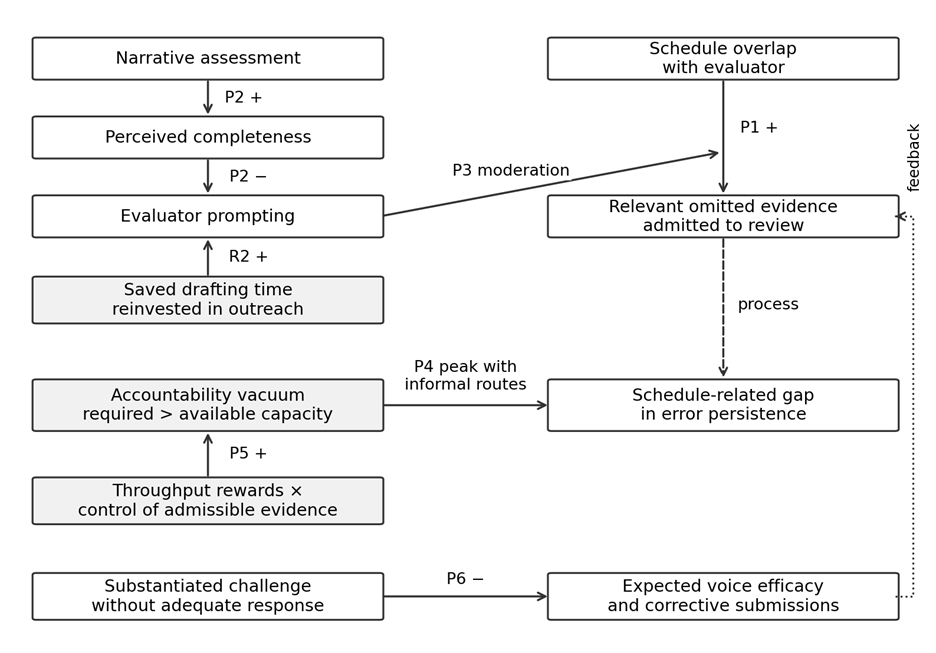
Note. Assigned answerability defines the model’s scope. P2 includes completeness-mediated prompting; P3 concerns prompting × overlap. P4 predicts peak disparity under deficient but informally navigable review. P5 feeds the capacity shortfall; P6 is general voice feedback. R2 shows reinvested drafting savings; R1 predicts equalization through valid common records. Dashed paths indicate process connections.
5 Governance and Institutional Implications
5.1 Visible judgment
Visible judgment targets perceived completeness and the loss of active inquiry. A concise judgment note should identify the recommendation, evidence inspected, material categories checked for missing coverage, and grounds for acceptance or amendment. Both agreement and override require proportionate reasoning. A source-linked narrative should distinguish observed activity, evaluative inference, and categories for which evidence is absent.
For the hybrid team, the manager checks whether mentoring and coordination form part of the criteria and whether the source set captures them. Coverage training should make recurring omissions recognizable, and drafting savings should be protected for inquiry rather than automatically converted into additional cases. Common questions are sent before calibration rather than only to employees who come readily to mind. Generated explanations remain drafts requiring verification. Sampled audits examine whether sources support the claims and whether omissions triggered inquiry.
The cost falls on employees gathering evidence, managers checking it, and specialists handling exceptions. Executives must allocate review time and adjust competing throughput demands. Smaller organizations can use short templates and shared reviewers; consequential uses should be restricted where an adequate review chain cannot be provided. Documentation is useful when it changes evidence or action, rather than adding another compulsory signature.
5.2 Contestable systems
Contestability targets the conversion of admission gaps into persistent errors. Procedural-justice research highlights voice, consistency, accuracy, and correctability (Colquitt, 2001). A functioning process lets affected employees introduce relevant evidence and reach an authority able to amend the assessment and arrange remedy.
An evidence gate tests whether the source set covers the declared criterion. A boundary gate specifies authorized uses: a project summary tool does not automatically support promotion ranking. An intervention gate tests correction from end to end—reopening calibration, amending a record, changing an allocation, and notifying the employee before the relevant consequence becomes irreversible. Permissions, response times, and remedies must be tested through actual or standardized cases.
Evidence standards should be protected from unilateral narrowing by actors rewarded for rapid closure. Reviewers should track required and available review capacity alongside substantiated discrepancies, time to remedy, recurrence, and differences across schedules. Informal exceptions should be logged so that a process dependent on sponsorship is visible. Override frequency alone cannot establish scrutiny or fairness. Collective representation and appeal bodies are useful where they can obtain records and require action.
5.3 Relational anchoring
Relational anchoring targets dependence on informal overlap. The manager offers the same evidence categories, submission deadlines, and response commitments to employees on different office days. Peer corroboration supplements this process, with checks on relevance and favoritism. Useful in-person collaboration can coexist with predictable remote access to evaluators.
The test is whether overlap continues to predict admission and persistence after a common route is introduced. Meeting counts are insufficient. Monitoring should compare the effort required to submit evidence, the quality of response, and completed correction. Employees with limited overlap should not have to perform extensive extra reporting to secure ordinary recognition. Privacy-protecting ways to establish relevant contribution are preferable to continuous recording of interaction.
5.4 Regulation and substantive human involvement
The AI Act’s Article 14 addresses effective human oversight, including interpreting outputs and overriding or interrupting operation. Article 26 requires overseers with appropriate competence, training, authority, and support; Annex III includes specified employment and worker-management uses, subject to the classification rules (European Parliament & Council, 2024). As of 27 October 2026, the amended timetable sets 2 December 2027 for the relevant Annex III high-risk obligations (European Parliament & Council, 2026). The organizational requirement is to make oversight exercisable through evidence access and intervention arrangements, not merely to designate a reviewer.
GDPR Article 22 concerns solely automated decisions producing legal or similarly significant effects, with exceptions and safeguards (European Parliament & Council, 2016). SCHUFA complicates a simple division between automated and AI-assisted decisions. In Case C-634/21, the Court held that producing an automated creditworthiness probability can itself constitute automated decision-making where the recipient draws strongly on it in establishing, implementing, or terminating a contractual relationship (Court of Justice of the European Union, 2023). The case concerns credit scoring; its implications for particular employment assessments require analysis of their facts. It nonetheless prevents assuming that a nominal human decision-maker necessarily removes an arrangement from Article 22. The model supplies process evidence about actual inquiry and influence without itself determining legal compliance.
A US anchor is Title VII of the Civil Rights Act, whose employment-discrimination provisions address compensation, terms, conditions, privileges, and employment opportunities on protected grounds (Civil Rights Act of 1964, 42 U.S.C. § 2000e-2(a)). This supplies an outcome-based legal concern distinct from the AI Act’s oversight design requirements. A schedule-related disparity requires further evidence and legal analysis before it establishes prohibited discrimination. The model identifies organizational processes and records relevant to that investigation without equating schedule differences with a legal finding.
5.5 Systems that execute actions
Agentic systems add an intervention-window problem. An agent that reallocates projects or communicates ratings before review requires bounded permissions, action records, pause triggers, and reversal or remedy procedures. The relevant capacity includes whether an error can be reconstructed and corrected before its effects become difficult to reverse. This extends the persistence model beyond recommendations while preserving the distinction between generating an assessment and executing an employment-related action.
6 Discussion and Research Agenda
6.1 The connected theoretical contribution
The model connects a behavioral pathway to two sources of unequal outcomes. P2 links narrative presentation through perceived completeness to prompting; P3 explains why low prompting widens the overlap advantage in evidence admission. P4 predicts that the resulting persistence disadvantage peaks under review with a capacity shortfall and informal exceptions. P5 explains an incentive arrangement that can create or sustain the shortfall, while P6 explains how responses to challenge change the evidence available in subsequent cycles.
The demand-relative definition distinguishes the accountability vacuum from low resources alone. Its consequences depend on the review work required within a decision window, the capacity supplied, and whether alternative routes remain available. It therefore connects deployment choices about review volume to the organization of evidence and intervention. Saved drafting time can reduce the shortfall when it remains available for outreach, supplying a countervailing resource pathway.
Both competing pathways remain substantive. Li et al. (2026) support the possibility that well-calibrated LLM ratings improve evaluation of supplied evidence. R2 concerns the separate organizational question of whether drafting savings become additional outreach. Our contribution is to distinguish evaluation quality conditional on supplied evidence from coverage of the work that should have been supplied, and to explain how review can recover that missing coverage equitably.
6.2 Tests of the integrated model
A sequential design can test P2’s mediation before examining P3’s interaction. A format experiment holds content and source visibility constant and records perceived completeness and actual requests for evidence. A second stage varies prompting and schedule-linked contact opportunities. Prior coverage awareness, common submission routes, and warnings are measured or randomized separately. R2 requires time-use data distinguishing saved assembly work from outreach and additional caseload.
Field research should follow initial records, evidence admission, review arrangements, and implemented corrections across cycles. It should distinguish researcher verification from organizational awareness and assess errors against declared criteria. P4 requires separate measures of review demand, available capacity, and informal navigability; overall persistence and between-schedule differences are reported together. P5 concerns changes in usable capacity under fixed baseline permissions and comparable demands. P6 requires temporal observations of response, efficacy expectations, and later submissions. Table 1 consolidates the measures and principal alternatives for each claim.
Table 1 Integrated propositions and empirical comparisons
Claim | Relationship | Measures and boundary conditions |
P1 | Overlap → admission; common route weakens effect | Shared work periods; omitted evidence considered; prior relationships and access to corroborators. |
P2 | Narrative → perceived completeness → reduced prompting | Match content and source visibility; measure requests, reopened records, fluency, and prior coverage awareness separately. |
P3 | Low prompting enlarges overlap advantage in admission | Prompting × overlap; incomplete coverage; common submission route; warnings and coverage knowledge. |
P4 | Persistence gap peaks under deficient but informally navigable review | Demand-relative shortfall; standardized escalation cases and sponsorship routes; report overall harm and group gap. |
P5 | Throughput rewards × evidence control → capacity shortfall | Compare baseline staffing, formal rights, demands, and caseload; measure usable evidence access, review time, and response availability. |
P6 | Unaddressed challenge → efficacy → later submissions | Response history and temporal mediation; burden and retaliation concerns; differential schedule response remains open. |
R1 | Valid common records reduce schedule-related assessment disparities | Fixed criteria and adequate source coverage; benchmark against declared criteria. |
R2 | Reinvested drafting savings → outreach → smaller admission gap | Assembly time saved; review time retained; outreach performed; savings absorbed by additional cases. |
6.3 Conceptual approach and limits
Following Jaakkola (2020), the article uses focused theory synthesis to construct a process model. Sources were selected purposively for spatial access, evaluative judgment, accountability, and voice, with targeted searches for recent performance-evaluation studies and relevant legal materials. This is a conceptual analysis supported by evidence for component mechanisms; the complete interaction and persistence pathway remains to be tested. Appendix A consolidates the theoretical positioning so that the main text can develop the mechanism directly.
The criteria-relative benchmark is a material limitation. Corroborating records and external raters can establish whether stated criteria were applied consistently, but neither establishes that those criteria exhaust legitimate contribution. Sociomateriality and socio-technical work design explain why evidentiary categories and usable authority are organizational achievements (Orlikowski & Scott, 2008; Trist & Bamforth, 1951). Research should examine how criteria were chosen and whose work they exclude, alongside error correction within them.
The strongest scope is evaluation in knowledge work with incomplete contribution records, meaningful variation in overlap, and consequential review. The proposed peak in disparities depends on informal routes being usable by some employees; universal blockage can erase that pattern while increasing overall error persistence. Similar mechanisms can occur in global or colocated organizations, and schedule effects must be distinguished from prior relationship quality. Evidence about proximity and training does not establish group disparities in assessments. Distributional consequences require direct measurement, including the constraints that shape schedules.
Finally, common submissions can impose burdens, supplemental accounts can introduce favoritism, and review bodies can become ritual. Interventions should be judged on evidentiary quality, correction, employee effort, and privacy. High-capacity processes can still make errors; the model predicts differences in how those errors are discovered and remedied over time.
7 Conclusion
AI-generated narratives can reduce the inquiry needed to discover what an assessment leaves out. In hybrid teams, employees with limited overlap may then lose a corrective route on which they rely more heavily. The accountability vacuum matters when review demands exceed the usable capacity supplied. Where informal exceptions remain available, this shortfall can turn an admission disadvantage into unequal persistence; where correction is blocked for everyone, the wider failure appears in overall harm.
Visible judgment, contestable systems, and relational anchoring connect obligations to evidence and remedy. Their purpose is to make missing contributions discoverable and demonstrable errors correctable on equitable terms, while preserving the benefits of valid shared records and structured assessment. The managerial task is to match review obligations with usable capacity and to preserve the time and institutional support required for inquiry and correction.
Appendix A Theoretical Positioning
Table A1 Theoretical positioning and explanatory roles
Literature or construct | Established focus | Role in this model |
Dispersed teams and LMX
Cramton (2001); Polzer et al. (2006); O’Leary and Mortensen (2010); Liden et al. (2006) | Mutual knowledge, subgroups, and differentiated relationships | Schedule overlap as a structural antecedent of admission, distinct from relationship quality. |
Visibility and measurement
Kerr (1975); Leonardi and Treem (2020); Weber and Treem (2025) | Selective observability, proxies, and inference | Criterion coverage and the benefit of valid common records. |
Fluency and evaluation
Alter and Oppenheimer (2009); Kahneman (2011); Uhlmann and Cohen (2005); Li et al. (2026) | Processing ease, available evidence, fixed criteria, and rating quality | Perceived completeness and actual prompting; distinguish coverage from evaluation of supplied evidence. |
Productivity and time allocation
Noy and Zhang (2023) | Generative assistance and writing productivity | Ground the possibility of drafting savings; reinvestment in outreach remains a proposed mechanism. |
Socio-technical and sociomaterial work
Trist and Bamforth (1951); Orlikowski and Scott (2008) | Work design and enactment of evidence | Decision-relative requirements, usable authority, and the institutional construction of criteria. |
Computing accountability and responsibility gaps
Nissenbaum (1996); Matthias (2004); Bovens (2007) | Barriers to responsibility and relationships of answerability | Assigned answerability as scope; a demanded–available capacity shortfall as the focal condition. |
Automation and human control
Bainbridge (1983); Parasuraman and Manzey (2010); Santoni de Sio and van den Hoven (2018) | Supervisory limits, reliance, and meaningful control | Antecedents to substantive inquiry and correction. |
Moral crumple zones and algorithmic control
Elish (2019); Kellogg et al. (2020); Green (2022) | Responsibility without control and contested power | Incentive effects on capacity and the consequences of deficient review. |
Voice and procedural justice
Morrison and Milliken (2000); Detert and Edmondson (2011); Colquitt (2001); Bernstein (2012) | Expected response, correctability, and visibility | General voice feedback; distinguish futility from surveillance, burden, and retaliation concerns. |
References
Alter, A. L., & Oppenheimer, D. M. (2009). Uniting the tribes of fluency to form a metacognitive nation. Personality and Social Psychology Review, 13(3), 219–235. https://doi.org/10.1177/1088868309341564
Bainbridge, L. (1983). Ironies of automation. Automatica, 19(6), 775–779. https://doi.org/10.1016/0005-1098(83)90046-8
Bansal, G., Wu, T., Zhou, J., Fok, R., Nushi, B., Kamar, E., Ribeiro, M. T., & Weld, D. S. (2021). Does the whole exceed its parts? The effect of AI explanations on complementary team performance. Proceedings of the 2021 CHI Conference on Human Factors in Computing Systems. https://doi.org/10.1145/3411764.3445717
Bernstein, E. S. (2012). The transparency paradox: A role for privacy in organizational learning and operational control. Administrative Science Quarterly, 57(2), 181–216. https://doi.org/10.1177/0001839212453028
Bloom, N., Han, R., & Liang, J. (2024). Hybrid working from home improves retention without damaging performance. Nature, 630, 920–925. https://doi.org/10.1038/s41586-024-07500-2
Bovens, M. (2007). Analysing and assessing accountability: A conceptual framework. European Law Journal, 13(4), 447–468. https://doi.org/10.1111/j.1468-0386.2007.00378.x
Civil Rights Act of 1964, 42 U.S.C. § 2000e-2(a), as amended. https://uscode.house.gov/view.xhtml?req=granuleid:USC-prelim-title42-section2000e-2&num=0&edition=prelim
Colquitt, J. A. (2001). On the dimensionality of organizational justice: A construct validation of a measure. Journal of Applied Psychology, 86(3), 386–400. https://doi.org/10.1037/0021-9010.86.3.386
Court of Justice of the European Union. (2023). OQ v Land Hessen (SCHUFA Holding (Scoring)), Case C-634/21, judgment of 7 December 2023. https://eur-lex.europa.eu/legal-content/EN/TXT/?uri=CELEX:62021CJ0634
Cramton, C. D. (2001). The mutual knowledge problem and its consequences for dispersed collaboration. Organization Science, 12(3), 346–371. https://doi.org/10.1287/orsc.12.3.346.10098
Detert, J. R., & Edmondson, A. C. (2011). Implicit voice theories: Taken-for-granted rules of self-censorship at work. Academy of Management Journal, 54(3), 461–488. https://doi.org/10.5465/amj.2011.61967925
Elish, M. C. (2019). Moral crumple zones: Cautionary tales in human–robot interaction. Engaging Science, Technology, and Society, 5, 40–60. https://doi.org/10.17351/ests2019.260
Emanuel, N., Harrington, E., & Pallais, A. (2026). The power of proximity to coworkers. The Quarterly Journal of Economics, 141(3), 1825–1870. https://doi.org/10.1093/qje/qjag027
European Parliament & Council of the European Union. (2016). Regulation (EU) 2016/679 (General Data Protection Regulation), Article 22. https://eur-lex.europa.eu/eli/reg/2016/679/oj
European Parliament & Council of the European Union. (2024). Regulation (EU) 2024/1689 (Artificial Intelligence Act), Articles 14 and 26 and Annex III, as amended. https://eur-lex.europa.eu/eli/reg/2024/1689/oj
European Parliament & Council of the European Union. (2026). Regulation (EU) 2026/1744 amending Regulation (EU) 2024/1689. OJ L, 2026/1744, 24.7.2026. https://eur-lex.europa.eu/eli/reg/2026/1744/oj
Green, B. (2022). The flaws of policies requiring human oversight of government algorithms. Computer Law & Security Review, 45, Article 105681. https://doi.org/10.1016/j.clsr.2022.105681
Jaakkola, E. (2020). Designing conceptual articles: Four approaches. AMS Review, 10, 18–26. https://doi.org/10.1007/s13162-020-00161-0
Kahneman, D. (2011). Thinking, fast and slow. Farrar, Straus and Giroux.
Kellogg, K. C., Valentine, M. A., & Christin, A. (2020). Algorithms at work: The new contested terrain of control. Academy of Management Annals, 14(1), 366–410. https://doi.org/10.5465/annals.2018.0174
Kerr, S. (1975). On the folly of rewarding A, while hoping for B. Academy of Management Journal, 18(4), 769–783. https://doi.org/10.5465/255378
Lebovitz, S., Lifshitz-Assaf, H., & Levina, N. (2022). To engage or not to engage with AI for critical judgments: How professionals deal with opacity when using AI for medical diagnosis. Organization Science, 33(1), 126–148. https://doi.org/10.1287/orsc.2021.1549
Leonardi, P. M., & Treem, J. W. (2020). Behavioral visibility: A new paradigm for organization studies in the age of digitization, digitalization, and datafication. Organization Studies, 41(12), 1601–1625. https://doi.org/10.1177/0170840620970728
Li, N., Zhou, H., & Xu, M. (2026). From text to insight: Leveraging large language models for performance evaluation in management. Personnel Psychology, 79(2), 251–267. https://doi.org/10.1111/peps.70020
Liden, R. C., Erdogan, B., Wayne, S. J., & Sparrowe, R. T. (2006). Leader–member exchange, differentiation, and task interdependence: Implications for individual and group performance. Journal of Organizational Behavior, 27(6), 723–746. https://doi.org/10.1002/job.409
Matthias, A. (2004). The responsibility gap: Ascribing responsibility for the actions of learning automata. Ethics and Information Technology, 6(3), 175–183. https://doi.org/10.1007/s10676-004-3422-1
Morrison, E. W., & Milliken, F. J. (2000). Organizational silence: A barrier to change and development in a pluralistic world. Academy of Management Review, 25(4), 706–725. https://doi.org/10.5465/amr.2000.3707697
Nissenbaum, H. (1996). Accountability in a computerized society. Science and Engineering Ethics, 2(1), 25–42. https://doi.org/10.1007/BF02639315
Noy, S., & Zhang, W. (2023). Experimental evidence on the productivity effects of generative artificial intelligence. Science, 381(6654), 187–192. https://doi.org/10.1126/science.adh2586
O’Leary, M. B., & Mortensen, M. (2010). Go (Con)figure: Subgroups, imbalance, and isolates in geographically dispersed teams. Organization Science, 21(1), 115–131. https://doi.org/10.1287/orsc.1090.0434
Orlikowski, W. J., & Scott, S. V. (2008). Sociomateriality: Challenging the separation of technology, work and organization. Academy of Management Annals, 2(1), 433–474. https://doi.org/10.1080/19416520802211644
Parasuraman, R., & Manzey, D. H. (2010). Complacency and bias in human use of automation: An attentional integration. Human Factors, 52(3), 381–410. https://doi.org/10.1177/0018720810376055
Polzer, J. T., Crisp, C. B., Jarvenpaa, S. L., & Kim, J. W. (2006). Extending the faultline model to geographically dispersed teams: How colocated subgroups can impair group functioning. Academy of Management Journal, 49(4), 679–692. https://doi.org/10.5465/amj.2006.22083024
Santoni de Sio, F., & van den Hoven, J. (2018). Meaningful human control over autonomous systems: A philosophical account. Frontiers in Robotics and AI, 5, Article 15. https://doi.org/10.3389/frobt.2018.00015
Trist, E. L., & Bamforth, K. W. (1951). Some social and psychological consequences of the longwall method of coal-getting: An examination of the psychological situation and defences of a work group in relation to the social structure and technological content of the work system. Human Relations, 4(1), 3–38. https://doi.org/10.1177/001872675100400101
Uhlmann, E. L., & Cohen, G. L. (2005). Constructed criteria: Redefining merit to justify discrimination. Psychological Science, 16(6), 474–480. https://doi.org/10.1111/j.0956-7976.2005.01559.x
Weber, M. S., & Treem, J. W. (2025). Organizational metrics of technology use and the transparency paradox. Management Communication Quarterly, 39(3), 499–530. https://doi.org/10.1177/08933189241309320
Yang, L., Holtz, D., Jaffe, S., Suri, S., Sinha, S., Weston, J., Joyce, C., Shah, N., Sherman, K., Hecht, B., & Teevan, J. (2022). The effects of remote work on collaboration among information workers. Nature Human Behaviour, 6, 43–54. https://doi.org/10.1038/s41562-021-01196-4