Quick Takeaways
Defining Self-Acceptance: True self-acceptance is the willingness to acknowledge and remain in contact with unwelcome personal characteristics, actions, and experiences without immediately denying or escaping them.
The Mechanism of "Selective Updating": The paper introduces selective updating—a process where negative evidence revises a specific judgment about a behavior or ability without becoming a devastating global verdict on the whole person.
Separating Security from Positivity: Secure self-esteem is framed as a balanced profile (favorable global regard with low contingency and limited defense) rather than a constant stream of positive self-evaluation.
Falsifiable Predictions: The model outlines four concrete predictions to test how acknowledgment preserves local correction, distinguishes valid feedback from hostility, and supports real behavioral change.
Abstract
Positive self-evaluation can coexist with openness or defensiveness. This article proposes that self-acceptance, understood as willingness to acknowledge unwelcome characteristics, experiences, and actions, may help explain the difference. Its central mechanism is selective updating: negative evidence can revise judgments about a particular ability or behavior without becoming a verdict on the whole person. The account distinguishes acceptance from favorable self-evaluation, unconditional worth, self-compassion, and resignation. Direct studies of unconditional self-acceptance provide partial support, alongside unsupported predictions about immediate reactions and renewed effort. Related research on compassion and emotional acceptance offers additional, indirect evidence. Four predictions specify when acceptance should preserve responsiveness to valid feedback, limit global self-rejection, and support corrective action. Competing explanations and measurement requirements clarify how these claims could fail. The model positions acceptance as one possible contributor to secure self-esteem and explains how openness to change may coexist with continuing self-respect.
Keywords: self-acceptance; secure self-esteem; contingent self-worth; defensiveness; feedback; self-improvement
1. Introduction
A person can acknowledge a serious limitation without concluding that they are worthless. Another person can insist on their own worth while being unable to acknowledge the same limitation. The difference concerns more than how positively each person evaluates themselves. It concerns what happens when experience makes a positive self-view difficult to maintain.
This distinction is central to the difference between secure and fragile self-esteem. High self-esteem may be relatively stable and lightly defended, or dependent on recurring success and approval (Kernis, 2003). In research linking these qualities to verbal defensiveness, people with high self-esteem showed less defensive responding when their self-esteem was stable or less contingent (Kernis et al., 2008). A favorable global evaluation therefore leaves an important psychological question unanswered: how does a person respond when a particular aspect of the self is challenged?
Self-acceptance offers a plausible answer. Someone who can acknowledge being anxious, unskilled, rejected, or responsible for harm may have less need to deny that information to preserve self-respect. Yet the familiar claim that acceptance produces secure self-esteem risks circularity. If acceptance is defined as low defensiveness and unconditional worth, and security is measured by those same properties, the proposed explanation simply redescribes its outcome.
This article develops a more discriminating account. Acceptance concerns willingness to acknowledge unwelcome self-relevant content. Self-esteem concerns global evaluation. The proposed connection is a process through which people update specific self-judgments without treating every unfavorable update as a verdict on their whole person. This process is termed selective updating. The term identifies the present synthesis, rather than an established psychological construct or a newly validated mechanism.
The account proposes that self-acceptance supports secure self-esteem by changing how people respond to unfavorable self-information. Acceptance should help people engage with valid criticism, distinguish local shortcomings from global worth, and act on what they learn. Feeling better after criticism alone would be insufficient evidence. The strongest test is whether people can become more accurate and responsible while becoming less globally self-rejecting.
2. Scope and Theoretical Commitments
This is a conceptual synthesis, not a systematic review or an empirical report. Literature was selected to clarify constructs, identify direct tests and relevant counterevidence, and develop predictions. The synthesis does not claim exhaustive database coverage or provide a quantitative estimate of effects. Studies of unconditional self-acceptance receive priority when assessing direct support. Research on compassion, mindfulness, or acceptance of emotions is used to identify plausible processes and alternatives, not to substitute one construct for another.
The model concerns responses to information about abilities, conduct, personal history, and social evaluation. It does not assume that distress is caused primarily by poor self-relating. Rejection can carry real losses, criticism can be abusive, and failure can threaten livelihood. Acceptance may alter the meaning of these events for the self without removing their material consequences.
Nor does the argument require dismissing self-esteem. The skeptical assessment of self-esteem's benefits offered by Baumeister et al. (2003) should be read alongside the later review by Orth and Robins (2022), which concludes that self-esteem has prospective benefits across several life domains. Longitudinal prediction does not by itself establish causality, but it makes a blanket claim that self-esteem is merely an illusion or an unhelpful goal untenable. The present question is how favorable self-evaluation may coexist with openness to correction.
3. Acceptance, Evaluation, and Security
Self-acceptance is defined here as willingness to acknowledge and remain in contact with personally unwelcome characteristics, experiences, and actions. Acknowledgment means allowing that a limitation, feeling, memory, or action belongs to one's experience. Remaining in contact means being willing to consider it rather than immediately escaping, denying, or replacing it with a more flattering account. Neither component guarantees that the person's interpretation is accurate.
This definition deliberately leaves reduced global self-rejection and lower defensiveness as outcomes to explain. It also leaves acceptance distinguishable from liking oneself. A person may acknowledge a disliked trait while retaining a generally unfavorable self-view. Conversely, a person may like themselves while refusing to consider evidence of a particular weakness. Whether these possibilities produce separable empirical dimensions is a measurement question, not something terminology can settle.
Table 1. Distinctions required by the model
Construct | Defining focus | Role and distinction |
Self-acceptance | Willingness to encounter unwelcome self-content | Proposed antecedent; does not require favorable evaluation or low distress. |
Global self-esteem | Overall evaluation of oneself | Level of regard; distinguished from contingency and defensiveness (Rosenberg, 1965). |
Unconditional self-acceptance | Unconditional worth or foregoing global self-rating | REBT formulation; overlaps with the proposed stance but also specifies an evaluative philosophy (Nadel et al., 2026). |
Self-compassion | Kindness, common humanity, and mindfulness in difficulty | Broader response to suffering; acknowledgment does not by itself include warmth (Neff, 2003). |
Secure self-esteem | Favorable regard with low contingency and limited defense | Proposed longer-term profile; its indicators should remain separately observable. |
Resignation | Expectation that change is unavailable or not worthwhile | Can coexist with acknowledgment; predicts different behavior. |
Acceptance also differs from approval and resignation. Acknowledging that one acted cruelly does not make the action acceptable. Recognizing a limitation does not imply that it is permanent. Resignation adds an expectation that change is unavailable or not worth attempting; acceptance, as used here, makes no such commitment.
Secure self-esteem is treated as a profile rather than a single score: a generally favorable global self-evaluation accompanied by relatively low dependence on particular outcomes and limited defensive responding. Stability is informative when interpreted in context. Unchanging self-evaluation can reflect rigidity, while temporary disappointment can reflect appropriate engagement. Defensiveness, contingency, and stability should therefore be measured separately rather than combined automatically into an index that conceals disagreements among them.
The model also distinguishes two senses of worth. A normative claim that people deserve basic dignity is not equivalent to a person's momentary feeling of worth. The former can guide how someone chooses to relate to themselves even while the latter remains painful or unstable. Confusing these levels makes acceptance look either implausibly effortless or reducible to a positive mood.
4. Intellectual Foundations and the Remaining Gap
Rogers (1959) located defensive distortion in conditions of worth. When positive regard depends on meeting particular standards, experiences that violate those standards become difficult to acknowledge. Acceptance offers a way to make previously threatening experience available to awareness. This tradition supplies the model's central link between self-regard and openness, although it does not establish the proposed causal sequence empirically.
Ellis (2005) challenged global self-rating itself. Particular actions and attributes can be evaluated without grading the whole person. That position creates a genuine tension for an account linking acceptance to self-esteem: perhaps the healthiest outcome is less global evaluation, rather than a securely positive evaluation. Contemporary REBT scholarship makes the picture more nuanced. Nadel et al. (2026) describe both affirming worth unconditionally and foregoing global self-rating as routes to unconditional self-acceptance. These routes should not be assumed to produce identical psychological outcomes.
Branden (1994) explicitly treated self-acceptance as a practice supporting self-esteem. His account preserves a connection between acceptance, agency, and efficacy, but its clinical and philosophical formulation is not direct experimental evidence for that connection. Ryan and Brown (2003), by contrast, question the need to pursue self-esteem and emphasize psychological need satisfaction. The present model does not resolve this philosophical disagreement by choosing a preferred vocabulary. It asks whether acceptance changes responses to setbacks and whether favorable global evaluation contributes anything further.
Contingencies-of-self-worth theory supplies the closest established explanatory framework. Crocker and Wolfe (2001) describe how self-esteem rises and falls with events in domains on which people stake their worth; Crocker and Park (2004) examine the costs of pursuing self-esteem. The proposed contribution is not the discovery that contingency is costly. It is a narrower integration: willingness to encounter unwelcome self-information may help reduce its generalization into global worth while preserving its usefulness for local correction.
That claim also needs to earn its place beside self-affirmation theory. Reflection on important values can reduce defensive responses by supporting a broader sense of self-integrity (Cohen & Sherman, 2014). Acceptance may instead allow continued engagement with the challenged aspect itself. These are proposed distinctions in process, not grounds for claiming that acceptance is superior. If both operate entirely through a common reduction in threat, acceptance may prove to be one route within a broader mechanism.
5. What the Evidence Actually Establishes
The available evidence supports selected links rather than the full causal sequence (Table 2). The most direct feedback study associated measured unconditional self-acceptance with less reported self-esteem lability and less derogation of a negative evaluator, controlling for self-esteem level; predictions concerning immediate mood and state self-esteem reactivity, impression management, and willingness to give another speech were unsupported (Chamberlain & Haaga, 2001b). Because acceptance was measured rather than randomly assigned, these findings establish neither a causal buffer nor a general advantage across outcomes.
Evidence on self-compassion and emotional acceptance broadens the case for constructive self-relating, but cannot identify acknowledgment as the active ingredient. Compassion includes kindness and common humanity, while acceptance of thoughts and feelings is narrower than acceptance of one's traits, actions, and history. These studies therefore provide tests of related processes rather than interchangeable evidence for the proposed model.
Table 2. Evidence relevant to the proposed mechanism
Evidence | What it contributes | What remains unresolved |
Chamberlain & Haaga (2001a, 2001b) | Direct acceptance measures; selected health and feedback-response associations, with several unsupported predictions. | Causal effects of acceptance and the full proposed sequence. |
Kernis et al. (2008) | Links markers of security to less verbal defensiveness. | Whether acceptance produces those markers. |
Neff & Vonk (2009); Breines & Chen (2012) | Associational and experimental evidence concerning compassion, security, and improvement. | Whether acknowledgment rather than kindness or other components explains the effects. |
Ford et al. (2018) | Evidence concerning acceptance of mental experiences and stress responses. | Transfer to global self-rejection and enduring secure self-esteem. |
Brueckmann et al. (2023) | Developmental links among self-esteem profiles, conditional regard, and self-kindness. | Direction of acceptance–security effects and common social causes. |
The resulting evidential conclusion is specific. Relevant research links acceptance and related forms of self-relating to selected indicators of security and constructive responses. It does not yet establish the full sequence from self-acceptance through selective updating to enduring secure self-esteem. Nadel et al. (2026) likewise identify a need for stronger longitudinal, experimental, and clinical evidence in the unconditional-acceptance literature.
6. The Proposed Mechanism: Selective Updating
Consider two students receiving credible feedback that their essays have weak arguments. Both feel disappointed. One revises the judgment, “I am currently good at building arguments,” seeks clarification, and rewrites. The other concludes, “This proves I am inadequate,” or dismisses the evaluator to prevent that conclusion. The model concerns why the first response can remain psychologically available when the feedback matters.
The proposed sequence begins with acknowledgment. A person allows the unwelcome possibility to be considered: the argument may be weak, the criticism may contain useful information, or the harm may be real. This willingness creates an opportunity for evidence evaluation. It does not determine the verdict. Acknowledgment may lead to accepting valid feedback, rejecting an unsupported accusation, or withholding judgment pending further information.
The second step concerns generalization. Specific evidence may justify revising a belief about competence or conduct without justifying a global judgment of personal worth. Acceptance is proposed to support this distinction by making contact with a limitation tolerable before that limitation is resolved. Reduced global self-rejection is thus a hypothesized consequence of acceptance, rather than part of its definition.
The third step concerns action. When a setback does not require immediate restoration of global worth, attention may become more available for repair, learning, or a considered change of goal. This is a conditional prediction. Opportunities, resources, fatigue, perceived controllability, and the value of the goal still influence behavior. Continuing every task would be as poor a criterion of adaptation as abandoning every task.
Over repeated episodes, these responses may contribute to secure self-esteem. Learning may increase competence, while recognizing that disappointment is survivable may reduce reliance on perfect performance. The sequence can also run in reverse: secure relationships and self-esteem may make acknowledgment easier. The model requires neither acceptance to come first in development nor its influence to be stronger than the reverse influence.
Figure 1 summarizes the proposed sequence; the arrows express hypotheses rather than demonstrated causal effects.
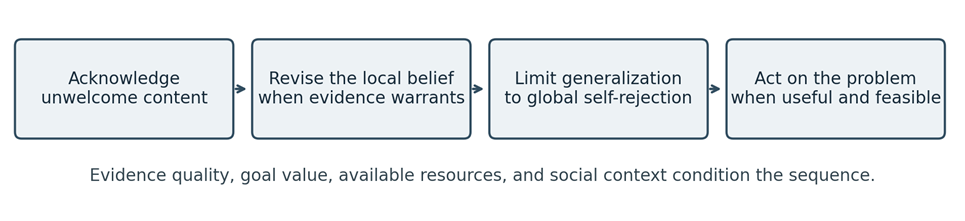
Figure 1. Proposed selective-updating sequence. Arrows represent hypotheses; acknowledgment does not require agreement with invalid criticism.
Three features distinguish this account from a generic claim that acceptance reduces distress. First, valid negative evidence should still change the relevant local belief. Second, changes in local belief should generalize less strongly to global self-rejection. Third, behavioral responsiveness should be preserved when correction is feasible and worthwhile. A smaller emotional response without these features could reflect disengagement, suppression, or indifference.
Acceptance may therefore alter the structure of responding before it changes average self-esteem. Someone may remain disappointed and retain a modest global self-evaluation while becoming more willing to learn. Such a result would support an early process in the model without demonstrating that secure high self-esteem has developed.
7. Predictions That Distinguish Support From Failure
Four core predictions expose the account to meaningful tests while distinguishing its essential claims from questions of scope and specificity.
P1: Preserved local correction with reduced global generalization. Following credible negative feedback, greater acceptance should predict appropriate downward revision of the relevant ability or behavior judgment, accompanied by a weaker increase in global self-rejection. The crucial contrast is between these responses. If local updating is also suppressed, the result would fit defensive disengagement better than selective updating.
P2: Better discrimination between useful and unsupported criticism. Greater acceptance should predict responsiveness to diagnostic feedback without indiscriminate agreement with criticism. Evidence quality and evaluator hostility should be varied separately where possible. Increased agreement with both valid and arbitrary criticism would challenge the claim that acceptance facilitates constructive engagement.
P3: Corrective action when action is worthwhile. With a valued, attainable goal and an available route to improvement, acceptance should preserve or increase appropriate corrective behavior after setbacks. Relevant outcomes include revising a specific error, choosing useful instruction, or completing an offered repair. Reliable reductions in correction under these conditions would count against the growth pathway. Strategic withdrawal from an unattainable or harmful goal would not.
P4: Prospective change beyond stable individual differences. Within-person increases in acceptance should precede some reduction in the generalization from setbacks to global self-rejection, beyond prior levels of both. The reverse pathway should also be estimated. Repeated, precise evidence that acceptance changes do not precede any such change would weaken the proposed contributory role, even if between-person correlations remained strong.
These predictions do not require an interaction between acceptance and baseline self-esteem in every study. Acceptance could have an additive association with defensiveness across self-esteem levels. Neither do they require acceptance to outperform every credible comparison. Equivalent effects from compassion or self-affirmation would challenge specificity, not automatically disprove a shared causal pathway.
Failure must also be distinguished from imprecision. A nonsignificant result with a wide interval cannot establish absence. Studies should specify a smallest effect of theoretical interest and use confidence intervals or equivalence tests to assess whether meaningful effects have been excluded. Predictions about preserving effort require an explicit acceptable-loss margin; an ordinary null test is insufficient to establish that motivation is unharmed.
8. Measurement and Research Priorities
The first priority is to separate the proposed predictor from its outcomes. Ryff's (1989) self-acceptance dimension includes favorable self-attitudes and acceptance of one's past, creating potential overlap with favorable self-evaluation. The same concern applies to unconditional acceptance: Thompson and Waltz (2008) reported a USAQ–Rosenberg correlation of .51 in 167 students and cited an earlier correlation of .56 from Chamberlain and Haaga (2001a). They considered measurement weaknesses, genuine construct overlap, and response tendencies as possible explanations. Different scale names therefore cannot establish that acknowledgment, evaluation, and contingency are distinct.
Researchers should test competing measurement models and inspect overlapping item content before interpreting incremental prediction. A useful battery would distinguish willingness to consider an unwelcome limitation, domain-specific evaluation, global self-esteem, and global self-rejection. It should combine self-report with voluntary inspection of diagnostic feedback and blind coding of responses to its substance. These behaviors are imperfect indicators: information seeking can reflect anxiety, and refusal can reflect justified distrust. Convergence across methods is more persuasive than statistical adjustment between overlapping questionnaires alone.
An initial experiment could independently vary an acknowledgment-focused prompt and feedback diagnosticity, holding writing time and task exposure constant. Compassion or self-affirmation comparisons could test specificity. Manipulation checks should assess willingness separately from mood, kindness, and perceived worth. Instructions should not directly prescribe decoupling of worth if decoupling is the downstream mechanism being tested. Outcomes should distinguish appraisal, local belief revision, global self-rejection, and feasible corrective behavior; evaluator derogation alone cannot distinguish defensiveness from justified skepticism.
Longitudinal research should separate stable between-person differences from within-person change, a distinction conventional cross-lagged models can obscure (Hamaker et al., 2015). Random-intercept or intensive longitudinal models may help, but neither removes all time-varying confounding. Temporally ordered mediation likewise does not establish a causal mechanism. Daily assessments should record setbacks, domain relevance, local judgments, and recovery alongside global self-evaluation, because low variability can reflect fewer challenges, ceiling effects, or rigidity rather than security. The target is appropriate responsiveness with limited global spillover.
9. Competing Explanations and Boundary Conditions
Several accounts could reproduce parts of the predicted pattern. Low neuroticism might explain lower distress; secure attachment might explain both acceptance and resilience; competence might explain confidence in the face of evaluation; and supportive environments might make acknowledgment less costly. These factors belong in a causal argument, not simply in a long list of statistical controls. Some may be common causes, while others may lie on the pathway under study. Adjusting indiscriminately could remove the very process researchers intend to understand.
The strongest redundancy challenge comes from unconditional worth and self-compassion. If willingness to acknowledge a limitation adds nothing once those constructs are measured well, acceptance may be a component or manifestation of a broader stance. A useful theoretical outcome would then be clarification of that component's role, rather than insistence on a separate construct. If acceptance produces constructive engagement without increases in favorable global evaluation, the theory should retain the engagement mechanism and narrow its claim about self-esteem.
Positive illusions pose a further objection. Taylor and Brown (1988) argued that positively biased self-evaluation, perceived control, and optimism can support psychological well-being. The present account does not require complete accuracy or the removal of every favorable bias: acknowledgment is willingness to consider unwelcome information, not a guarantee of veridical self-knowledge. It predicts less rejection of credible, actionable evidence when a local correction is warranted, while allowing optimism about future improvement. This distinction must be tested rather than assumed. If acceptance merely weakens helpful optimism without improving evidence use or corrective action, its proposed growth benefit would be undermined.
The motivation objection deserves a similarly conditional answer. Acceptance need not eliminate dissatisfaction with performance, concern for others, or commitment to a valued goal. Breines and Chen (2012) provide evidence that a compassionate response can support improvement. The present model nevertheless allows acceptance to coexist with low effort when goals are unimportant, opportunities are absent, or resignation is also present. It predicts a benefit from separating self-rejection from correction, not effort independent of every other motivational condition.
Moral responsibility provides a demanding boundary test. Acknowledgment of wrongdoing could support apology and restitution by reducing avoidance. It could also be used rhetorically to dismiss consequences: “I accept myself, so I need not change.” The latter response does not support the growth pathway. Studies should measure responsibility and actual repair where possible, rather than infer moral improvement from reduced shame or increased self-kindness.
Self-criticism also has multiple meanings. Specific criticism of a behavior can guide learning; global contempt for oneself can obstruct it. Cultural norms may change how criticism, modesty, dignity, and acceptance are understood (Heine et al., 1999). Consequently, a broad prediction that acceptance should work less well in cultures valuing self-criticism is premature. Research should assess the meaning and function of criticism within the setting, establish measurement comparability, and test the proposed process directly.
Finally, safety and power affect the costs of acknowledgment. In a punitive organization or coercive relationship, disclosure can invite harm. Psychological willingness to recognize a limitation should be separated from the decision to disclose it. Acceptance of one's experience can coexist with rejecting mistreatment, challenging an evaluation, or leaving an unsafe setting. The model would become socially misleading if it treated endurance of injustice as evidence of security.
10. Limitations
This account is conceptual and does not establish that self-acceptance causes secure self-esteem. Direct evidence is largely correlational, while experimental findings on related constructs cannot isolate the contribution of acceptance itself. Selective updating is a proposed process construct, not a validated measure or an established mechanism, and its distinctiveness from existing accounts remains to be demonstrated.
11. Implications and Conclusion
The practical implication is a change in what counts as progress. A higher self-esteem score alone cannot show whether someone has become more open to correction or more dependent on reassurance. More informative questions are whether the person can name a limitation, evaluate evidence about it, retain basic self-respect, and choose a useful response. These questions apply to education, work, relationships, and clinical research without making the article a prescription for a particular intervention.
For example, useful feedback can identify a specific problem and a route to revision without attaching a global label to the recipient. That approach is compatible with high standards: the work can require substantial improvement, and harmful behavior can warrant serious consequences. The model's applied hypothesis is that correction becomes easier when acknowledging a problem does not require accepting global personal condemnation. Its effectiveness must still be evaluated in the relevant setting.
Self-acceptance may support secure self-esteem because it changes how people live with unfavorable information, not simply because it makes their self-evaluations more positive. The decisive possibility is selective updating: a person can revise a judgment about what they can do or what they have done while retaining the standing to learn, repair, and begin again. Existing evidence supports parts of this account and leaves other parts unresolved. A stronger theory emerges from preserving both facts. Acceptance earns explanatory value when it helps people face what needs to change without requiring rejection of the person who must change it.
References
Baumeister, R. F., Campbell, J. D., Krueger, J. I., & Vohs, K. D. (2003). Does high self-esteem cause better performance, interpersonal success, happiness, or healthier lifestyles? Psychological Science in the Public Interest, 4(1), 1–44. https://doi.org/10.1111/1529-1006.01431
Branden, N. (1994). The six pillars of self-esteem. Bantam Books.
Breines, J. G., & Chen, S. (2012). Self-compassion increases self-improvement motivation. Personality and Social Psychology Bulletin, 38(9), 1133–1143. https://doi.org/10.1177/0146167212445599
Brueckmann, M., Teuber, Z., Hollmann, J., & Wild, E. (2023). What if parental love is conditional …? Children’s self-esteem profiles and their relationship with parental conditional regard and self-kindness. BMC Psychology, 11, Article 322. https://doi.org/10.1186/s40359-023-01380-3
Chamberlain, J. M., & Haaga, D. A. F. (2001a). Unconditional self-acceptance and psychological health. Journal of Rational-Emotive & Cognitive-Behavior Therapy, 19(3), 163–176. https://doi.org/10.1023/A:1011189416600
Chamberlain, J. M., & Haaga, D. A. F. (2001b). Unconditional self-acceptance and responses to negative feedback. Journal of Rational-Emotive & Cognitive-Behavior Therapy, 19(3), 177–189. https://doi.org/10.1023/A:1011141500670
Cohen, G. L., & Sherman, D. K. (2014). The psychology of change: Self-affirmation and social psychological intervention. Annual Review of Psychology, 65, 333–371. https://doi.org/10.1146/annurev-psych-010213-115137
Crocker, J., & Park, L. E. (2004). The costly pursuit of self-esteem. Psychological Bulletin, 130(3), 392–414. https://doi.org/10.1037/0033-2909.130.3.392
Crocker, J., & Wolfe, C. T. (2001). Contingencies of self-worth. Psychological Review, 108(3), 593–623. https://doi.org/10.1037/0033-295X.108.3.593
Ellis, A. (2005). The myth of self-esteem: How rational emotive behavior therapy can change your life forever. Prometheus Books.
Ford, B. Q., Lam, P., John, O. P., & Mauss, I. B. (2018). The psychological health benefits of accepting negative emotions and thoughts: Laboratory, diary, and longitudinal evidence. Journal of Personality and Social Psychology, 115(6), 1075–1092. https://doi.org/10.1037/pspp0000157
Hamaker, E. L., Kuiper, R. M., & Grasman, R. P. P. P. (2015). A critique of the cross-lagged panel model. Psychological Methods, 20(1), 102–116. https://doi.org/10.1037/a0038889
Heine, S. J., Lehman, D. R., Markus, H. R., & Kitayama, S. (1999). Is there a universal need for positive self-regard? Psychological Review, 106(4), 766–794. https://doi.org/10.1037/0033-295X.106.4.766
Kernis, M. H. (2003). Toward a conceptualization of optimal self-esteem. Psychological Inquiry, 14(1), 1–26. https://doi.org/10.1207/S15327965PLI1401_01
Kernis, M. H., Lakey, C. E., & Heppner, W. L. (2008). Secure versus fragile high self-esteem as a predictor of verbal defensiveness: Converging findings across three different markers. Journal of Personality, 76(3), 477–512. https://doi.org/10.1111/j.1467-6494.2008.00493.x
Nadel, M. H., Chamberlain, J., & Haaga, D. A. F. (2026). Unconditional self-acceptance in rational emotive behavior therapy. Journal of Rational-Emotive & Cognitive-Behavior Therapy, 44, Article 21. https://doi.org/10.1007/s10942-026-00650-4
Neff, K. D. (2003). Self-compassion: An alternative conceptualization of a healthy attitude toward oneself. Self and Identity, 2(2), 85–101. https://doi.org/10.1080/15298860309032
Neff, K. D., & Vonk, R. (2009). Self-compassion versus global self-esteem: Two different ways of relating to oneself. Journal of Personality, 77(1), 23–50. https://doi.org/10.1111/j.1467-6494.2008.00537.x
Orth, U., & Robins, R. W. (2022). Is high self-esteem beneficial? Revisiting a classic question. American Psychologist, 77(1), 5–17. https://doi.org/10.1037/amp0000922
Rogers, C. R. (1959). A theory of therapy, personality, and interpersonal relationships, as developed in the client-centered framework. In S. Koch (Ed.), Psychology: A study of a science (Vol. 3, pp. 184–256). McGraw-Hill.
Rosenberg, M. (1965). Society and the adolescent self-image. Princeton University Press.
Ryan, R. M., & Brown, K. W. (2003). Why we don't need self-esteem: On fundamental needs, contingent love, and mindfulness. Psychological Inquiry, 14(1), 71–76. https://selfdeterminationtheory.org/wp-content/uploads/2014/04/2003_RyanBrown_CommentPI.pdf
Ryff, C. D. (1989). Happiness is everything, or is it? Explorations on the meaning of psychological well-being. Journal of Personality and Social Psychology, 57(6), 1069–1081. https://doi.org/10.1037/0022-3514.57.6.1069
Taylor, S. E., & Brown, J. D. (1988). Illusion and well-being: A social psychological perspective on mental health. Psychological Bulletin, 103(2), 193–210. https://doi.org/10.1037/0033-2909.103.2.193
Thompson, B. L., & Waltz, J. A. (2008). Mindfulness, self-esteem, and unconditional self-acceptance. Journal of Rational-Emotive & Cognitive-Behavior Therapy, 26(2), 119–126. https://doi.org/10.1007/s10942-007-0059-0