Quick takeaways
The cost can extend beyond feeling bad. Low self-esteem may influence whether we pursue opportunities, seek support, or spend money to feel worthy.
Protecting ourselves now can carry a later cost. Avoiding rejection may also mean missing a job, friendship, or learning experience.
Spending can serve as emotional compensation. Some purchases may help repair threatened self-worth, but buying luxury goods does not establish that someone has low self-esteem.
Consequences can outlast the behavior. Feeling better or stopping unnecessary spending does not automatically restore missed opportunities or depleted savings.
Recovery depends partly on available options. Replacement opportunities, financial buffers, and support can determine whether a setback fades or creates further difficulties.
This is a proposed explanation, not a proven causal chain. Circumstances can contribute to both low self-esteem and disadvantage. The article does not blame people for their difficulties.
Abstract
Low self-esteem prospectively predicts difficulties in several life domains, but these associations do not establish an attributable or preventable cost. We propose a conditional framework in which persistent negative self-evaluation can generate lasting consequences chiefly by restricting engagement with beneficial experiences and, as a secondary route with less direct evidence linking chronic low self-esteem to lasting costs, by committing resources to symbolic self-worth repair. Neither response is necessarily harmful. Whether a response leaves a lasting cost depends on the quality of available alternatives and on the recoverability of what is lost or committed. The framework’s most distinctive prediction follows: among people with similar initial losses and similar current self-esteem and behavior, those whose losses are harder to recover will retain greater disadvantage. Reducing a specified response can limit further losses attributable to it while earlier consequences persist in the absence of effective substitutes or compensating resources. Longitudinal evidence supports associations with internalizing symptoms and relationships; experiments on temporary self-threat support part of the consumption route; evidence linking chronic low self-esteem, repeated responses, and durable objective costs is incomplete. Four propositions, an evidence map, and a cost ledger specify what would support or challenge the account and keep observed, attributable, and preventable burden apart.
Keywords: self-esteem; avoidance; compensatory consumption; cumulative disadvantage; recoverability; opportunity
1. Introduction
One person declines an invitation rather than risk rejection. Another buys a visible status good after an experience of inadequacy. The first response reduces exposure; the second increases expenditure. Both may serve an immediate concern about personal worth, yet their later consequences depend on what the person loses, commits, and can subsequently recover. The psychological question is how self-evaluation becomes consequential action. The economic question is when that action creates additional burden, who bears it, and how much could actually be prevented.
Neither question is answered by the long-running debate over whether high self-esteem is beneficial. Baumeister et al. (2003) challenged expansive claims that raising self-esteem would solve major social problems. Crocker and Park (2004) showed that organizing behavior around protecting self-worth can itself be costly. Orth and Robins (2022) later reviewed longitudinal evidence for prospective benefits across several domains. After this literature, a new contribution cannot rest on showing that self-esteem predicts adjustment. It must explain how specific consequences arise and what would justify attributing them to self-esteem rather than to the circumstances that produce both low self-esteem and disadvantage.
The gap is one of attribution. Prospective associations are well documented for some outcomes, but an association is not an additional cost, and an additional cost is not necessarily a preventable one. Aggregate cost figures for a psychological risk factor require assumptions about causation, about what would have happened otherwise, and about which consequences may be added together. Those assumptions are rarely stated, and for self-esteem much of the evidence needed to support them is absent.
We propose that persistent negative global self-evaluation can contribute to lasting costs, chiefly through restricted engagement. Avoidance can protect against humiliation, but it can also remove access to support, learning, and participation. We also consider a secondary route, committing resources to symbolic repair, because it produces economic consequences by a different mechanism and because experiments on self-threat and consumption exist. Consumption is one example of resource commitment, not the only one; other compensatory responses, such as substance use, risk-taking, or overwork, are plausible but outside our scope. Costs arise only when a response leaves the person worse off relative to a feasible alternative, taking both benefits and later consequences into account.
The contribution concerns the persistence of consequences across changes in the person. A missed opportunity or financial obligation can remain consequential after the response that produced it has stopped. We distinguish repeated short-term losses, persistent losses, and compounding losses that reduce future options, and we make recoverability, the realistic cost and feasibility of restoring what was lost, the central explanatory variable. This yields three contributions. First, it generates a specific prediction about recovery, and a self-esteem-specific prediction about response, that differ from predictions based on current distress, behavior, or material disadvantage alone. Second, it assesses the evidence link by link (Table 1) and shows that the behavioral and economic links are the least directly tested. Third, it pairs four propositions (Table 2), each with rival explanations and disconfirming observations, with a cost ledger (Table 3) that keeps observed, attributable, and preventable burden apart.
The article is a conceptual synthesis, not a systematic review, meta-analysis, or economic evaluation. We select established theoretical accounts, longitudinal studies and meta-analyses of self-esteem outcomes, experiments on self-threat and consumption, and methodological critiques relevant to attribution. These designs answer different questions; in particular, manipulating a temporary threat does not estimate the long-term causal effect of chronic low self-esteem. The framework’s novelty is the proposed integration around recoverability and future constraints, not the discovery of avoidance or compensatory consumption. Section 3.5 explains how the framework relates to existing accounts.
2. Defining the Explanatory Target
Global self-esteem is a person’s overall evaluation of personal worth (Rosenberg, 1965). It differs from confidence about a particular skill, satisfaction with appearance, and beliefs about one’s standing within an organization. A person may judge their professional abilities favorably while considering themselves fundamentally unworthy of affection; conversely, uncertainty about a task need not imply global self-devaluation. Domain-specific measures should therefore not be substituted for global self-esteem when estimating its consequences.
Level, instability, and contingency also require separation. A consistently negative self-evaluation differs from a fluctuating one, and both differ from making worth depend on achievement or approval. Crocker and Park’s (2004) account of contingent self-worth is relevant to defensive behavior, but it does not show that everyone with low self-esteem pursues validation defensively. The present framework concerns persistent negative global evaluation; contingency and instability are candidate moderators that must be measured independently.
Persistence is a temporal property, not a diagnostic category. Self-esteem should ordinarily be modeled continuously, with repeated observations distinguishing enduring differences from temporary departures from a person’s typical level. A single low score cannot establish chronic exposure. Nor does the term risk factor imply that low self-esteem is a disorder or a personal failing.
The framework does not assume that the consequences of low self-esteem mirror those of high self-esteem, nor that they differ. Evidence that indiscriminate praise fails does not show that sustained self-devaluation is harmless. Equally, a negative linear association between self-esteem and adverse outcomes does not show that the low end of the distribution has a distinctive causal process. A disproportionate penalty at low levels is a further hypothesis requiring nonlinear tests, adequate representation across the distribution, and checks for floor effects. Our account permits accumulation under linear associations and does not depend on a low-end threshold. Under linearity, “costs of low self-esteem” and “benefits of higher self-esteem” describe the same gradient; we use the former because the mechanism concerns protective responses to self-devaluation.
Persistent low self-esteem and temporary self-threat must also be kept apart. A person with generally positive self-regard can experience a threatening setback, while a person with chronically negative self-regard may respond without status seeking. The primary target of this article is persistent negative self-evaluation. Temporary threat enters in two ways: as the best-controlled experimental evidence for parts of the compensation route, and as a competing explanation for why a given response occurs. Chronic and acute exposures must therefore be measured separately. Compensation describes the function of a response, not a diagnosis inferred from an expensive product, and luxury, status signaling, materialism, and compulsive buying are distinct constructs. The framework concerns a purchase motivated by self-worth repair and its consequences, not an assumption that luxury buyers have low self-esteem.
3. A Conditional Account of Accumulating Costs
3.1 From relational signal to action
Sociometer theory treats self-esteem as responsive to perceived relational value (Leary et al., 1995), which gives a reason to expect negative self-evaluations to track rejection and exclusion. The signal alone, however, does not establish that it causes subsequent harm. A low reading may accurately reflect a hostile environment, and raising the reading without altering that environment need not improve outcomes.
The proposed sequence (Figure 1) begins when persistent negative global self-evaluation influences the appraisal of an encounter or opportunity: whether acceptance is likely, whether participation is worth the exposure, or whether acquiring a status signal would repair a threatened identity. Appraisal may lead to withdrawal or to compensatory commitment. Only when a response changes subsequent experience or resource availability does the framework posit an additional consequence through these routes. Negative feelings alone do not establish either pathway.
3.2 Withdrawal and foregone corrective experience
Withdrawal can reduce exposure to an evaluative situation while removing a chance to discover that acceptance, competence, or repair is possible. Its immediate effect on distress is not assumed: avoiding an interview can bring relief, but it may also sustain worry. The relevant hypothesis is that anticipated protection helps explain the response and that the response changes access to a beneficial experience. Both links require measurement rather than inference from a self-esteem score.
Consider two applicants with comparable qualifications and resources, each of whom receives a rejection. Applicant A treats it as information about one application and applies again. Applicant B treats it as confirmation of personal worthlessness and stops applying. The economic consequence depends on the change in subsequent applications and available jobs, not on the negative self-evaluation alone. A study that measures only self-esteem and later income cannot tell whether this sequence occurred. We return to these applicants when discussing the propositions and the cost ledger.
Rumination and reassurance seeking are related processes, not other names for withdrawal. Kuster et al. (2012) reported a prospective indirect association linking lower self-esteem to later depression through rumination across five assessments of 663 participants. This supports a candidate cognitive route, but it does not show that rumination reduces participation. Reassurance seeking can increase contact rather than remove it, and positive self-statements can backfire for people with low self-esteem (Wood et al., 2009), which suggests that attempts at self-repair do not always resolve the underlying concern. We therefore treat sustained negative appraisal and reassurance as possible parallel processes, specifying withdrawal as the primary behavioral route and resource commitment as the secondary route.
3.3 A secondary route: compensatory resource commitment
Compensatory consumption concerns using products or services to regulate a discrepancy in self-perception. Mandel et al. (2017) organize several such strategies, and related experiments link powerlessness to status consumption (Rucker & Galinsky, 2008). For the present framework, the relevant case is acquiring a status signal as a way of repairing threatened worth. This response can increase purchasing rather than suppress engagement, so its symbolic benefit and its later material consequences must be measured separately.
Sivanathan and Pettit (2010) reported experiments in which self-threat increased interest in status goods, with reduced interest when an alternative affirmation was supplied. Pettit and Sivanathan (2011) further reported experimental evidence linking self-threat, credit use, and status-related expenditure. These studies support components of the proposed route. They concern temporary threat, however, and do not establish that chronically low self-esteem generally produces luxury buying, repeated borrowing, or eventual financial distress. That is why we label this route secondary.
The proposed long-term sequence is conditional: a self-worth concern motivates a purchase, the purchase provides some anticipated or experienced repair, and the associated commitment reduces resources available later. Repetition could extend this constraint, particularly when commitments persist after any psychological benefit fades. Whether relief actually occurs, how long it lasts, and whether it predicts repetition are empirical questions. The theory also permits compensation that resolves the concern and produces no lasting loss.
A designer item bought within a comfortable budget may provide lasting enjoyment with little financial strain. The same expenditure can displace necessities or create a difficult obligation for someone with a smaller buffer. Even then, purchasing may be understandable in a setting that rewards visible status. The relevant comparison is with a feasible alternative that meets similar practical and psychological needs. Price, branding, and income alone cannot identify maladaptive compensation.
3.4 Repeated, persistent, and compounding losses
Repeated losses are adverse experiences that recur but do not necessarily alter what happens next. Persistent losses remain after the precipitating response stops: delayed entry into training, depleted savings, or an outstanding financial obligation. Compounding losses additionally constrain later opportunities, so an earlier loss helps produce a subsequent one. These distinctions matter because a sum across repeated episodes can grow without any developmental amplification. The framework’s central explanatory target is persistence and compounding, not merely the arithmetic sum of discomfort.
The routes have different entry conditions. Withdrawal incurs an opportunity cost only when a beneficial and feasible alternative was available. Compensatory consumption can incur a private financial loss through costly commitment even when no corrective interpersonal experience was available. Repetition can amplify either route, but it is not necessary for a single missed deadline or binding obligation to produce a persistent loss. Compounding requires the additional step that the resulting constraint changes future choices or opportunities.
Recoverability concerns the realistic cost, delay, and feasibility of restoring a lost opportunity or resource. It is not identical to whether an event happens only once. An annual course may have a substitute elsewhere, while a nominally ongoing service may become inaccessible after debt, illness, or disengagement. We predict that equally large initial losses will have different trajectories when replacement opportunities, refunds, savings buffers, or debt terms differ. Environments therefore affect not only whether a response occurs, but also whether its consequences persist.
This yields the framework’s most distinctive prediction. If two people have similar initial losses and later reach comparable self-esteem and behavior, the person facing less recoverable consequences should retain a larger disadvantage. If trajectories instead converge once current behavior changes, persistence through external constraints receives less support. A compounding account additionally requires showing that the initial constraint helps generate a new loss, rather than merely remaining present. Recoverability must be measured independently of later outcomes; defining irreversibility by the fact that recovery did not occur would make the prediction circular. The comparison states a theoretical prediction, not a sufficient adjustment strategy, because initial losses and later behavior may themselves result from earlier self-esteem and environments, and conditioning on them can introduce selection bias. Stronger tests would use variation in recoverability that is plausibly independent of the earlier response, such as differences in whether a program reopens, refund rules, or debt terms.
We note a limit on what this logic shows. The recovery prediction is a general feature of cumulative disadvantage and applies to any cause of a missed opportunity or financial commitment. Self-esteem enters the framework through the earlier links: whether it predicts the appraisal and the response (Propositions 1 and 2). The recovery claims (Propositions 3 and 4) explain why consequences persist once a response has occurred, not why low self-esteem matters in particular.
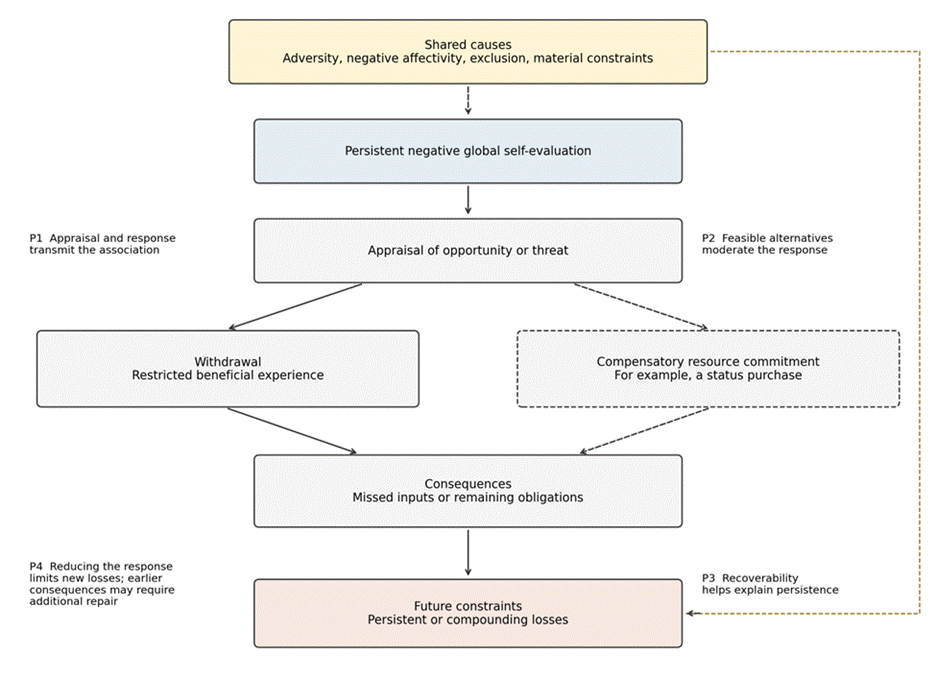
Figure 1. Proposed routes from persistent negative self-evaluation to lasting consequences. P1 concerns transmission through appraisal and response; P2 concerns moderation by feasible alternatives; P3 concerns recoverability; P4 distinguishes preventing further losses from recovery of earlier ones. The dashed consumption route has less direct evidence linking chronic low self-esteem to lasting costs. Shared causes and reciprocal effects must be addressed in empirical tests. Recovery may occur through replacement opportunities or compensating resources without reversing the original event. Arrows represent hypotheses, not established causal effects.
3.5 Relation to existing accounts
The account builds on several established explanations. Cognitive models of social anxiety describe how avoidance and safety behaviors can prevent disconfirmation (Clark & Wells, 1995). Work on perceived regard links self-esteem to security in close relationships (Murray et al., 2000), while self-verification theory describes the role of existing self-views in interpersonal feedback (Swann, 1987). Crocker and Park (2004) explain why contingent pursuit of self-worth can be costly. The compensatory consumer behavior model organizes responses to discrepancies between actual and desired selves (Mandel et al., 2017). Cumulative disadvantage perspectives address how earlier differences shape later circumstances (Dannefer, 2003). None of these ideas is claimed as new here.
The proposed extension is a joint account of the consequences that remain after a protective response ends. Withdrawal may remove a beneficial input; symbolic repair may commit a resource. Their consequences converge when either changes the person’s later feasible choices. This predicts divergence in recovery among people whose current self-esteem and behavior have become similar but whose earlier losses differ in recoverability. The claim goes beyond predicting an immediate response to threat, while remaining a hypothesis to test rather than an established self-esteem effect.
4. What the Evidence Supports
4.1 A link-by-link assessment
Evidence for an endpoint association cannot validate each step in a proposed chain. Table 1 distinguishes direct evidence about a named link from adjacent evidence involving another construct or outcome, and from untested extensions. The labels concern fit to the claim, not a formal assessment of study quality. The withdrawal and consumption routes have different evidential profiles: longitudinal self-esteem associations do not identify the behavioral chain, whereas short experiments on consumption do not establish persistent costs.
Table 1. Evidence map for the proposed framework
Claim | Evidence and scope | Remaining inference |
Self-esteem predicts later difficulties | Direct prospective associations in Sowislo and Orth (2013), Harris and Orth (2020), and Solberg et al. (2025). | Does not identify a behavioral pathway or attributable cost. |
Self-evaluation shapes appraisal | Relationship-specific evidence in Murray et al. (2000); sociometer theory in Leary et al. (1995). | Extension to work and consumption appraisals requires direct tests. |
Appraisal changes withdrawal | Adjacent theory from Clark and Wells (1995). Kuster et al. (2012) test self-esteem and rumination, not this entire link. | Observe appraisal before actual avoidance and participation. |
Withdrawal reduces access to help | Adjacent evidence on self-stigma and willingness to seek counseling (Vogel et al., 2007). | Requires service records and actual use, not intentions. |
Self-threat changes status consumption | Direct experimental evidence about temporary threat and status choices in Sivanathan and Pettit (2010). | Chronic low self-esteem and repeated real-world buying are different targets. |
Threat and credit affect commitment | Direct experimental evidence on credit and status expenditure in Pettit and Sivanathan (2011). | Does not establish later debt distress or persistence. |
Chronic low self-esteem leads to financial strain | No direct longitudinal evidence identified in this synthesis; adjacent literatures link materialism to lower well-being (Dittmar et al., 2014) and debt to poorer mental health (Richardson et al., 2013). | Neither literature identifies self-esteem as the source; the bridge is untested. |
Responses generate persistent or compounding losses | Untested integrated extension; Dannefer (2003) supplies an adjacent life-course account. | Track objective consequences after responses stop and measure future options. |
Changing self-esteem prevents downstream costs | O’Mara et al. (2006) provide adjacent self-concept intervention evidence. | Requires outcome-specific causal evidence and follow-up. |
Note. “Direct” and “adjacent” describe evidential fit to the named claim, not formal quality grades. No cited study establishes the complete long-term sequence.
4.2 Internalizing symptoms
Sowislo and Orth (2013) meta-analyzed 77 longitudinal studies of depression and 18 of anxiety. The prospective coefficient from self-esteem to depression was −.16, compared with −.08 for the reverse path; corresponding anxiety coefficients were −.10 and −.08. These are substantial relative to proposed benchmarks for cross-lagged associations (Orth et al., 2024), but their magnitude does not establish clinical benefit, absolute disease incidence, or monetary burden. They support a prospective association without identifying the response through which it arises.
Solberg et al. (2025) examined 3,251 Norwegians at five assessments from 1992 to 2020. Random-intercept cross-lagged models indicated reciprocal within-person associations between self-esteem and depressive symptoms, anxiety symptoms, and disordered eating, which suggests that associations are not confined to stable differences between people. The authors identify unequal assessment intervals and unmeasured time-varying covariates as limitations. The results are compatible with bidirectional influence but do not show that changing self-esteem would reduce symptoms by the observational coefficients.
Measurement overlap deserves attention because depression scales contain worthlessness items. Analyses should be repeated with overlapping items removed, preserving the validity of both constructs. Taken together, the findings make internalizing symptoms the priority domain for testing the proposed process, while leaving open whether self-devaluation acts independently, mediates adversity, or partly reflects an evolving syndrome.
4.3 Relationships and consequences for others
Harris and Orth (2020) synthesized longitudinal evidence for reciprocal associations between self-esteem and social relationships. The findings support a feedback perspective in which relationships shape self-evaluation and self-evaluation predicts later relationship experience. Temporal ordering in observational data does not, however, identify the behavioral mechanism or the burden borne by partners.
Our framework predicts consequences for others only when a specified interpersonal process occurs. For example, repeated withdrawal might reduce mutual support, whereas direct communication might protect a relationship despite low self-esteem. Testing these possibilities requires dyadic data and partner-reported outcomes. Individual distress, relationship dissatisfaction, and a partner’s additional caregiving time are different outcomes, and counting all three requires clear boundaries.
The framework has a clear scope limit in situations of abuse. Abuse can cause negative self-evaluation, while practical barriers, threats, financial dependence, and coercion constrain the responses available to a victim. A statistical indirect association involving self-esteem cannot explain why someone remains in an abusive relationship, and cross-sectional mediation is especially inadequate for reconstructing such a process (Maxwell & Cole, 2007). Responsibility for abuse rests with the perpetrator. The account does not make self-esteem a prerequisite for deserving protection, nor does it assume that changing self-esteem removes danger.
4.4 Education, work, and economic opportunity
Trzesniewski et al. (2006) linked adolescent low self-esteem in the Dunedin cohort to poorer adult health, economic prospects, and criminal behavior, using multiple sources of outcome information and adjusting for adolescent depression and socioeconomic background. A comparison study in the Christchurch cohort reported that associations were substantially reduced after adjustment for earlier family, individual, and behavioral confounders (Boden et al., 2008). Together these studies show both why the association matters and why it cannot be read as an effect size for self-esteem alone.
Waddell (2006) reported associations between youth attitude and self-esteem indicators and later education, employment, earnings, and job characteristics, reaching beyond perceived satisfaction to economically consequential outcomes. Its measures and historical cohort limit its use as a contemporary causal estimate for global self-esteem. For education specifically, a meta-analysis of self-beliefs and achievement found positive but modest prospective links (Valentine et al., 2004), and many self-belief measures there are domain-specific rather than global.
Krauss and Orth (2022) synthesized longitudinal associations between self-esteem and work experiences, and interpretation remains contested: Sorjonen et al. (2024) argued that adjusted cross-lagged estimates in those data could be spurious. Lustenberger et al. (2026) reanalyzed two longitudinal studies using random-intercept and dynamic panel models; 13 of 36 tested cross-lagged paths were significant and in the expected direction. This is evidence of selective prospective links, not uniformly established effects across work outcomes.
The distinction matters for aggregation. Lower earnings may reflect hours, health, occupational access, discrimination, bargaining conditions, or preferences, and an earnings difference is not automatically a reduction in social output. Organizational costs require organizational outcomes, such as verified absence, replacement expenditure, or service quality, linked to the relevant psychological process. Employees with low self-esteem should not be characterized as liabilities on the basis of individual associations.
4.5 Help-seeking and treatment access
Treatment access offers a plausible connection between withdrawal and health consequences. Vogel et al. (2007) examined self-stigma and willingness to seek counseling, providing adjacent evidence about attitudes and intentions. This does not establish a global self-esteem effect on actual service use, delayed treatment, or discontinuation; such outcomes require behavioral or service records. A later increase in willingness would also not show that the health consequences of earlier delay had been reversed.
4.6 Physical health, confounding, and modifiability
Stamatakis et al. (2004) followed 2,682 Finnish men. Low self-esteem predicted age-adjusted mortality, but the association did not remain after adjustment for other psychosocial characteristics, particularly hopelessness. The result limits claims that self-esteem independently predicts mortality, though it cannot distinguish confounding from mediation, because adjustment has different implications depending on the causal position of the covariate. Chronic stress physiology, health behavior, and delayed care are plausible pathways, but objective outcomes and repeated measurement of the proposed mediators are needed before such pathways enter any attributable-burden estimate.
Common causes such as childhood adversity, discrimination, unsafe environments, and general negative affectivity may produce both negative self-evaluation and disadvantage. Core self-evaluations research illustrates the overlap among relevant traits (Judge & Bono, 2001). Statistical adjustment must follow a defensible causal model: attenuation after controlling neuroticism can reflect shared variance, measurement limitations, confounding, or removal of part of the process. It is informative but not automatically decisive. Self-concept intervention findings (O’Mara et al., 2006) are adjacent to, rather than direct evidence for, changing global self-esteem and thereby preventing objective downstream costs.
4.7 The consumption evidence and the missing longitudinal bridge
The consumer literature supplies experimental leverage on the immediate response to threat, complementing longitudinal work on self-esteem outcomes (Sivanathan & Pettit, 2010; Pettit & Sivanathan, 2011). Its central limitation for this article is the longitudinal bridge: immediate preference or expenditure is not evidence of persistent financial harm. Adjacent literatures link materialism to lower well-being (Dittmar et al., 2014) and unsecured debt to poorer mental health (Richardson et al., 2013), but neither shows that low self-esteem is the source. A convincing test would distinguish chronic self-esteem, the triggering threat, the status motive, actual commitment, and later strain. Materialism, income insecurity, social norms, and general reward seeking are competing explanations. Their roles should be specified rather than treated as interchangeable controls.
5. Four Propositions and Their Alternatives
Four propositions organize the framework (Table 2). Each concerns a particular link or recovery pattern, rather than all possible consequences of self-esteem, and each is stated so that a specific pattern of results would count against it. The behavioral paths may coexist, alternate, or fail to occur. Their value lies in explaining differences in later constraints beyond what a current self-esteem score or a generic measure of distress already predicts.
Proposition 1 (behavioral transmission). Persistent negative global self-evaluation will predict later withdrawal or, secondarily, resource commitment through specified responses, and these responses will carry part of the prospective association with later outcomes beyond general negative affectivity and baseline symptoms. The proposition is weakened if self-esteem predicts outcomes but not the responses, if the responses do not precede reduced participation or commitment, or if the mediated share disappears under a justified causal and measurement model that accounts for neuroticism and baseline symptoms (Section 4.6).
Proposition 2 (feasible alternatives). The association between self-esteem and the response will be smaller where access is safe, credible, and less dependent on self-initiated exposure to evaluation, or where a credible nonfinancial route to affirmation exists. This is a prediction of interaction on a specified outcome scale, not merely of higher average participation in supportive settings; an interaction in absolute participation probabilities need not appear on an odds-ratio scale. A larger benefit at lower self-esteem supports the proposed moderation. Equal benefits fail to support it, though they do not by themselves show that no self-esteem-related process was interrupted. Neither pattern alone establishes or rules out mediation through the specified response.
Proposition 3 (recoverability). At comparable initial loss and comparable subsequent behavior, losses that are harder to recover will produce more persistent disadvantage. Recoverability must be measured prospectively and independently of outcomes. The proposition is weakened if trajectories converge regardless of measured replacement options and reversal costs. Because initial loss and subsequent behavior may themselves result from earlier self-esteem and environments, the contrast should not be implemented by simple matching or adjustment (Section 3.4).
Proposition 4 (outcome-specific recovery). Reducing a specified response should reduce new losses attributable to that response. Within the proposed pathway, improvements in self-esteem should reduce those losses to the extent that they change the relevant response. Recovery from earlier losses should be slower when the resulting constraints remain consequential and no effective substitute or compensating resource becomes available. This permits recovery through replacement opportunities, repayment, additional income, or other resources without reversing the original event. Reduced distress can also be a valuable benefit without material recovery. The proposition distinguishes preventing further losses from recovering earlier ones; it does not make reversal of the original constraint a necessary condition for every improvement.
Table 2. Propositions, predictions, rival explanations, and disconfirming observations
Proposition | Observable prediction | Rival explanation | Would count against it |
P1. Behavioral transmission | Self-esteem precedes a specified response, followed by reduced beneficial input or resource commitment; the response carries part of the later outcome. | General negative affectivity or neuroticism; reverse causation from early symptoms. | Response does not transmit the association despite valid measurement and adequate temporal coverage. |
P2. Feasible alternatives | The self-esteem–response association is smaller where access is safe and credible, or a nonfinancial affirmation route exists. | Supportive settings raise participation for everyone; selection into settings. | Access helps equally at all self-esteem levels (no support for moderation), or the gap persists despite verified access changes. |
P3. Recoverability | At comparable initial loss and subsequent behavior, harder-to-recover consequences produce more persistent disadvantage. | Differences in initial value, resources, or unmeasured circumstances. | Trajectories converge independently of prospectively measured replacement options and reversal costs. |
P4. Outcome-specific recovery | Reducing a specified response reduces new losses attributable to it. Earlier losses persist longer where replacement options and compensating resources are limited. | Recovery through other opportunities, resources, or general improvement over time. | Precisely estimated recovery trajectories do not differ across independently measured or credibly varied replacement options and compensating resources over the specified follow-up. |
Note. P1 and P2 concern whether self-esteem drives the response; P3 and P4 concern why consequences persist once a response has occurred and apply to any cause of loss.
The two applicants show how the propositions fit together. If Applicant B resumes applying, the new behavior may prevent further missed applications, but it does not recreate the closed training window; a substitute opportunity could nevertheless restore the corresponding outcome (P3 and P4). A transparent, low-exposure application process should shrink the difference between A and B, more so if B’s self-esteem is lower (P2). Now consider an individual who responds to rejection by purchasing a status good on credit. Ending the spending response may prevent new commitments while leaving prior obligations. These examples predict a common distinction between stopping a process and recovering from its consequences, despite different outward behavior.
A discriminating example. Consider two hypothetical applicants with similar measured current distress, income, and savings who receive the same rejection. A predictive model containing only those measured variables assigns them similar reapplication probabilities. The framework predicts additional variation associated with persistent self-esteem through a specified appraisal and withdrawal response (P1), and a smaller participation gap under a low-exposure application process (P2). If an opportunity closes, replacement options and compensating resources should help explain later recovery beyond current self-esteem or behavior (P3 and P4). These are proposed contrasts, not claims that all distress-based or material-disadvantage theories make identical predictions. If self-esteem does not predict the specified appraisal and response beyond the competing explanations under a justified model, P1 receives less support. If the low-exposure process benefits applicants equally across self-esteem levels, P2’s moderation prediction receives less support. Neither result alone resolves the recovery propositions. As in Section 3.4, the comparison is not a sufficient causal adjustment strategy.
6. Accounting for Costs Without Assuming Their Cause
6.1 Four quantities that answer different questions
An observed burden is an outcome difference between people with different self-esteem histories. An incremental association is the remaining difference after specified adjustment. An attributable burden is the difference under a defined causal counterfactual. A preventable burden is the difference under an implementable strategy. These quantities need not be similar. Adjustment can remove confounding, block a mediator, or introduce bias, and its interpretation depends on the question and timing.
A strategy that reduces avoidant disengagement or supplies a nonfinancial route to self-affirmation is more interpretable than an undefined instruction to increase self-esteem by one point (Hernán & Taubman, 2008). Even so, strategies can have direct effects outside self-esteem. Safer applications, therapy, and improved credit conditions must be evaluated as specific changes; their consequences cannot be assigned wholly to self-esteem because scores improve.
6.2 A ledger of outcomes and bearers
A useful ledger separates resource use, lost participation or production, consumption and obligations, subjective welfare loss, and consequences borne by others (Table 3). Each category is meaningful, but the categories are not automatically additive. The choice of perspective and the inclusion of nonhealth consequences should be explicit, consistent with economic-evaluation guidance (Sanders et al., 2016) and with critical appraisal standards for cost-of-illness studies (Larg & Moss, 2011).
Table 3. Accounting categories and boundaries
Category | Candidate measure | Boundary |
Health resources | Service records and unit costs | Attribute relevant utilization; avoid assigning unrelated care. |
Participation and production | Applications, hours, absence, earnings | Private earnings loss and social output loss can differ. |
Consumption and obligations | Outlays, balances, fees, resale value, necessities displaced | Account for goods received; do not count principal and repayment twice; interest includes transfers. |
Subjective welfare | Distress and preference-based well-being | A real benefit can occur without material recovery; avoid duplicate valuations. |
Consequences for others | Partner time and organizational records | Measure directly and separate private from societal consequences. |
Applying the ledger to the applicants, Applicant B’s missed applications lower B’s own earnings and may delay B’s career, which is a real loss to B. Whether it is also a loss to society depends on whether the vacancies went unfilled or were filled by another worker, an issue that friction-cost reasoning treats explicitly (Koopmanschap et al., 1995). A transfer payment is not itself a net consumption of social resources, and an employer’s expenditure and society’s loss may overlap without being identical.
For consumption, purchase price is a financial outlay, not automatically a net welfare loss: the person receives a good, which can have use, enjoyment, and resale value. Borrowed principal and its later repayment must not be counted as two separate losses. Interest and fees are private financial burdens; in a societal account, their transfer component must be distinguished from real resource costs. Missed necessities, default administration, and distress require separate evidence and valuation, and household consequences are not established by the buyer’s self-esteem score.
The accounting horizon also matters. Some expenses occur immediately while benefits emerge later, so costs and benefits require a stated discount rate, price year, and uncertainty analysis. Distribution should remain visible: earnings-based valuations alone risk assigning less importance to harms experienced by people who are unemployed, unpaid caregivers, or poorly paid. Reporting health, participation, and time outcomes alongside money avoids equating income with human value.
No aggregate dollar estimate is warranted by the evidence reviewed here. The costs of body dissatisfaction, workplace conflict, consumer debt, or luxury consumption cannot be assigned to low self-esteem on the basis of correlations or a short-term threat experiment. Any attributable estimate must identify a defined exposure, the relevant sequence, and the counterfactual, while preserving overlap among outcomes.
7. Research Priorities
The immediate priority is to establish the proposed sequences and recovery patterns. The following questions translate the framework into observable contrasts without requiring that all be tested in a single study.
1. Observe sequences, not further baseline correlations. Link repeated self-esteem assessments to concrete appraisals, actions, opportunities, and later outcomes. Short measurement intervals (daily or weekly) can capture protective responses, while administrative follow-up can assess education, service use, and employment. Intervals should match the proposed mechanism; a multiyear lag cannot identify the timing of an immediate protective response.
2. Match models to the question. Within-person models separate within-person variation from stable between-person differences; conventional cross-lagged estimates can mix these sources (Hamaker et al., 2015). A random intercept does not remove all time-varying confounding, measurement error, or selection. Both enduring self-esteem differences and temporary self-threat should be assessed rather than treated as interchangeable exposures.
3. Specify the causal structure. Causal diagrams should state whether depression, adversity, and relationship quality precede self-esteem, follow it, or change roles across time. Where repeated feedback exists, ordinary covariate adjustment can be inappropriate, and interventions should be defined well enough to be implemented (Hernán & Taubman, 2008).
4. Treat missingness substantively. People experiencing deteriorating health, exclusion, or unemployment may be least likely to remain in a survey. Retention comparisons, sensitivity analyses, and linkage where permitted are necessary to evaluate whose accumulating costs remain unobserved.
5. Test environmental interruption and recovery separately. Compare uptake under procedures that differ in evaluative exposure, with baseline self-esteem as a continuous moderator, and measure whether actual participation changes. For consumption, assess whether an alternative source of affirmation changes status-specific choices rather than all purchasing. A later recovery phase should measure whether replacement opportunities or reversal of financial commitments alter persistent outcomes. These contrasts identify effects of the procedures themselves; they do not automatically identify a chronic self-esteem effect.
6. Measure recoverability before explaining persistence. Assess replacement options, time delays, reversibility of commitments, and available buffers independently of later outcomes. Compare trajectories after the response stops, and distinguish a remaining loss from a new loss generated by that constraint.
7. Examine generalization. Much of the evidence comes from high-income settings, and local meanings of worth, interdependence, discrimination, and available support may change the pathway. Longitudinal measurement invariance and context-specific opportunity measures should precede comparisons across groups, so that an apparent difference in self-esteem is not mistaken for a difference in construct meaning, response style, or exposure to exclusion.
8. Limitations of the Framework
The framework combines evidence at different levels and time scales. Experiments on temporary self-threat support only part of the consumption route, and longitudinal endpoint associations support only part of the withdrawal route; the complete sequences, their prevalence, and their incremental explanatory value remain open. Consumption is treated as one example of resource commitment, and other compensatory responses may matter as much or more. The recovery logic in Propositions 3 and 4 is not specific to self-esteem, so the framework’s distinctive claim about self-esteem rests on Propositions 1 and 2. Physiological processes, hostility, and risk-taking may contribute through other routes. Because this is a selective conceptual synthesis, systematic evidence appraisal could alter the weight given to each domain. Stronger designs could show that self-esteem is mainly a marker of adversity or that material circumstances explain persistence without a distinct self-evaluative contribution. Either result would limit the theory and redirect attention toward the conditions generating the observed associations.
9. Conclusion
The costs associated with low self-esteem need not arise solely through doing less. People may withdraw from opportunities or commit resources to symbolic repair, and either response can be understandable and beneficial in the moment. Lasting burden becomes plausible when the response leaves a persistent constraint, especially one that reduces later options, and the recoverability of that constraint helps explain how long it lasts. The distinction among repeated, persistent, and compounding losses explains why recovery in self-esteem, behavior, and circumstances may proceed at different rates. Establishing these sequences requires more than endpoint associations or evidence of temporary self-threat. It requires observing the response, the lost or committed resource, the feasible alternative, and the subsequent trajectory. This provides a focused way to investigate the price of self-devaluation without presuming that luxury buyers are insecure, that all compensation is harmful, or that an aggregate societal bill is already known.
References
Baumeister, R. F., Campbell, J. D., Krueger, J. I., & Vohs, K. D. (2003). Does high self-esteem cause better performance, interpersonal success, happiness, or healthier lifestyles? Psychological Science in the Public Interest, 4(1), 1–44. https://doi.org/10.1111/1529-1006.01431
Boden, J. M., Fergusson, D. M., & Horwood, L. J. (2008). Does adolescent self-esteem predict later life outcomes? A test of the causal role of self-esteem. Development and Psychopathology, 20(1), 319–339.
Clark, D. M., & Wells, A. (1995). A cognitive model of social phobia. In R. G. Heimberg, M. R. Liebowitz, D. A. Hope, & F. R. Schneier (Eds.), Social phobia: Diagnosis, assessment, and treatment (pp. 69–93). Guilford Press.
Crocker, J., & Park, L. E. (2004). The costly pursuit of self-esteem. Psychological Bulletin, 130(3), 392–414. https://doi.org/10.1037/0033-2909.130.3.392
Dannefer, D. (2003). Cumulative advantage/disadvantage and the life course: Cross-fertilizing age and social science theory. Journals of Gerontology: Series B, 58(6), S327–S337.
Dittmar, H., Bond, R., Hurst, M., & Kasser, T. (2014). The relationship between materialism and personal well-being: A meta-analysis. Journal of Personality and Social Psychology, 107(5), 879–924.
Hamaker, E. L., Kuiper, R. M., & Grasman, R. P. P. P. (2015). A critique of the cross-lagged panel model. Psychological Methods, 20(1), 102–116. https://doi.org/10.1037/a0038889
Harris, M. A., & Orth, U. (2020). The link between self-esteem and social relationships: A meta-analysis of longitudinal studies. Journal of Personality and Social Psychology, 119(6), 1459–1477. https://doi.org/10.1037/pspp0000265
Hernán, M. A., & Taubman, S. L. (2008). Does obesity shorten life? The importance of well-defined interventions to answer causal questions. International Journal of Obesity, 32(Suppl. 3), S8–S14.
Judge, T. A., & Bono, J. E. (2001). Relationship of core self-evaluations traits—self-esteem, generalized self-efficacy, locus of control, and emotional stability—with job satisfaction and job performance: A meta-analysis. Journal of Applied Psychology, 86(1), 80–92.
Koopmanschap, M. A., Rutten, F. F. H., van Ineveld, B. M., & van Roijen, L. (1995). The friction cost method for measuring indirect costs of disease. Journal of Health Economics, 14(2), 171–189.
Krauss, S., & Orth, U. (2022). Work experiences and self-esteem development: A meta-analysis of longitudinal studies. European Journal of Personality, 36(6), 849–869. https://doi.org/10.1177/08902070211027142
Kuster, F., Orth, U., & Meier, L. L. (2012). Rumination mediates the prospective effect of low self-esteem on depression: A five-wave longitudinal study. Personality and Social Psychology Bulletin, 38(6), 747–759. https://doi.org/10.1177/0146167212437250
Larg, A., & Moss, J. R. (2011). Cost-of-illness studies: A guide to critical evaluation. PharmacoEconomics, 29(8), 653–671.
Leary, M. R., Tambor, E. S., Terdal, S. K., & Downs, D. L. (1995). Self-esteem as an interpersonal monitor: The sociometer hypothesis. Journal of Personality and Social Psychology, 68(3), 518–530. https://doi.org/10.1037/0022-3514.68.3.518
Lustenberger, M., Meier, L. L., & Orth, U. (2026). Reciprocal effects between self-esteem and work experiences: A reanalysis of two longitudinal studies. European Journal of Personality, 40(4), 876–889. https://doi.org/10.1177/08902070251411574
Mandel, N., Rucker, D. D., Levav, J., & Galinsky, A. D. (2017). The compensatory consumer behavior model: How self-discrepancies drive consumer behavior. Journal of Consumer Psychology, 27(1), 133–146. https://doi.org/10.1016/j.jcps.2016.05.003
Maxwell, S. E., & Cole, D. A. (2007). Bias in cross-sectional analyses of longitudinal mediation. Psychological Methods, 12(1), 23–44. https://doi.org/10.1037/1082-989X.12.1.23
Murray, S. L., Holmes, J. G., & Griffin, D. W. (2000). Self-esteem and the quest for felt security: How perceived regard regulates attachment processes. Journal of Personality and Social Psychology, 78(3), 478–498.
O’Mara, A. J., Marsh, H. W., Craven, R. G., & Debus, R. L. (2006). Do self-concept interventions make a difference? A synergistic blend of construct validation and meta-analysis. Educational Psychologist, 41(3), 181–206.
Orth, U., & Robins, R. W. (2022). Is high self-esteem beneficial? Revisiting a classic question. American Psychologist, 77(1), 5–17. https://doi.org/10.1037/amp0000922
Orth, U., Meier, L. L., Bühler, J. L., Dapp, L. C., Krauss, S., Messerli, D., & Robins, R. W. (2024). Effect size guidelines for cross-lagged effects. Psychological Methods, 29(2), 421–433.
Pettit, N. C., & Sivanathan, N. (2011). The plastic trap: Self-threat drives credit usage and status consumption. Social Psychological and Personality Science, 2(2), 146–153. https://doi.org/10.1177/1948550610385138
Richardson, T., Elliott, P., & Roberts, R. (2013). The relationship between personal unsecured debt and mental and physical health: A systematic review and meta-analysis. Clinical Psychology Review, 33(8), 1148–1162.
Rosenberg, M. (1965). Society and the adolescent self-image. Princeton University Press. https://doi.org/10.1515/9781400876136
Rucker, D. D., & Galinsky, A. D. (2008). Desire to acquire: Powerlessness and compensatory consumption. Journal of Consumer Research, 35(2), 257–267.
Sanders, G. D., Neumann, P. J., Basu, A., Brock, D. W., Feeny, D., Krahn, M., Kuntz, K. M., Meltzer, D. O., Owens, D. K., Prosser, L. A., Salomon, J. A., Sculpher, M. J., Trikalinos, T. A., Russell, L. B., Siegel, J. E., & Ganiats, T. G. (2016). Recommendations for conduct, methodological practices, and reporting of cost-effectiveness analyses: Second Panel on Cost-Effectiveness in Health and Medicine. JAMA, 316(10), 1093–1103. https://doi.org/10.1001/jama.2016.12195
Sivanathan, N., & Pettit, N. C. (2010). Protecting the self through consumption: Status goods as affirmational commodities. Journal of Experimental Social Psychology, 46(3), 564–570. https://doi.org/10.1016/j.jesp.2010.01.006
Solberg, O. M., Cortés-García, L., Rodríguez-Cano, R., Wichstrøm, L., & von Soest, T. (2025). From adolescence to midlife: Within-person associations between self-esteem and internalizing symptoms across 28 years. Journal of Affective Disorders, 389, Article 119663. https://doi.org/10.1016/j.jad.2025.119663
Sorjonen, K., Melin, M., & Melin, B. (2024). Spurious prospective effects between work experiences and self-esteem: A reanalysis of a meta-analysis of longitudinal studies. European Journal of Personality, 38(3), 534–543. https://doi.org/10.1177/08902070231197876
Sowislo, J. F., & Orth, U. (2013). Does low self-esteem predict depression and anxiety? A meta-analysis of longitudinal studies. Psychological Bulletin, 139(1), 213–240. https://doi.org/10.1037/a0028931
Stamatakis, K. A., Lynch, J., Everson, S. A., Raghunathan, T., Salonen, J. T., & Kaplan, G. A. (2004). Self-esteem and mortality: Prospective evidence from a population-based study. Annals of Epidemiology, 14(1), 58–65. https://doi.org/10.1016/S1047-2797(03)00078-4
Swann, W. B., Jr. (1987). Identity negotiation: Where two roads meet. Journal of Personality and Social Psychology, 53(6), 1038–1051.
Trzesniewski, K. H., Donnellan, M. B., Moffitt, T. E., Robins, R. W., Poulton, R., & Caspi, A. (2006). Low self-esteem during adolescence predicts poor health, criminal behavior, and limited economic prospects during adulthood. Developmental Psychology, 42(2), 381–390. https://doi.org/10.1037/0012-1649.42.2.381
Valentine, J. C., DuBois, D. L., & Cooper, H. (2004). The relation between self-beliefs and academic achievement: A meta-analytic review. Educational Psychologist, 39(2), 111–133.
Vogel, D. L., Wade, N. G., & Hackler, A. H. (2007). Perceived public stigma and the willingness to seek counseling: The mediating roles of self-stigma and attitudes toward counseling. Journal of Counseling Psychology, 54(1), 40–50.
Waddell, G. R. (2006). Labor-market consequences of poor attitude and low self-esteem in youth. Economic Inquiry, 44(1), 69–97. https://doi.org/10.1093/ei/cbj005
Wood, J. V., Perunovic, W. Q. E., & Lee, J. W. (2009). Positive self-statements: Power for some, peril for others. Psychological Science, 20(7), 860–866.