Quick takeaways
· Detailed guidance can be useful during learning, danger, illness, or enduring support needs. The concern is repeated interference with decisions someone could reasonably make, without sufficient justification for overriding them.
· Constantly taking over may reduce initiative, undermine confidence, or restrict learning. These are different outcomes. Hesitating around a controlling person does not prove that someone has lost ability.
· A controller may feel reassured by intervening. Meanwhile, the recipient may learn to wait for approval. The controller can then mistake that waiting for evidence that further intervention is necessary.
· Warmth and good intentions do not determine whether control is appropriate. Support can preserve agency even when substantial assistance remains necessary.
· Research supports important parts of this explanation, including the costs of intrusive control and the social reinforcement of dependence. The complete micromanagement cycle proposed here still requires direct testing.
Abstract
Detailed supervision can facilitate learning and protect safety, yet persistent decision substitution may restrict another person’s agency. This conceptual article develops an account of chronic micromanagement across work, family, and care relationships. We distinguish oversight intensity from calibration to competence, risk, support needs, and decision authority. Integrating self-determination theory, social cognitive theory, and research on dependence, monitoring, and attribution, we propose two maintenance processes. Intervention may relieve controller uncertainty, increasing subsequent intervention. Decision substitution may also frustrate recipient autonomy or restrict practice, producing inhibited initiative, diminished self-efficacy, or slower skill acquisition. Interpreting these changes as enduring incapacity may sustain control after its initial justification weakens. The contribution specifies how affective reinforcement and interpretation of behavior shaped by control may jointly delay the release of authority. Five propositions address adjustment to evidence, relief, recipient pathways, attributional feedback, and cross-context consistency. We distinguish the account from dependency-support scripts, monitoring-based attribution, and explanations involving recipient difficulty, selection, structural requirements, and consensual specialization. Proposed studies assess competence independently and manipulate explanations for observed dependence alongside alternative reassurance. The account explains how control could sustain its apparent necessity without assuming permanent incapacity or a pathological personality type.
Keywords: micromanagement, interpersonal control, autonomy support, self-efficacy, dependence, behavioral confirmation
Introduction
A manager continues to approve routine decisions after an employee has learned the job. A spouse repeatedly corrects how a partner loads the dishwasher or organizes errands even when the partner’s approach is adequate. A caregiver takes over choices that a person receiving assistance could still make. These interactions differ in authority and purpose, but they raise a common psychological question: how can involvement intended to secure competent action become a pattern that restricts the other person’s capacity to act?
The problem is not detailed involvement by itself. A novice may need explicit instruction, a dangerous task may require continuous supervision, and a person with enduring support needs may benefit from extensive assistance. Concern arises when one person repeatedly retains or appropriates fine-grained decisions beyond what these conditions justify. This pattern can be experienced as a stable interpersonal style: the other person must approve the method, correct the sequence, or remain indispensable to completion.
Organizational research now offers a direct empirical foundation. Vu’s (2025) review documented fragmentation in the micromanagement literature. Subsequently, Deen et al. (2025) developed a nine-item Micromanagement Scale through five studies using eight samples totaling 1,723 employed individuals. Their conceptualization identifies controlling, close monitoring, and detail focus, qualified by excessiveness, persistence, and lack of necessity. The theoretical task is therefore to explain how an identifiable pattern develops and persists, rather than to announce that it remains undefined or unmeasured.
We propose that control can alter the evidence used to justify its continuation. Intervening may reassure the controller, while repeatedly replacing the recipient’s decisions can reduce opportunities to initiate, practice, and demonstrate independent judgment. The recipient may subsequently wait for approval or doubt an adequate decision. If the controller interprets that behavior as preexisting incapacity, further intervention appears warranted. The relationship can thereby sustain the dependence invoked to defend control.
This possibility is not wholly new. Dependency-support research already explains how social responses can reinforce dependence, and monitoring research shows that observation changes both conduct and its interpretation. The present account makes a narrower contribution: it specifies when immediate relief for the controller and interpretation of behavior shaped by control may jointly delay the return of decision authority. Its central outcome is persistence after the original need weakens. Its empirical burden is to explain that persistence beyond actual recipient difficulty and external requirements.
This is a theory-building narrative synthesis. It integrates research selected for relevance to the proposed mechanisms and their alternatives, including recent construct validation and meta-analyses; it does not report a systematic search, new empirical data, or pooled estimates. Organizational findings directly inform workplace micromanagement. Parenting, couple, and care findings establish related processes and boundary conditions, while their extension to a common cross-domain construct remains a proposal.
Defining the pattern and its limits
Oversight intensity and calibration
Chronic micromanagement is defined here as a persistent interpersonal pattern of prescribing, monitoring, or overriding fine-grained decisions beyond what task demands, available evidence of competence, support needs, and legitimate decision authority justify. This formulation extends the workplace construct as a hypothesis about other relationships, not as an assumption that a supervisory scale is already valid in marriage or care.
The definition excludes harm from the predictor. Recipients need not become distressed or perform poorly for control to be excessive, and distress alone does not establish excessiveness. Instead, assessment concerns the relationship between observable restrictions and independently assessed justification. Relevant indicators include unnecessary approval requirements, reversals of adequate decisions, and intervention before a person has a reasonable opportunity to complete an agreed responsibility.
Intensity describes how much oversight occurs. Calibration describes whether its scope and form respond to relevant conditions. Close oversight may be well calibrated in hazardous work; a small but persistent intrusion may be poorly calibrated if it overrides a decision properly belonging to someone else. The judgment requires task-specific evidence of competence, consequences of error, feasible alternatives, and the allocation of responsibilities. A supervisor’s dislike of a method does not itself establish inadequate performance. A partner’s greater efficiency does not automatically confer authority over the other’s choices.
Chronicity means recurrence across opportunities to reconsider control, not a fixed number of days. Continued assistance is not necessarily chronic micromanagement. When support needs remain substantial, help may properly remain extensive while preferences and participation are preserved. Capacity can also decline, and risk can rise. Calibration therefore involves adjustment in both directions, rather than a universal expectation that support must disappear.
Agency within dependence
Self-determination theory distinguishes autonomy, the experience of volition and endorsement, from independence. People can autonomously accept advice, delegate decisions, and depend on others. Competence concerns felt effectiveness, while relatedness concerns connection. Active need frustration involves pressure or thwarting and is not simply the absence of support (R. M. Ryan & Deci, 2000, 2017; Vansteenkiste et al., 2020).
Structure and autonomy support can coexist. Jang et al. (2010) found complementary associations of teacher structure and autonomy support with engagement. Scaffolding likewise provides a precedent for tailoring assistance to what a learner can accomplish with help (Wood et al., 1976). The relevant distinction is whether guidance helps the recipient participate meaningfully or substitutes another person’s preferences for that participation.
This distinction is especially consequential in care. A diagnostic label or need for physical assistance does not establish incapacity for every decision. The dignity-of-risk tradition challenges the presumption that needing support eliminates the opportunity to make reasonable choices with uncertain outcomes (Perske, 1972). In close relationships, Feeney’s (2007) dependency-paradox research similarly indicates that responsive acceptance of dependence can support autonomous functioning. Dependence is therefore not the pathological endpoint assumed by this model. The concern is avoidable restriction of agency within dependence.
Neighboring forms of control
Micromanagement is distinguishable from psychological control, which intrudes into inner experience through guilt induction, shame, or conditional affection (Soenens & Vansteenkiste, 2010), and from abusive supervision, which involves sustained hostile supervisory behavior (Tepper, 2000). Fine-grained interference can occur without either hostility or manipulation of affection. Conversely, these patterns may coexist and compound its effects.
Overprotection concerns shielding someone from difficulty or danger, whereas micromanagement concerns retaining detailed control of how action proceeds. Helicopter parenting overlaps with both but has been studied as a distinguishable pattern during emerging adulthood (Padilla-Walker & Nelson, 2012). Maternal gatekeeping concerns constraints on another parent’s participation in family work and offers a related household process (Allen & Hawkins, 1999). These literatures should inform construct validation without being collapsed into interchangeable measures.
Ordinary coordination and consensual specialization also require separation. Shared finances or childcare can make one person’s choices consequential for another; disagreement is not automatically an illegitimate intrusion. However, acquiescence does not establish endorsement when refusal carries substantial costs. The distinction depends on the actual distribution of decision rights, the acceptability of alternatives, and whether arrangements can be revised.
What existing explanations establish
Motivational and developmental processes
Self-determination theory provides the primary account of motivational consequences. A meta-review supports the broader importance of need-supportive contexts across domains (R. M. Ryan et al., 2022). Workplace syntheses connect autonomy and need satisfaction with motivation and adjustment (Deci et al., 2017; Van den Broeck et al., 2016). In sport, Bartholomew et al. (2011) linked perceived interpersonal control with need thwarting and diminished functioning using cross-sectional and diary evidence. These findings support a mechanism involving experienced pressure, but they do not establish the proposed longitudinal micromanagement cycle.
Social cognitive theory explains a different potential consequence. Mastery experiences inform self-efficacy, which influences effort and persistence (Bandura, 1977, 1997). Success achieved under another person’s direction may be attributed to that direction, while repeated takeover can remove opportunities for independent mastery. Error-management research further indicates that active exploration and constructive engagement with errors can improve transfer relative to error-avoidant training, particularly on novel tasks (Keith & Frese, 2008; Frese & Keith, 2015). The extension is that protecting every immediate output may sometimes restrict later learning. This does not imply that more errors are always beneficial or that dangerous mistakes should be permitted.
Social reinforcement of dependence
The dependency-support script is the closest developmental precursor. Baltes and Wahl (1992) examined its generalization from institutions to community care, documenting interactions in which dependence was supported and independent behavior received ambivalent responses. Baltes et al. (1994) subsequently reported changes in staff behavior and residents’ independence following staff training. These studies already establish that interaction patterns can help maintain dependence and that expectations of incompetence matter.
Helping research adds that assistance can supply either solutions or resources for solving problems independently. Nadler and Chernyak-Hai (2014) showed that recipient status and helpers’ interpretations can influence this distinction. These findings caution against treating the amount of help as equivalent to its developmental value. They also mean that the present article cannot claim novelty merely for proposing that assistance can perpetuate dependence.
Monitoring and interpretation
Monitoring research makes an equally important claim on the proposed attributional process. Strickland (1958) showed that surveillance can shape trust judgments. Schweitzer et al. (2018) later found in repeated trust games that observers could mistake strategically compliant behavior under monitoring for trustworthiness. Their result demonstrates that monitoring can contaminate the evidence used to evaluate a person, including in a direction that increases trust. Persistent distrust is therefore not an inevitable consequence of monitoring.
Control also conveys information to its recipient. Falk and Kosfeld (2006) found that imposed minimum requirements could reduce voluntary performance in an experimental principal–agent setting, with negatively responding participants often interpreting control as distrust or restricted choice. In a different literature, Ravid et al.’s (2023) meta-analysis found no evidence that electronic performance monitoring improves worker performance and found higher stress in monitored conditions. Monitoring is broader than micromanagement, and these findings should not be converted into a universal estimate of its effects.
The proposed explanatory increment
The proposed account concerns the interaction between controller reinforcement, recipient development, and judgments about the need for control. Dependency-support scripts explain social contingencies that favor dependence. Monitoring studies explain how behavior changes under observation and how observers misread it. The present model asks when those processes become coupled to immediate relief from intervening, allowing fine-grained restrictions to persist after task-specific need has declined.
Two predictions identify the increment. First, controllers who obtain greater relief from intervening should release authority more slowly after credible improvement, even when task outcomes and current risk are comparable. Second, explaining how restrictions produced approval seeking should reduce subsequent restriction more when controllers accept that explanation and have an alternative source of reassurance. Correcting competence beliefs alone may leave an affectively reinforced habit intact; reducing uncertainty alone may leave a belief in the recipient’s incapacity intact. These are proposed conditional effects, not claims that either mechanism is always present or that combined effects must be statistically superadditive.
Table 1
Relationship of the proposed model to established explanations
Established account | What it already explains | Additional question in this model |
Basic psychological needs
R. M. Ryan and Deci (2017) | Pressure can undermine volition and adjustment. | Why does restriction persist after competence improves? |
Dependency-support script
Baltes and Wahl (1992) | Social responses can reinforce dependence and neglect independence. | Does controller relief help sustain restrictions when dependence is recognized as induced? |
Monitoring and attribution
Schweitzer et al. (2018) | Monitoring changes behavior and can distort judgments about the actor. | When does interpreting control-shaped behavior as incapacity delay the release of authority? |
Safety-behavior account
Salkovskis (1991) | Protective acts can preserve fears by preventing disconfirmation. | Do changes in the recipient create an additional justification for continuing the protective act? |
Note. These are explanatory emphases, not exclusive boundaries of the cited theories. The proposed increment requires direct tests of persistence and of both maintenance processes.
How chronic control may maintain itself
The controller’s immediate experience
A manager or partner can experience another person’s uncertain action as uncomfortable, particularly when the outcome feels personally consequential. Requiring approval or taking over may reduce uncertainty before any objective improvement can be established. If this relief increases the probability of intervening on later occasions, the behavior is negatively reinforced. The explanation concerns consequences that maintain conduct, not a diagnosis or an assumption of benevolent intent.
Clinical work on safety behaviors supplies a relevant analogy. Protective actions can prevent disconfirmation of a feared outcome because success is attributed to the precaution (Salkovskis, 1991). A 2026 systematic review and meta-analysis found that standalone safety-behavior manipulations affected symptoms, while also identifying moderators and publication-bias concerns (Goodson et al., 2026). This strengthens the clinical basis for investigating protective behavior as a maintenance process. It does not establish that interpersonal micromanagement is a safety behavior or that clinical treatment findings transfer to supervisors and partners.
External pressure may increase the incentive to intervene. Pelletier et al. (2002) linked perceived pressures on teachers with their motivation and reported teaching behavior; Reeve (2009) analyzed reasons teachers adopt controlling styles. The organizational extension is that accountability can make uncertainty personally costly even when the manager’s involvement adds little quality. Status motives, time scarcity, preference rigidity, and hostility offer other routes. The relief pathway is supported only if relief is measured and predicts later intervention, rather than inferred from its occurrence.
The recipient’s experience and opportunities
Decision substitution can impose pressure without hostility. A recipient may experience the controller’s preferred method as compulsory, or infer that independent judgment is unwelcome. This can reduce self-initiated action while leaving skill intact. Warmth may preserve relatedness even as autonomy is frustrated; attachment to the controller is not evidence that the restrictions are harmless.
A separate pathway concerns practice. When someone else identifies each problem, selects the response, and intercepts deviations, the recipient has fewer opportunities to generate and evaluate decisions. Successful completion may provide little evidence of what the recipient can do without that assistance. Repeated interruption may therefore affect confidence, acquisition of new skills, or both. The effect should depend on which learning opportunities are actually removed, rather than on feedback frequency alone.
Three outcomes must be distinguished. Inhibited initiative is reduced independent action in a particular context despite retained capacity. Diminished self-efficacy is reduced belief in task-specific capacity, whether or not that belief is accurate. Impaired skill acquisition is slower improvement or poorer transfer than would occur with adequate practice. Actual deterioration in a previously mastered skill is a stronger claim requiring evidence of decline from baseline. Neither reluctance nor frequent consultation establishes such deterioration.
Recipient adaptation can also be rational. Waiting for approval may avoid rework, conflict, or sanctions in an environment where unauthorized decisions are routinely reversed. The behavior may cease when decision rights credibly change. People may instead resist, conceal actions, or disengage, so dependence is one possible response rather than a universal outcome. Psychological costs and preserved performance can coexist.
Interpreting behavior produced under restriction
The longer feedback process arises when the controller treats behavior observed under control as an independent indicator of enduring ability. A recipient waits because acting without permission is penalized; the controller infers that the recipient cannot act without direction. Alternatively, repeated takeover restricts practice, and a genuine skill gap later develops. That gap can justify some current assistance while remaining partly attributable to the earlier pattern. The issue is causal history as well as present need.
Attribution and expectancy research makes such interpretations plausible without establishing their inevitability. Correspondence-bias research concerns underweighting situational constraints when inferring dispositions (Gilbert & Malone, 1995). Interpersonal expectancy research shows that expectations can help elicit confirming behavior (Snyder et al., 1977), although reviews emphasize that expectancy effects are often limited and expectations can be accurate (Jussim & Harber, 2005). The proposed controller therefore cannot be presumed mistaken simply because the recipient performs poorly.
Success may also fail to produce release. When the controller credits an adequate outcome entirely to personal intervention, competence remains untested in the controller’s view. Failure and success can then both support continued oversight: failure indicates incapacity, and success demonstrates the apparent necessity of control. This interpretation is testable only if researchers assess what controllers believe and how those beliefs respond to independent evidence. Continuing restriction by itself does not establish a self-sealing belief system.
Consider a hypothetical employee who initially needs approval for unfamiliar purchases. Later, an independent assessment demonstrates competence and the financial risk remains unchanged, but the supervisor retains every approval requirement. The employee waits rather than risk having an adequate decision reversed. The supervisor interprets that waiting as inability and feels reassured by taking over again. If initiative returns when discretion becomes credible, the pattern reflects inhibited action rather than lost skill. If performance on an independent transfer task also falls behind an appropriate comparison, restricted learning becomes a plausible additional explanation. The same visible hesitation therefore supports different conclusions depending on evidence beyond the interaction.
The short relief process and the longer attributional process can operate separately. Their coupling may make control particularly persistent because changing one source of reinforcement leaves the other available. Figure 1 distinguishes the controller’s relief from the recipient’s outcomes and identifies the behavioral evidence that can return to the controller. Cross-context stability is considered separately because it concerns who shows the pattern, rather than a causal step within an episode.
Figure 1
Proposed short and long processes maintaining decision substitution
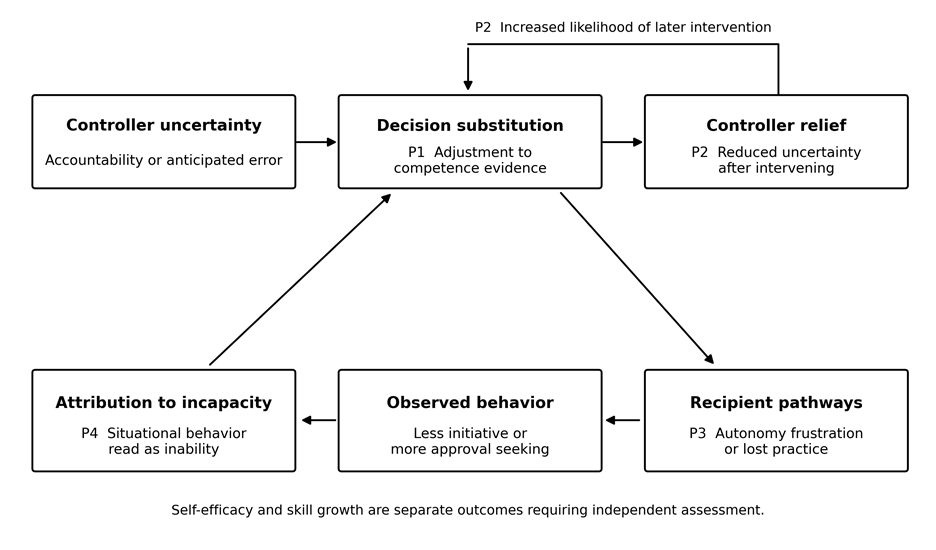
Note. All arrows represent proposed processes. Controller relief feeds into subsequent intervention, not merely reduced uncertainty. The longer process returns observable behavior to the controller’s interpretation; confidence and skill require separate assessment. P1 concerns the effect of threat or control preference on release after competence evidence. P5 concerns consistency across relationships and is not an arrow. Task risk, support needs, decision authority, consent, and power condition the processes.
Evidence across relationships and limits on generalization
Supervisory relationships
The most direct evidence concerns workplace micromanagement. Deen et al. (2025) reported discriminant and incremental validity relative to neighboring leadership constructs and associations with outcomes including exhaustion and turnover intentions. This supports treating micromanagement as more than a colloquial complaint, but the validation program does not establish a developmental loss of recipient capacity.
Slemp et al.’s (2018) meta-analysis of leader autonomy support included 72 studies, 83 samples, and 32,870 participants and linked autonomy support with favorable motivational and well-being outcomes. Its results support the motivational background of the model. Benefits of autonomy support cannot simply be inverted to estimate harms of micromanagement, and shared reports of supervision and well-being can reflect reciprocal influence or common method variance. Claims about skill loss require performance assessments beyond relationship ratings.
Parenting and development
Parenting evidence supports distinctions within intrusive involvement. K. M. Ryan et al. (2024), studying 701 Australian parents of adolescents, distinguished demanding from responsive features of helicopter and overprotective parenting. Demanding features had more adverse correlates; responsive features showed a different pattern, particularly after adjustment for demanding features. Because the evidence is correlational and partly depends on adjustment between correlated factors, it does not establish that responsive overinvolvement is beneficial.
A 2026 meta-analysis of 231 studies reported pooled correlations of .24 with internalizing symptoms and .22 with externalizing symptoms for intrusive parenting, with substantial heterogeneity (K. M. Ryan et al., 2026). A narrower review of overprotection measured using the EMBU found smaller associations, approximately .14 to .18 (de Roo et al., 2022). These syntheses support concern about intrusive environments but do not directly test restricted mastery or controller misattribution. Child difficulties may evoke intervention, and family stress may affect both. Developmental dependence also gives parents responsibilities that cannot be assumed in relationships between adults.
A recent two-wave study of 588 adolescents examined overprotection and problem behaviors over two years using multiple analytic specifications and reports from adolescents, parents, and teachers (Flamant et al., 2026). Results more consistently supported overprotection preceding increases in problem behaviors than the reverse direction. This strengthens temporal evidence for one component of the account, while remaining observational and addressing problem behaviors rather than lost agency. Reciprocal influence is a credible alternative to evaluate, not a finding that can be assumed equally strong in every sample.
Romantic relationships and care
Close-relationship research supports the importance of agency within connection. Need fulfillment has been linked to relationship functioning and well-being (Patrick et al., 2007), and self-determination theory offers an account of autonomy within romantic interdependence (Knee et al., 2013). Feeney (2007) supplies a particularly important boundary: responsive acceptance of dependence can support independence. The relevant contrast is therefore responsive assistance versus avoidable replacement of judgment, not dependence versus self-sufficiency.
Secure-base research brings the evidence closer to interference itself. Feeney (2004) examined nonintrusive, responsive support using observational and experimental methods. In a subsequent observational study of 167 married couples, availability, noninterference, and encouragement predicted exploration (Feeney & Thrush, 2010). Interference was associated with poorer task performance, lower persistence, and greater assistance seeking, but did not predict expressed self-confidence. This divergence reinforces the need to measure behavior and efficacy separately. Neither study established chronic micromanagement as a cross-domain construct or tested the proposed feedback cycle.
Attempts to influence a partner also cannot all be classified as harmful control. Overall et al. (2009) found that direct strategies, both positive and negative, predicted subsequent change in targeted partner characteristics. Their findings caution against equating unpleasant influence with developmental harm or assuming that supportive tone always produces better long-term outcomes. Chronic micromanagement must be identified through persistent restrictions and their justification, not simply through conflict or negative affect. Direct validation of the proposed construct and cycle in couples is still needed.
In care, classic research found benefits from enhanced choice and responsibility among nursing home residents (Langer & Rodin, 1976). Schulz and Hanusa (1978) reported declines after the termination of an intervention involving predictable or controllable positive events. The latter finding supports caution about ending beneficial arrangements; it does not isolate autonomy without support as the cause of decline. Together with dependency-support research, these studies show why preserving agency and providing continuing assistance should be considered jointly. They cannot establish effects across all disabilities or contemporary care arrangements.
Propositions and competing explanations
Proposition 1 concerns adjustment to competence evidence
When controllers experience greater accountability-related threat or have a stronger independently measured desire for control, equivalent evidence of improving recipient competence will produce less release of discretionary decision authority, holding task risk and external requirements constant. The key prediction is an interaction between a measured or manipulated antecedent and competence evidence. Chronic micromanagement must not be used to predict persistence when persistence already defines the construct.
Desire for control (Burger & Cooper, 1979) and other-oriented perfectionism (Hewitt & Flett, 1991) are candidate dispositions, not established causes of micromanagement. Researchers should also separate failure to receive credible evidence, failure to accept it, and failure to change restrictions despite accepting it. If people release authority appropriately once competence information is available, information scarcity is a better explanation than the proposed calibration process.
Proposition 2 concerns reinforcement by relief
Within controllers, uncertainty reduction following discretionary intervention will predict a higher probability of intervention at the next comparable opportunity, conditional on pre-intervention need and task risk. The prediction concerns relief temporally associated with the controller’s own action, not merely low anxiety after successful outcomes. It should weaken when credible quality information supplies reassurance without personal intervention. No relationship between relief and subsequent intervention would challenge this pathway even if other reasons for overcontrol remain.
Proposition 3 concerns divergent recipient pathways
Repeated unnecessary decision substitution will reduce initiative through experienced autonomy frustration; where it also removes meaningful practice, it will impede task-specific efficacy development or skill acquisition. Initiative can change quickly and recover when authority changes. Skill acquisition requires repeated opportunities and appropriate assessment over time. Evidence for one pathway does not establish the other, and recipient distress alone confirms neither. On tasks with little opportunity for learning, the practice pathway should be weak even if pressure is experienced.
Proposition 4 concerns attributional feedback and coupled persistence
Given the same observed approval seeking, controllers who interpret it as stable incapacity will retain more authority than those who recognize its origin in restrictive procedures. Correcting that interpretation should reduce later restriction, especially when an alternative source of reassurance also reduces the need to intervene for relief. The distinctive prediction is continued restriction after objective need declines, with changes in attributed cause and controller relief explaining separate portions of that persistence. If accurate attribution leaves restrictions unchanged, the attributional explanation weakens; status, habit, or external obligation may instead dominate.
Proposition 5 concerns consistency across relationships
A generalized micromanaging style will be supported only if controlling tendencies recur across recipients and domains after accounting for risk, recipient competence, authority, and support preferences. Stability within one dyad is insufficient. A person may be controlling at work under punitive accountability and autonomy supportive at home. Cross-context consistency would support a person-level tendency without implying a personality disorder or ruling out contextual influence. Multiple recipients and tasks are necessary to distinguish style from one difficult relationship.
Rival accounts and discriminating evidence
A need-responsive reverse-causation account predicts that actual recipient difficulty elicits intervention and that intervention decreases when recognized difficulty resolves, unless risk or external requirements remain. The present model permits difficulty to initiate control but predicts additional persistence that cannot be explained by current need. A lagged association between recipient problems and later control supports neither explanation exclusively.
A pure selection account attributes the association to preexisting differences in who enters or remains in controlling relationships. It predicts no within-recipient deterioration attributable to exposure once initial differences and relevant changes are addressed. The proposed developmental pathway requires changes in initiative, efficacy, or learning within recipients, preferably following experimentally varied decision substitution. Selection and developmental effects can coexist.
A structural-requirement account predicts that mandatory procedures and accountability demands explain restriction. It is distinguished by separating compulsory checks from discretionary additions and by observing behavior when requirements change. Structural conditions may also trigger relief-seeking or biased interpretation, so contextual and psychological explanations need not compete. A residual association with individual differences does not itself identify the psychological mechanism.
A consensual-specialization account predicts that concentration of decisions is endorsed, revisable, and compatible with the recipient’s goals. It can explain substantial dependence without agency loss. Desired support should therefore be assessed before and during the relationship, and withdrawal of consent must be practically possible. The complete proposed cycle would be weakened if restriction consistently tracked need or freely chosen arrangements and neither relief nor interpretation added explanatory value. Table 2 summarizes tests of the five propositions.
Table 2
Predictions and evidence that would challenge the five propositions
Proposition | Discriminating prediction | Challenging evidence |
P1
Adjustment to evidence | Threat or desire for control predicts less release after equivalent competence improvement. | Restrictions update with competence once information, risk, and obligations are matched. |
P2
Relief | Within-controller relief predicts intervention at the next comparable opportunity. | Relief adds no predictive value beyond prior need, risk, and stable individual differences. |
P3
Recipient pathways | Pressure predicts less initiative; preserving practice attenuates learning costs. | Initiative, efficacy, and transfer remain equivalent despite verified exposure and adequate precision. |
P4
Attributional feedback | Correcting the cause attributed to approval seeking and providing reassurance each facilitate release. | Accepted attributional correction and alternative reassurance leave discretionary restrictions unchanged. |
P5
Generalized style | Residual control tendencies recur across recipients, tasks, and domains. | Consistency disappears when competence, risk, obligations, and preferences are accounted for. |
Note. Predictions concern proposed mechanisms. Need-responsive reverse causation, selection, structural requirements, and consensual specialization are specified separately in the text. Null findings must be sufficiently precise to be informative.
A research program that tests the mechanisms
Establish exposure independently of its outcomes
Workplace research should use the existing Micromanagement Scale alongside observations of decision allocation rather than inventing an outcome-laden substitute. Approval logs, interruptions, overrides of adequate choices, and opportunities for self-directed action can describe exposure. Independent, blinded assessments should establish task competence and consequences of error. Recipient reports remain essential for perceived pressure and distrust, but those experiences should not be included in the behavioral exposure score.
Couple and care measures require qualitative development and validation. Replacing “supervisor” with “partner” does not establish equivalence when decisions are shared or expertise shifts between tasks. Support needs, accessible communication, and actual opportunities to disagree must be assessed. Cross-domain and cultural comparisons require evidence of measurement equivalence; different mean scores could otherwise reflect different meanings of involvement.
Follow episodes and developmental change
A prospective dyadic study could record controller uncertainty before an episode, the intervention, immediate relief, recipient pressure, and independent action at subsequent opportunities. Slower changes in efficacy and skill should be assessed at intervals appropriate for learning. Multiple recipients per controller would help separate person-level tendencies from dyad-specific patterns. Independently scored decisions would reveal whether requests for approval reflect actual difficulty or constrained initiative.
Analyses should distinguish stable between-person differences from within-person change, a distinction conventional cross-lagged models can obscure (Hamaker et al., 2015). Multilevel or random-intercept approaches address that issue under their assumptions but do not eliminate time-varying confounding. Workload, fatigue, conflict, and changing risk require attention. Errors caused by earlier restrictions may be mediators, so indiscriminately adjusting for all later errors can remove part of the process under investigation. Total developmental effects and effects conditional on current need should be specified separately.
Separate decision substitution from learning opportunity
A low-risk adult experiment could cross whether participants retain meaningful task decisions with whether they receive additional protected opportunities for independent practice. All conditions would receive the same initial instruction, access to correct information, and total scheduled contact. In the substitution condition, adequate choices would require approval or be replaced; protected practice would permit decisions without subsequent override. Assignment must demonstrably change experienced decision authority and actual practice, rather than merely change instructions.
Later independent and transfer tasks would distinguish outcomes. Restored initiative with intact performance would support contextual inhibition. Lower efficacy despite intact performance would support a confidence pathway. Poorer transfer that is reduced by protected practice would support a learning pathway. Because practice can also improve autonomy and confidence, this factorial design would not by itself establish unique mediators. Temporal measures and further targeted manipulations would be needed. The design tests whether preserving practice attenuates a developmental cost while some controlling interactions remain.
The independent phase must clearly change the rules, verify understanding, and allow an adaptation period. Otherwise, hesitation may reflect uncertainty about permission. Researchers should also measure resistance, concealment, and disengagement rather than counting only compliant dependence as a possible response. Immediate output and later learning are separate outcomes: improved supervised performance cannot establish a developmental benefit, and dissatisfaction cannot establish skill loss.
Test why controllers continue intervening
A complementary experiment could present controllers with identical competent performance and identical earlier approval seeking, while varying whether credible information identifies that approval seeking as induced by restrictive procedures. A second factor could provide reliable quality assurance without controller intervention. Subsequent discretionary approval requirements would test whether attributional correction and alternative reassurance each facilitate release. Believed competence, uncertainty, and relief would be measured separately.
This design tests whether the interpretation of dependence and the availability of reassurance jointly govern continued restrictions. It does not show that naturally occurring micromanagement originally produced the behavior presented. Establishing the full cycle requires converging evidence that substitution changes recipients, those changes alter controllers’ judgments, and altered judgments affect subsequent restrictions. Brief laboratory effects should not be described as chronic patterns without repeated observation.
Primary contrasts, timing, and exclusion rules should be preregistered. Sample-size planning must reflect the smallest theoretically meaningful effects, clustering, repeated measurements, and attrition; no numerical power claim is warranted without those specifications. Tests of negligible effects require informative intervals or equivalence criteria, rather than nonsignificant results alone. Experimental exposure should involve consenting adults, reversible restrictions, and low-risk tasks, not prolonged intrusive control imposed on vulnerable recipients.
Boundary conditions and implications
Task risk limits the scope of independent trial and error. In dangerous settings, simulated practice or bounded decisions may preserve learning while essential safety checks remain. Disability and illness can require stable or increasing help; the question is whether choices within the person’s capacity are still available. Legitimate restrictions should be assessed against feasible alternatives, rather than against an unrealistic standard of complete independence.
Power shapes what recipients can do in response. An employee may depend on favorable evaluations, and a partner may face financial or interpersonal costs for disagreement. Waiting for approval under these conditions is not shared responsibility for imposed control. Where intimidation, surveillance, or restrictions on movement and resources occur, a focus on routine task interference alone understates the problem. Suggestions for negotiated autonomy presume that negotiation is feasible and safe.
Culture can affect expectations of involvement and the meaning of oversight. The model does not equate an individualistic division of tasks with healthy functioning. It predicts costs when decision substitution undermines endorsed participation or restricts necessary learning, but the expression and strength of these processes require cross-cultural testing. Acceptance of a norm, practical freedom to revise an arrangement, and actual need should be measured separately.
The practical implication is to make the justification and review of oversight explicit. Outcome standards, meaningful areas of discretion, and agreed evidence for adjusting support may help distinguish guidance from a persistent preference for control. Where practice has been restricted, restoring authority may need to include opportunities to relearn or rebuild confidence. These are implications for evaluation, not an empirically established treatment package. A controller’s willingness to reduce unnecessary intervention is itself an outcome to explain.
The account has corresponding limits. Evidence is stronger for component processes than for their complete coupling in micromanagement. An apparent skill gap can precede control, emerge during control, or reflect both. Many recipients retain competence and respond with resistance rather than dependence. If control follows current need, updates appropriately to credible evidence, and is unaffected by relief or causal interpretation, the proposed maintenance explanation should be narrowed. Its value depends on identifying conditions of persistence that simpler explanations miss.
Conclusion
Chronic micromanagement concerns what happens when detailed control repeatedly exceeds its justification and fails to make room for the other person’s agency. The proposed account explains how intervention may reassure a controller while restricting the recipient’s opportunities to act, learn, and demonstrate competence. If resulting hesitation or dependence is treated as evidence of enduring incapacity, the pattern can sustain its apparent necessity. This possibility builds on established research rather than replacing it. Its contribution is to specify how controller relief and interpretation of control-shaped behavior may delay the release of authority, and how those processes can be tested without confusing dependence with incapacity or assistance with harm.
References
Allen, S. M., & Hawkins, A. J. (1999). Maternal gatekeeping: Mothers' beliefs and behaviors that inhibit greater father involvement in family work. Journal of Marriage and Family, 61(1), 199–212. https://doi.org/10.2307/353894
Baltes, M. M., Neumann, E.-M., & Zank, S. (1994). Maintenance and rehabilitation of independence in old age: An intervention program for staff. Psychology and Aging, 9(2), 179–188. https://doi.org/10.1037/0882-7974.9.2.179
Baltes, M. M., & Wahl, H.-W. (1992). The dependency-support script in institutions: Generalization to community settings. Psychology and Aging, 7(3), 409–418. https://doi.org/10.1037/0882-7974.7.3.409
Bandura, A. (1977). Self-efficacy: Toward a unifying theory of behavioral change. Psychological Review, 84(2), 191–215. https://doi.org/10.1037/0033-295X.84.2.191
Bandura, A. (1997). Self-efficacy: The exercise of control. W. H. Freeman.
Bartholomew, K. J., Ntoumanis, N., Ryan, R. M., Bosch, J. A., & Thøgersen-Ntoumani, C. (2011). Self-determination theory and diminished functioning: The role of interpersonal control and psychological need thwarting. Personality and Social Psychology Bulletin, 37(11), 1459–1473. https://doi.org/10.1177/0146167211413125
Burger, J. M., & Cooper, H. M. (1979). The desirability of control. Motivation and Emotion, 3(4), 381–393. https://doi.org/10.1007/BF00994052
Deci, E. L., Olafsen, A. H., & Ryan, R. M. (2017). Self-determination theory in work organizations: The state of a science. Annual Review of Organizational Psychology and Organizational Behavior, 4, 19–43. https://doi.org/10.1146/annurev-orgpsych-032516-113108
Deen, C. M., Kiewitz, C., Kim, J.-Y., Restubog, S. L. D., Chih, Y.-Y., & Tang, R. L. (2025). Helicopter bosses: Development and validation of the Micromanagement Scale. Journal of Management. Advance online publication. https://doi.org/10.1177/01492063251378092
de Roo, M., Veenstra, R., & Kretschmer, T. (2022). Internalizing and externalizing correlates of parental overprotection as measured by the EMBU: A systematic review and meta-analysis. Social Development, 31(4), 962–983. https://doi.org/10.1111/sode.12590
Falk, A., & Kosfeld, M. (2006). The hidden costs of control. American Economic Review, 96(5), 1611–1630. https://doi.org/10.1257/aer.96.5.1611
Feeney, B. C. (2004). A secure base: Responsive support of goal strivings and exploration in adult intimate relationships. Journal of Personality and Social Psychology, 87(5), 631–648. https://doi.org/10.1037/0022-3514.87.5.631
Feeney, B. C. (2007). The dependency paradox in close relationships: Accepting dependence promotes independence. Journal of Personality and Social Psychology, 92(2), 268–285. https://doi.org/10.1037/0022-3514.92.2.268
Feeney, B. C., & Thrush, R. L. (2010). Relationship influences on exploration in adulthood: The characteristics and function of a secure base. Journal of Personality and Social Psychology, 98(1), 57–76. https://doi.org/10.1037/a0016961
Flamant, N., Soenens, B., Tiemeier, H., Waterschoot, J., & Prinzie, P. (2026). Examining bidirectional associations between overprotective parenting and adolescent problem behaviors: A multiverse analysis. Journal of Child Psychology and Psychiatry, 67(10), 1649–1663. https://doi.org/10.1111/jcpp.70166
Frese, M., & Keith, N. (2015). Action errors, error management, and learning in organizations. Annual Review of Psychology, 66, 661–687. https://doi.org/10.1146/annurev-psych-010814-015205
Gilbert, D. T., & Malone, P. S. (1995). The correspondence bias. Psychological Bulletin, 117(1), 21–38. https://doi.org/10.1037/0033-2909.117.1.21
Goodson, J. T., Patel, T. A., Zech, J. M., Sala, M. C., & Cougle, J. R. (2026). The standalone effect of safety behavior manipulations: A systematic review and meta-analysis. Clinical Psychology Review, 124, Article 102703. https://doi.org/10.1016/j.cpr.2026.102703
Hamaker, E. L., Kuiper, R. M., & Grasman, R. P. P. P. (2015). A critique of the cross-lagged panel model. Psychological Methods, 20(1), 102–116. https://doi.org/10.1037/a0038889
Hewitt, P. L., & Flett, G. L. (1991). Perfectionism in the self and social contexts: Conceptualization, assessment, and association with psychopathology. Journal of Personality and Social Psychology, 60(3), 456–470. https://doi.org/10.1037/0022-3514.60.3.456
Jang, H., Reeve, J., & Deci, E. L. (2010). Engaging students in learning activities: It is not autonomy support or structure but autonomy support and structure. Journal of Educational Psychology, 102(3), 588–600. https://doi.org/10.1037/a0019682
Jussim, L., & Harber, K. D. (2005). Teacher expectations and self-fulfilling prophecies: Knowns and unknowns, resolved and unresolved controversies. Personality and Social Psychology Review, 9(2), 131–155. https://doi.org/10.1207/s15327957pspr0902_3
Keith, N., & Frese, M. (2008). Effectiveness of error management training: A meta-analysis. Journal of Applied Psychology, 93(1), 59–69. https://doi.org/10.1037/0021-9010.93.1.59
Knee, C. R., Hadden, B. W., Porter, B., & Rodriguez, L. M. (2013). Self-determination theory and romantic relationship processes. Personality and Social Psychology Review, 17(4), 307–324. https://doi.org/10.1177/1088868313498000
Langer, E. J., & Rodin, J. (1976). The effects of choice and enhanced personal responsibility for the aged: A field experiment in an institutional setting. Journal of Personality and Social Psychology, 34(2), 191–198. https://doi.org/10.1037/0022-3514.34.2.191
Nadler, A., & Chernyak-Hai, L. (2014). Helping them stay where they are: Status effects on dependency/autonomy-oriented helping. Journal of Personality and Social Psychology, 106(1), 58–72. https://doi.org/10.1037/a0034152
Overall, N. C., Fletcher, G. J. O., Simpson, J. A., & Sibley, C. G. (2009). Regulating partners in intimate relationships: The costs and benefits of different communication strategies. Journal of Personality and Social Psychology, 96(3), 620–639. https://doi.org/10.1037/a0012961
Padilla-Walker, L. M., & Nelson, L. J. (2012). Black hawk down? Establishing helicopter parenting as a distinct construct from other forms of parental control during emerging adulthood. Journal of Adolescence, 35(5), 1177–1190. https://doi.org/10.1016/j.adolescence.2012.03.007
Patrick, H., Knee, C. R., Canevello, A., & Lonsbary, C. (2007). The role of need fulfillment in relationship functioning and well-being: A self-determination theory perspective. Journal of Personality and Social Psychology, 92(3), 434–457. https://doi.org/10.1037/0022-3514.92.3.434
Pelletier, L. G., Séguin-Lévesque, C., & Legault, L. (2002). Pressure from above and pressure from below as determinants of teachers' motivation and teaching behaviors. Journal of Educational Psychology, 94(1), 186–196. https://doi.org/10.1037/0022-0663.94.1.186
Perske, R. (1972). The dignity of risk and the mentally retarded. Mental Retardation, 10(1), 24–27.
Ravid, D. M., White, J. C., Tomczak, D. L., Miles, A. F., & Behrend, T. S. (2023). A meta-analysis of the effects of electronic performance monitoring on work outcomes. Personnel Psychology, 76(1), 5–40. https://doi.org/10.1111/peps.12514
Reeve, J. (2009). Why teachers adopt a controlling motivating style toward students and how they can become more autonomy supportive. Educational Psychologist, 44(3), 159–175. https://doi.org/10.1080/00461520903028990
Ryan, K. M., Zimmer-Gembeck, M. J., Hawes, T., Kovacs, T., & Leahy, N. (2026). Intrusive parenting and adolescent internalizing and externalizing symptoms: Three-level meta-analytic reviews considering parenting concepts and methodology. Clinical Child and Family Psychology Review, 29(1), 105–127. https://doi.org/10.1007/s10567-025-00555-1
Ryan, K. M., Zimmer-Gembeck, M. J., Speechley, M., Stuart, J., Soenens, B., Zimmermann, G., & Van Petegem, S. (2024). Identifying correlates of demanding and responsive features in helicopter and overprotective parenting. Journal of Child and Family Studies, 33, 2826–2843. https://doi.org/10.1007/s10826-024-02896-x
Ryan, R. M., & Deci, E. L. (2000). Self-determination theory and the facilitation of intrinsic motivation, social development, and well-being. American Psychologist, 55(1), 68–78. https://doi.org/10.1037/0003-066X.55.1.68
Ryan, R. M., & Deci, E. L. (2017). Self-determination theory: Basic psychological needs in motivation, development, and wellness. Guilford Press. https://doi.org/10.1521/9781462538966
Ryan, R. M., Duineveld, J. J., Di Domenico, S. I., Ryan, W. S., Steward, B. A., & Bradshaw, E. L. (2022). We know this much is (meta-analytically) true: A meta-review of meta-analytic findings evaluating self-determination theory. Psychological Bulletin, 148(11–12), 813–842. https://doi.org/10.1037/bul0000385
Salkovskis, P. M. (1991). The importance of behaviour in the maintenance of anxiety and panic: A cognitive account. Behavioural Psychotherapy, 19(1), 6–19. https://doi.org/10.1017/S0141347300011472
Schulz, R., & Hanusa, B. H. (1978). Long-term effects of control and predictability-enhancing interventions: Findings and ethical issues. Journal of Personality and Social Psychology, 36(11), 1194–1201. https://doi.org/10.1037/0022-3514.36.11.1194
Schweitzer, M. E., Ho, T.-H., & Zhang, X. (2018). How monitoring influences trust: A tale of two faces. Management Science, 64(1), 253–270. https://doi.org/10.1287/mnsc.2016.2586
Slemp, G. R., Kern, M. L., Patrick, K. J., & Ryan, R. M. (2018). Leader autonomy support in the workplace: A meta-analytic review. Motivation and Emotion, 42(5), 706–724. https://doi.org/10.1007/s11031-018-9698-y
Snyder, M., Tanke, E. D., & Berscheid, E. (1977). Social perception and interpersonal behavior: On the self-fulfilling nature of social stereotypes. Journal of Personality and Social Psychology, 35(9), 656–666. https://doi.org/10.1037/0022-3514.35.9.656
Soenens, B., & Vansteenkiste, M. (2010). A theoretical upgrade of the concept of parental psychological control: Proposing new insights on the basis of self-determination theory. Developmental Review, 30(1), 74–99. https://doi.org/10.1016/j.dr.2009.11.001
Strickland, L. H. (1958). Surveillance and trust. Journal of Personality, 26(2), 200–215. https://doi.org/10.1111/j.1467-6494.1958.tb01580.x
Tepper, B. J. (2000). Consequences of abusive supervision. Academy of Management Journal, 43(2), 178–190. https://doi.org/10.5465/1556375
Van den Broeck, A., Ferris, D. L., Chang, C.-H., & Rosen, C. C. (2016). A review of self-determination theory's basic psychological needs at work. Journal of Management, 42(5), 1195–1229. https://doi.org/10.1177/0149206316632058
Vansteenkiste, M., Ryan, R. M., & Soenens, B. (2020). Basic psychological need theory: Advancements, critical themes, and future directions. Motivation and Emotion, 44, 1–31. https://doi.org/10.1007/s11031-019-09818-1
Vu, T. T. (2025). Micromanagement: A systematic literature review and future research agenda. Sage Open, 15(4), Article 21582440251383211. https://doi.org/10.1177/21582440251383211
Wood, D., Bruner, J. S., & Ross, G. (1976). The role of tutoring in problem solving. Journal of Child Psychology and Psychiatry, 17(2), 89–100. https://doi.org/10.1111/j.1469-7610.1976.tb00381.x