Quick Takeaways
The Core Dilemma: Helping someone you already have a personal relationship with (like a relative) or someone who shares your profession (like a doctor treating another doctor) creates unique professional challenges.
Two Separate Pressures: The article divides these challenges into two distinct pathways:
Relational Overlap: Mixing personal and professional relationships leads to role conflict (competing obligations).
Recipient Expertise: When the recipient understands the field, it creates evaluative pressure, leading to helper competence threat and recipient autonomy/identity threat.
Strain vs. Quality: Higher stress or strain does not automatically mean poor care. Familiarity and expertise also introduce a "resource pathway"—boosting trust, better information, and informed participation.
Targeted Solutions: Solving role conflict requires clear upfront role agreements, whereas reducing evaluative pressure requires lowering scrutiny and welcoming open disagreement.
Abstract
Why can it be harder to help a relative or another professional than an unfamiliar recipient? We propose a dyadic model that separates two conditions: relational overlap, in which a personal relationship continues alongside the helping relationship, and recipient expertise, in which the recipient can evaluate relevant professional decisions. Relational overlap can create incompatible obligations; expertise can create competence concerns for the helper and identity or autonomy concerns for the recipient. Consequences for relationships or standing beyond the encounter can amplify these processes. A parallel resource pathway allows familiarity, trust, and informed participation to improve care even when helper effort increases. The model integrates role theory, boundary scholarship, social evaluation, and the psychology of receiving help. Evidence from physicians treating relatives and physician-patients, including qualitative research on psychiatrists treating doctors, illustrates the proposed mechanisms. Teachers instructing their own children remain a less-tested extension. Four propositions distinguish antecedents, mediated processes, targeted safeguards, and the separation of strain from outcomes. The key prediction is selective: clarifying relational obligations should primarily reduce role conflict, whereas reducing evaluative pressure should primarily reduce competence threat. This distinction provides a test of the model beyond a general claim that closeness makes helping difficult.
Keywords: professional helping, relational overlap, recipient expertise, role conflict, physician-patients, dual relationships
When Personal Relationships and Expertise Complicate Professional Helping
Physicians sometimes describe treating relatives as unusually difficult. Teachers report similar frustrations when instructing their own children, and mental health clinicians describe demanding encounters with healthcare professionals. These observations motivate a theoretical question: How do personal relationships and professional knowledge change the demands of giving and receiving help? They do not establish that these recipients are the most difficult or that their outcomes are worse. The present article develops a conditional explanation of the encounters, rather than a ranking of recipient groups.
An encounter-level framing also fits recent evidence: Jackson et al. (2026) estimated that clinicians perceived about 17% of nonpsychiatric clinic encounters as difficult, with ratings associated with both recipient characteristics and less clinician experience. Difficulty is thus a judgment situated in an interaction, not simply a recipient trait.
The central distinction is between relational overlap and recipient expertise. Relational overlap exists when the same people maintain a personal relationship alongside a helping relationship. Recipient expertise is knowledge relevant to the assessment, instruction, or treatment being offered. A physician treating a nonmedical relative faces the first condition without necessarily facing the second. A clinician treating an unfamiliar physician can face the second without a prior personal tie. Treating a physician-relative combines both. Shared occupation, personal familiarity, expertise, and institutional status should therefore not be treated as interchangeable.
We propose that these conditions create different psychological demands. Relational overlap can make professional and personal obligations incompatible. Relevant expertise can make the helper feel evaluated, while receiving help can challenge the recipient’s competence or control. These processes become more consequential when disagreement, disclosure, or failure can affect relationships and standing beyond the encounter. At the same time, familiarity and expertise provide resources that can improve information and decisions. Greater strain may therefore coexist with better care.
The contribution is an integration with a discriminating prediction. If the pathways differ, interventions should have selective effects: agreement about personal and professional obligations should primarily reduce role conflict, whereas reducing evaluative pressure should primarily reduce competence threat. Both may improve coordination, but through different processes. This prediction goes beyond applying the same label to several difficult encounters. Figure 1 presents the model; Table 2 identifies results that would count against its core claims.
Scope of the Argument
This is a theory article informed by a selective narrative synthesis. Literature was chosen to develop and contrast the proposed mechanisms across medicine, mental health care, and education; the synthesis is not a systematic estimate of prevalence or comparative difficulty. Table 1 distinguishes direct evidence about a relevant helping configuration, adjacent evidence about a proposed mechanism or related setting, and theoretical extensions. Generative AI tools assisted with drafting and revision, as disclosed in the Author Note; substantive claims are attributed to the original literature.
Theoretical Foundations and the Integrated Model
Roles create obligations to several audiences
Merton’s (1957) role-set analysis explains how one social position connects a person to several partners with different expectations. A teacher answers to pupils, parents, colleagues, and school leaders; a physician answers to patients, families, colleagues, and institutions. Kahn et al. (1964) distinguish incompatible role demands from uncertainty about what a role requires. The present model applies these established concepts to a specific arrangement: the recipient is also a personal relationship partner or a knowledgeable evaluator of professional performance.
The family cases involve more than the ordinary presence of multiple expectations. A decision addressed to one person can simultaneously enact two relationships. Asking a parent about alcohol use may fulfill an assessment obligation while violating expectations about respect or privacy. Grading one’s child may satisfy an educational obligation while becoming a perceived statement about parental loyalty. The proposed difficulty arises when participants disagree about which obligations govern the encounter or what its consequences mean.
Work-family conflict theory distinguishes interference based on time, strain, and behavior (Greenhaus & Beutell, 1985). It helps explain teacher-parent overload, but the focal mechanism here can arise without time competition: one correction or disclosure can acquire incompatible meanings in the same interaction. Boundary and role-transition theories further explain why moving between roles can require effort when domains are integrated (Ashforth et al., 2000; Clark, 2000). The model’s added task is to specify whose expectations conflict and which intervention should resolve that conflict.
Relational overlap and negotiated boundaries
Relational overlap is a structural condition, not a boundary violation. Gutheil and Gabbard (1993) distinguish context-sensitive boundary crossings from harmful violations. Zur (2007) similarly treats dual relationships and boundary decisions as matters requiring ethical and clinical judgment. This scholarship cautions against assuming that intimacy or contact outside a consultation necessarily undermines care. The issue is whether obligations, confidentiality, consent, and professional responsibilities remain workable.
Personal ties can make these tasks harder because the relationship continues after the encounter. A relative may feel unable to decline advice without appearing ungrateful. A teacher’s child may expect a school error to be discussed again at home. A helper may avoid a difficult topic to preserve a valued relationship. These are proposed effects of anticipated consequences, not evidence that either participant lacks goodwill. Agreement can prevent them: participants may accept that a particular conversation belongs to a bounded professional task while preserving the personal relationship.
Choice and power shape this process. A dependent child cannot choose or exit a helping arrangement as freely as an adult with alternatives. In a small community, referral may be difficult for either participant. Schank and Skovholt’s (1997) interviews with 16 rural and small-community psychologists documented recurring dilemmas involving overlapping relationships. Such settings make available alternatives and the recipient’s ability to refuse help part of the explanation, rather than background details.
Relevant expertise and evaluative pressure
Recipient expertise creates a different problem. The helper may expect close scrutiny of professional judgment. The VIP literature already describes how influential recipients can alter care. Weintraub (1964) introduced the VIP syndrome in hospital psychiatry; Alfandre et al. (2016) later emphasized how patient attributes and behavior can influence clinicians’ judgment. The present model retains that insight while separating expertise from power. A prestigious recipient may exert influence without understanding the task, whereas a knowledgeable recipient may lack institutional leverage.
Social-evaluative threat provides a plausible mechanism. Dickerson and Kemeny’s (2004) synthesis of laboratory studies identified evaluation and uncontrollability as important features of stressors that elicit cortisol responses. Our extension concerns attention and appraisal in professional encounters: perceived scrutiny may increase self-monitoring, defensiveness, or pressure to demonstrate competence. Whether that occurs should depend on the relevance of the recipient’s expertise and the anticipated costs of their judgment. An unrelated high-status credential is therefore a necessary comparator in research.
Expertise is not a demand for special treatment. A knowledgeable recipient may ask more questions because they recognize uncertainty or have different preferences. Those questions can improve decisions. Evaluative pressure is implicated only if perceived scrutiny explains additional strain or defensive behavior beyond task complexity, legitimate disagreement, recipient preferences, and status. Likewise, a helper’s discomfort is insufficient evidence that the recipient has behaved inappropriately.
Receiving help can threaten identity or autonomy
Parsons’s (1951) sick-role account made illness a social position involving rights and obligations, including seeking competent help and cooperating in recovery. It provides a historical lens on the transition from professional to patient. It should not be read as requiring passive compliance, particularly in chronic illness, mental health care, or shared decision-making. A clinician-patient may accept the need for care while still wanting active participation and protection of professional identity.
The psychology of receiving help clarifies that tension. Nadler and Fisher (1986) explain how aid can threaten self-esteem or perceived control. Self-determination theory identifies autonomy, competence, and relatedness as basic psychological needs (Deci & Ryan, 2000), while reactance theory links perceived freedom restrictions to efforts to restore choice (Steindl et al., 2015). These accounts predict sensitivity to how help is offered, rather than an occupational inability to accept it. Professional knowledge can support collaboration when it is invited and become defensive when the encounter is experienced as humiliating or coercive.
The recipient’s reaction need not be overt resistance. A person trying to appear competent or agreeable may conceal confusion, distress, or dissatisfaction. This is especially consequential when the helper mistakes apparent compliance for a strong working relationship. The model therefore treats candid disagreement, informed participation, and freedom to disclose as separate from obedience. Neither technical questioning nor refusal should be classified as a threat response without examining its meaning to the recipient.
Emotional reactions and the resource pathway
Role conflict and evaluative concerns can evoke anxiety, protectiveness, embarrassment, or defensiveness. These reactions become interference when they displace assessment, candor, or responsiveness. Countertransference research offers adjacent evidence: Hayes et al. (2018) found a modest negative association between countertransference reactions and psychotherapy outcomes (r = −.16), and a positive association between successful management and outcomes (r = .39), with heterogeneity. These findings support attending to the helper’s reactions, without establishing that the reactions are stronger in the focal configurations.
Family systems theory offers a complementary account of emotional interference. Bowen (1978) emphasizes differentiation, including the capacity to remain emotionally connected while maintaining considered judgment. This perspective suggests that emotionally significant family relationships may make differentiation especially demanding. Work on countertransference similarly treats a therapist’s inner experience as informative but potentially harmful when unrecognized (Gelso & Hayes, 2007). Whether these processes explain additional difficulty in the focal helping arrangements remains an empirical question; neither account by itself establishes that family members are harder to help.
The model also includes a distinct resource pathway. Relatives may supply contextual knowledge and trust; knowledgeable recipients may identify options, notice errors, and explain preferences. Johnson and Rehavi’s (2016) study of childbirth care found evidence that physician-patients’ information changed the effects of financial incentives on care. That study does not isolate a psychological pathway, but it illustrates why expertise need not undermine quality. The theoretical prediction is that better information exchange can improve decisions even when the helper expends more effort.
Four outcomes must therefore remain separate. Helper strain is experienced stress or emotional effort. Interaction quality concerns disclosure, coordination, and trust. Practice quality concerns the appropriateness of assessment and decisions. Recipient outcomes concern symptoms, functioning, learning, satisfaction, and autonomy. A demanding encounter may score well on the latter three; an easy encounter may conceal important omissions. Appropriate accommodation must also be distinguished from defensive departure: extra explanation or flexible scheduling can be justified, while unnecessary intervention or omitted assessment requires independent evaluation.
Why the two pathways should respond selectively
The model’s central prediction depends on a claim about what each demand is made of. Role conflict concerns what the helper or recipient should do: two legitimate expectations call for different actions at the same moment, such as asking a probing question and protecting a relative’s privacy. It should therefore be reduced by settling, in advance and with the other person’s agreement, which expectation governs a given decision. Competence or autonomy threat concerns what an outcome would mean for someone’s standing: a mistake, a disagreement, or a request for help may be read as evidence about ability or independence. It should be reduced by changing the evaluative context, for example by narrowing who will know about the encounter, welcoming disagreement, or giving the recipient real choices.
These routes need not be independent. Clarifying obligations may lower perceived scrutiny, and reducing evaluative pressure may make disagreement less costly. The prediction is relative: each safeguard should affect its intended mechanism more strongly than the alternative mechanism, although both may change. A factorial experiment should assess both perceptions after the intervention and before the outcomes. Direct contrasts require comparably reliable measures; a significant effect on one mediator and a nonsignificant effect on another does not establish a difference. Naturalistic studies can examine differential associations, but bundled safeguards and selection into helping arrangements limit causal conclusions.
A rival account is that both demands reflect general stakes, uncertainty, or distress. A differentiated account should improve prediction beyond such common factors and show the proposed relative responses to interventions. Correlated mediators alone would not distinguish the accounts, because distinct processes can covary. Little differential response under credible manipulations, combined with no incremental explanatory value, would weaken the case for separating the pathways. Conversely, selective effects would challenge a simple undifferentiated strain account without excluding all shared-process explanations.
Evidence Across Helping Configurations
Physicians treating relatives
Beigel et al. (2024) reviewed reasons for and against physicians treating family and friends. Much of the literature consisted of personal accounts rather than comparative research. The recurring tension between access and familiarity on one side and objectivity and professional obligations on the other fits the model’s competing pathways. Ethical analysis identifies plausible mechanisms and responsibilities; it does not provide an estimate of their average effects.
Mortsiefer et al. (2026) add recipient perspectives in a two-page research letter based on interviews with 13 young adults whose parents were physicians. Accounts included privileged access, omitted sensitive topics, departures from routine, and tensions between professional and parental responses to illness. This small, self-selected qualitative study is useful for identifying experiences and hypotheses. It carries little weight for estimating prevalence or comparing care quality. Its main contribution here is to show why privacy, loyalty, and emotional support must be assessed from the recipient’s perspective.
Physician-patients in medical care
Domeyer-Klenske and Rosenbaum (2012) interviewed 29 primary care physicians, including 15 family physicians and 14 general internists. Their thematic analysis identified challenges involving overlapping roles, assumptions about physician-patients’ knowledge and behavior, and access to informal care. Avinger et al. (2022) interviewed 21 physicians at one cancer center: 11 reported increased stress, 12 greater pressure not to disappoint physician-patients, and 17 privileges unavailable to other patients. None reported altering treatment plans, although some described changes in their approach. Together, these studies identify perceived demands and strategies; they do not establish that physician-patients receive poorer care.
Psychiatrists treating doctors
Direct evidence exists in mental health care. Stanton and Randal (2016) interviewed 11 doctor-patients and eight psychiatrists who treated doctors. Participants described professional expectations, vulnerability, judgment, and difficulty communicating disagreement. Psychiatrists reported both satisfying and highly challenging encounters, with shared identity sometimes supporting empathy. The small self-selected sample, which overrepresented doctors working in psychiatry, limits generalization. Its importance is the inclusion of both participant perspectives, not proof that doctors are harder to treat than other patients.
Help-seeking research addresses a related but earlier stage. Dyrbye et al. (2017) found that 2,325 of 5,829 physicians reported reluctance to seek mental health care because of licensure concerns. Some jurisdictions have revised such questions since those data were collected, so the figure should not be read as describing current rules; revising a form also does not establish that anticipated stigma has disappeared. Hogans-Mathews et al. (2026), using 2024 survey data from 1,195 respondents, found associations between stigma and perceived barriers. Current questions, perceived consequences, and treatment experience should be measured separately.
Petrie et al. (2025) reviewed 24 controlled physician-directed intervention studies, with 21 in the meta-analysis. The pooled result favored reduced common mental disorder symptoms, although bias and heterogeneity limited certainty and most studies concerned prevention. This evidence addresses symptom change under interventions, not comparative psychotherapy difficulty. The present argument draws its treatment-process evidence from Stanton and Randal (2016), and leaves extension to nurses and other healthcare professions open to direct study.
Teachers instructing their own children
The educational application remains less tested. Mutch and McKnight (2023) analyzed accounts from 21 teachers during pandemic schooling, including teacher-parents managing simultaneous professional and family responsibilities. This is adjacent evidence about role conflict under unusual work-family conditions, not a comparison of teachers instructing their own and other children in a classroom. Pomerantz et al. (2007) likewise show why the quality and motivation of parental involvement matter. Neither source establishes the motivating classroom claim.
The model predicts a more specific possibility: correction may become harder when a child expects it to carry relational consequences beyond the lesson, especially under peer scrutiny or limited choice. Trust and familiar communication may instead facilitate learning. Formal classroom instruction, homework assistance, and concurrent work-parenting demands should be studied separately. Child-reported autonomy and embarrassment, prior achievement, developmental stage, and existing family conflict are necessary parts of that analysis.
Four Core Propositions
The propositions concern effects beyond ordinary workload, recipient needs, prior relationship quality, and professional status. They use established mechanisms rather than requiring a new construct for consequences outside the encounter. Table 2 links each claim to a test and a possible disconfirmation.
Proposition 1 Differential antecedent effects
Relational overlap will predict perceived incompatibility between personal and professional obligations more strongly than relevant recipient expertise does. Relevant expertise will predict the helper’s perceived competence evaluation more strongly than relational overlap does, beyond familiarity and status. These are relative associations, not claims that either antecedent affects only one mechanism. Direct comparisons of effects, using comparably reliable measures, should test this differentiation. Precise estimates showing no predicted differentiation, together with no added explanatory value beyond general strain, would count against the claim.
Proposition 2 Mediation
Role conflict will mediate the association between relational overlap and disrupted coordination. Helper competence threat and recipient identity or autonomy threat are distinct candidate mediators of the expertise pathway and should be measured from the participant who experiences them. Each may predict guarded communication or defensive responses. Tests should establish temporal order and assess helper strain and recipient disclosure separately, rather than infer mediation from concurrent correlations.
Proposition 3 Moderation by targeted safeguards
Agreement about personal and professional obligations will weaken the association between relational overlap and role conflict. Reduced evaluative pressure will weaken the association between relevant expertise and helper competence threat; autonomy support will weaken the corresponding association with recipient identity or autonomy threat. These are interaction claims: each safeguard should attenuate its matched antecedent-to-mechanism association more than the alternatives. Benefits may be larger when continuing contact, reputational exposure, or limited alternatives raise the stakes. The safeguards should be manipulated separately because protecting helper competence and supporting recipient autonomy need not have the same effects.
Proposition 4 Parallel mediation and outcome dissociation
Familiarity and expertise will also predict trust or better information exchange, which can improve independently assessed practice and recipient outcomes. Consequently, helper strain will not be a sufficient indicator of poor care. Resource gains and disruptive processes should be assessed separately rather than inferred from a single net outcome.
Further extensions
Two additional processes warrant later testing. The type of anticipated loss may predict the direction of defensive departures, such as excess intervention to avoid appearing inattentive or omission to avoid embarrassment. Repeated interactions may also escalate when defensiveness in one participant elicits guardedness in the other. These extensions require stronger assumptions than the four core propositions and are not necessary for the model’s initial evaluation. Cultural norms, power, and access may alter the pathways; their operation should be measured rather than inferred from nationality or occupational labels.
A Focused Research Agenda
The first priority is experimental separation. A factorial vignette study can cross personal relationship with relevant recipient expertise, using an equally high-status but unrelated profession as a comparator. Measures should distinguish obligations, helper competence evaluation, recipient autonomy, strain, and concrete decisions. Standardized-recipient studies can then manipulate role clarification, evaluative pressure, and autonomy support separately. Direct comparisons of mediator responses test specificity; antecedent-by-safeguard interactions test the moderation claims. Preregistered analyses should compare these predictions with a common-strain account rather than rely on differences in statistical significance.
The second priority is prospective dyadic observation. Consecutive encounters should include independent helper and recipient reports before and after the interaction, followed where feasible by blinded assessments of decision appropriateness and outcomes. Within-helper comparisons can reduce confounding by stable professional style. Repeated observations can distinguish enduring differences from change, but cannot by themselves remove selection or time-varying confounding. Relational ties, expertise, status, severity, access, and entry pathway must remain separate measures.
Rival explanations deserve equal attention. Clinician-patients entering care may have more severe or delayed presentations. Privileged access may improve outcomes independently of psychological processes. Helpers may remember family failures disproportionately or mistake informed disagreement for disrespect. Teacher-parent distress may reflect time pressure or prior family conflict. Preregistered comparisons, precise null estimates, and multiple informants can determine whether the model adds explanatory value. Measures require validation and cross-setting comparability before a common quantitative index is justified.
Limitations
The model organizes evidence of unequal strength and has not been tested as an integrated explanation. Most direct studies are small, qualitative, or based on self-report; the narrative synthesis is selective. The motivating superlative, that particular groups are the most difficult, remains unsupported. The model’s value depends on explanatory gain beyond established role conflict, evaluation anxiety, and general distress. Evidence of distinct processes, selective intervention effects, and consequences for independently assessed outcomes would support that gain. Family-care observations and physician samples do not establish applicability to children, nurses, or other professions.
Implications for Practice
A practical use of the model is to identify the demand before selecting a safeguard. Figure 2 offers a decision sequence for supervision and consultation. It begins with permissibility under the applicable professional rules, then considers independent alternatives, and only then addresses negotiation. The sequence is a model-informed aid, not a validated screening instrument or permission to enter an otherwise prohibited relationship.
Where the arrangement is permissible, the helper should ask what the recipient can freely decline and which consequences they fear outside the encounter. In a family arrangement, negotiation may concern privacy, future discussion, fair evaluation, and who will take over if roles become incompatible. With a knowledgeable recipient, it may concern how expertise will be used, what remains uncertain, and how disagreement can be expressed without reputational cost. The aim is neither enforced distance nor deference to expertise; it is a workable agreement that protects assessment and recipient choice.
For example, when a clinician treats an unfamiliar physician, saying that routine assessment will still be completed may clarify procedure but leave scrutiny unchanged. Asking how much technical detail the recipient wants, explicitly welcoming disagreement, and discussing confidentiality may address a different source of strain. For a teacher instructing a child, an agreement about where school evaluation ends and family discussion begins may matter more than reassurance about professional expertise. These examples illustrate the selective-intervention prediction rather than established treatment effects.
Consultation should review whether safeguards are working from both perspectives. New omissions, guarded disclosure, coercion, or persistent role conflict should trigger reassessment and consideration of an independent helper, with continuity protected where needed. Shared knowledge and trust should be preserved when they support care. The model’s practical value lies in distinguishing productive effort from relational or evaluative interference, then choosing a response that addresses the process actually present.
Table 1
Evidence by Helping Configuration and Inferential Status
Configuration | Evidence tier | Illustrative sources | What the evidence contributes |
Physician treating relatives | Direct (ethical review; small qualitative study) | Beigel et al. (2024); Mortsiefer et al. (2026) | Ethical tensions and recipient accounts; the latter is a 13-person research letter. |
Physician treating physician-patients | Direct (qualitative) | Domeyer-Klenske and Rosenbaum (2012); Avinger et al. (2022) | Interviews with 29 primary care physicians and 21 physicians at one cancer center identify boundary, access, and evaluative demands; comparative outcomes were not measured. |
Psychiatrist treating doctors | Direct (qualitative) | Stanton and Randal (2016) | Interviews with 11 doctor-patients and eight treating psychiatrists; positive and difficult experiences. |
Professional mental health help-seeking and intervention response | Adjacent | Dyrbye et al. (2017); Hogans-Mathews et al. (2026); Petrie et al. (2025) | Barriers to entry and symptom change; these do not measure comparative treatment difficulty. |
Teacher-parent work-family demands | Adjacent | Mutch and McKnight (2023); Pomerantz et al. (2007) | Pandemic role conflict and parental involvement; neither tests the classroom comparison. |
Teacher instructing own child in a classroom; mental health care for nurses | Extension | Predictions developed in this article | The proposed pathways require direct tests in these specific configurations. |
Note. Direct denotes evidence about the configuration itself, whether empirical or ethical analysis, not causal evidence for the model. Adjacent denotes evidence about a related process or setting. Extension denotes a theoretical application not established by the sources summarized here. This table is an evidence map, not a formal quality rating.
Table 2
Core Claims and Discriminating Tests
Claim and type | Discriminating test | Evidence against the claim |
P1 Differential antecedent effects | Cross overlap and expertise; control status. Directly compare their associations with role conflict and helper competence evaluation using comparably reliable measures. | Precise estimates show no predicted differentiation and no gain beyond general strain. |
P2 Mediation | Measure helper and recipient mechanisms separately before coordination, strain, and disclosure; compare specific and common-factor pathways. | Credible temporal tests find no proposed indirect effects or no added explanation beyond common distress. |
P3 Moderation | Manipulate each safeguard separately. Test overlap × role clarification, expertise × reduced evaluation, and expertise × autonomy support; compare matched and alternative effects. | Credible manipulations yield precise estimates inconsistent with the predicted selective attenuation. |
P4 Parallel mediation | Measure resources separately from demands; independently assess practice and recipient outcomes while accounting for access and complexity. | No distinct resource pathway remains, or resource effects reduce entirely to access and complexity. |
Note. P1–P4 correspond to the four core propositions. Disconfirmation requires reliable measures, credible manipulations, and adequate precision. Correlated mediator reports alone do not establish causal mediation.
Figure 1
Distinct Demands and Resources in Professional Helping
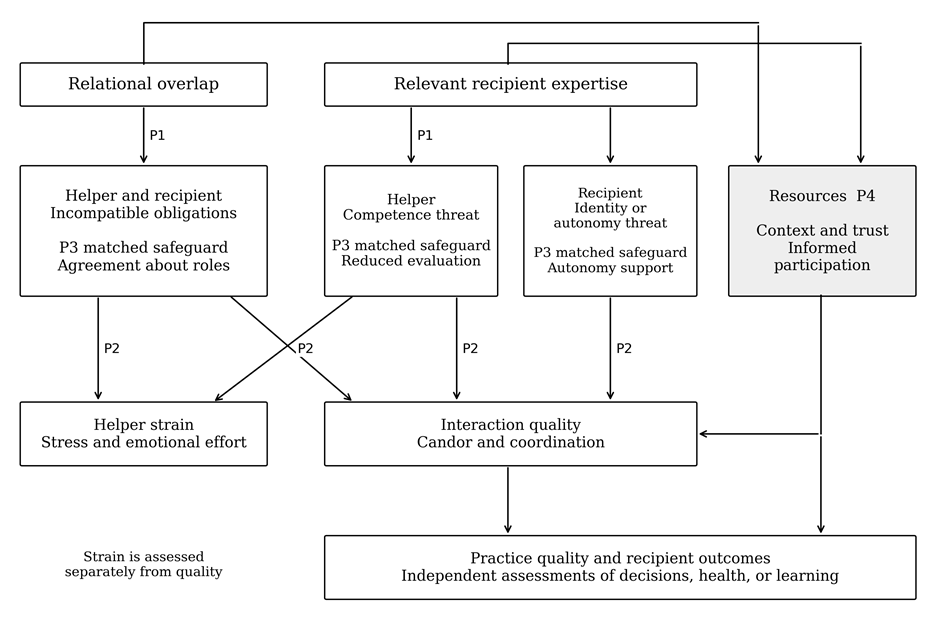
Note. P1 predicts relative antecedent effects; other cross-path effects remain possible. P2 concerns mediated effects through participant-specific demands. P3 lists the safeguard predicted to attenuate each matched antecedent-to-demand association; safeguards are interventions, not components of the demand. P4 adds resources that may improve interaction, practice, and recipient outcomes despite helper strain. Arrows represent hypotheses, not established causal effects. Consequences beyond the encounter may amplify demands. Reciprocal escalation is a further extension, omitted for clarity.
Figure 2
A Decision Sequence for Helping Across Roles
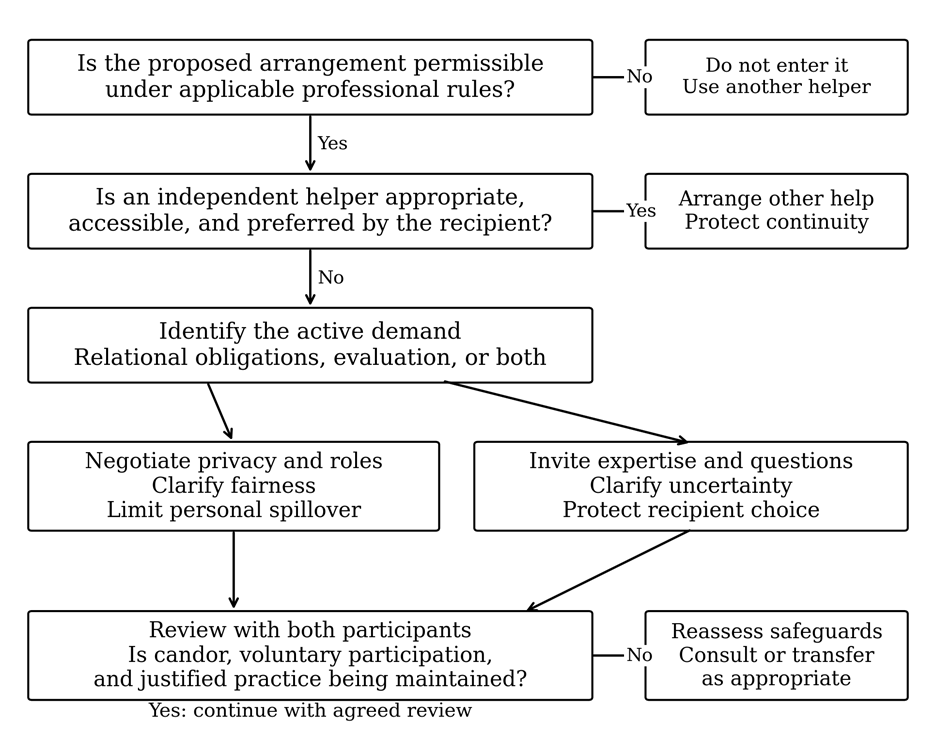
Note. This model-informed aid is not validated and does not replace professional rules, safeguarding duties, or clinical judgment. Shared professional status alone is not a dual relationship. Independent alternatives must be appropriate and accessible; emergency responsibilities and continuity of care remain relevant. Recipient disagreement should be assessed on its merits, not treated automatically as evidence of dysfunction.
References
Alfandre, D., Clever, S., Farber, N. J., Hughes, M. T., Redstone, P., & Lehmann, L. S. (2016). Caring for “very important patients”—Ethical dilemmas and suggestions for practical management. The American Journal of Medicine, 129(2), 143–147. https://doi.org/10.1016/j.amjmed.2015.09.019
Ashforth, B. E., Kreiner, G. E., & Fugate, M. (2000). All in a day’s work: Boundaries and micro role transitions. Academy of Management Review, 25(3), 472–491. https://doi.org/10.5465/amr.2000.3363315
Avinger, A. M., McClary, T., Dixon, M., & Pentz, R. D. (2022). Evaluation of standard-of-care practices among physicians who treat other physicians: A qualitative study. JAMA Network Open, 5(10), Article e2236914. https://doi.org/10.1001/jamanetworkopen.2022.36914
Beigel, F., Mertz, M., & Salloch, S. (2024). A systematic review documenting reasons whether physicians should provide treatment to their family and friends. Family Practice, 41(4), 395–403. https://doi.org/10.1093/fampra/cmac142
Bowen, M. (1978). Family therapy in clinical practice. Jason Aronson.
Clark, S. C. (2000). Work/family border theory: A new theory of work/family balance. Human Relations, 53(6), 747–770. https://doi.org/10.1177/0018726700536001
Deci, E. L., & Ryan, R. M. (2000). The “what” and “why” of goal pursuits: Human needs and the self-determination of behavior. Psychological Inquiry, 11(4), 227–268. https://doi.org/10.1207/S15327965PLI1104_01
Dickerson, S. S., & Kemeny, M. E. (2004). Acute stressors and cortisol responses: A theoretical integration and synthesis of laboratory research. Psychological Bulletin, 130(3), 355–391. https://doi.org/10.1037/0033-2909.130.3.355
Domeyer-Klenske, A., & Rosenbaum, M. (2012). When doctor becomes patient: Challenges and strategies in caring for physician-patients. Family Medicine, 44(7), 471–477. https://pubmed.ncbi.nlm.nih.gov/22791531/
Dyrbye, L. N., West, C. P., Sinsky, C. A., Goeders, L. E., Satele, D. V., & Shanafelt, T. D. (2017). Medical licensure questions and physician reluctance to seek care for mental health conditions. Mayo Clinic Proceedings, 92(10), 1486–1493. https://doi.org/10.1016/j.mayocp.2017.06.020
Gelso, C. J., & Hayes, J. A. (2007). Countertransference and the therapist’s inner experience: Perils and possibilities. Lawrence Erlbaum.
Greenhaus, J. H., & Beutell, N. J. (1985). Sources of conflict between work and family roles. Academy of Management Review, 10(1), 76–88. https://doi.org/10.5465/amr.1985.4277352
Gutheil, T. G., & Gabbard, G. O. (1993). The concept of boundaries in clinical practice: Theoretical and risk-management dimensions. American Journal of Psychiatry, 150(2), 188–196. https://doi.org/10.1176/ajp.150.2.188
Hayes, J. A., Gelso, C. J., Goldberg, S., & Kivlighan, D. M. (2018). Countertransference management and effective psychotherapy: Meta-analytic findings. Psychotherapy, 55(4), 496–507. https://doi.org/10.1037/pst0000189
Hogans-Mathews, S., Ghaffari, A., Welch, D., Bentze, N., Wongpaiboon, M., Eke, R., Birdsong, M., Nord, P., Kurian, L., Miller, E., Mouratidis, R., Shih, G., Harman, J., Petscher, Y., Rust, G., & Millender, E. F. (2026). Prevalence of mental health stigma, help-seeking behaviors, and barriers to seeking assistance: A CERA study of family physician educators. Family Medicine, 58(5), 347–353. https://doi.org/10.22454/FamMed.2026.106188
Jackson, J. L., Kuriyama, A., Whittle, J., Davis-Maxwell, A., Thompson, M., Murphy, M. G., Gondi, S., Brennan, K., Ganshert, C., & Fletcher, K. E. (2026). The prevalence and characteristics of difficult patient encounters: A systematic review and meta-analysis. Annals of Internal Medicine, 179(3), 382–393. https://doi.org/10.7326/ANNALS-25-01882
Johnson, E. M., & Rehavi, M. M. (2016). Physicians treating physicians: Information and incentives in childbirth. American Economic Journal: Economic Policy, 8(1), 115–141. https://doi.org/10.1257/pol.20140160
Kahn, R. L., Wolfe, D. M., Quinn, R. P., Snoek, J. D., & Rosenthal, R. A. (1964). Organizational stress: Studies in role conflict and ambiguity. Wiley.
Merton, R. K. (1957). The role-set: Problems in sociological theory. The British Journal of Sociology, 8(2), 106–120. https://doi.org/10.2307/587363
Mortsiefer, A., Zemke, A., Kalitzkus, V., Wilm, S., & Kersting, C. (2026). When physician parents treat their own children: A qualitative study. Deutsches Ärzteblatt International, 123(18), 512–513. https://doi.org/10.3238/arztebl.m2026.0094
Mutch, C., & McKnight, H. (2023). “I couldn’t do what I needed to do for my own family”: Teacher-parents during COVID-19 lockdowns. Social Sciences & Humanities Open, 7(1), Article 100401. https://doi.org/10.1016/j.ssaho.2023.100401
Nadler, A., & Fisher, J. D. (1986). The role of threat to self-esteem and perceived control in recipient reaction to help: Theory development and empirical validation. In L. Berkowitz (Ed.), Advances in experimental social psychology (Vol. 19, pp. 81–122). Academic Press. https://doi.org/10.1016/S0065-2601(08)60213-0
Parsons, T. (1951). The social system. Free Press.
Petrie, K., Gregory, M., Collins, D. A. J., Gayed, A., Sanatkar, S., Dean, K., Deady, M., & Harvey, S. B. (2025). A systematic review and meta-analysis of interventions to reduce or prevent symptoms of common mental disorders and suicidality in physicians. Nature Mental Health, 3, 838–851. https://doi.org/10.1038/s44220-025-00450-2
Pomerantz, E. M., Moorman, E. A., & Litwack, S. D. (2007). The how, whom, and why of parents’ involvement in children’s academic lives: More is not always better. Review of Educational Research, 77(3), 373–410. https://doi.org/10.3102/003465430305567
Schank, J. A., & Skovholt, T. M. (1997). Dual-relationship dilemmas of rural and small-community psychologists. Professional Psychology: Research and Practice, 28(1), 44–49. https://doi.org/10.1037/0735-7028.28.1.44
Stanton, J., & Randal, P. (2016). Developing a psychiatrist–patient relationship when both people are doctors: A qualitative study. BMJ Open, 6(5), Article e010216. https://doi.org/10.1136/bmjopen-2015-010216
Steindl, C., Jonas, E., Sittenthaler, S., Traut-Mattausch, E., & Greenberg, J. (2015). Understanding psychological reactance: New developments and findings. Zeitschrift für Psychologie, 223(4), 205–214. https://doi.org/10.1027/2151-2604/a000222
Weintraub, W. (1964). “The VIP syndrome”: A clinical study in hospital psychiatry. The Journal of Nervous and Mental Disease, 138(2), 181–193. https://doi.org/10.1097/00005053-196402000-00012
Zur, O. (2007). Boundaries in psychotherapy: Ethical and clinical explorations. American Psychological Association. https://doi.org/10.1037/11563-000