Research Hot Reads — November 11, 2026
Posted by
Sora Wise
1 week ago
76 reads
New Studies
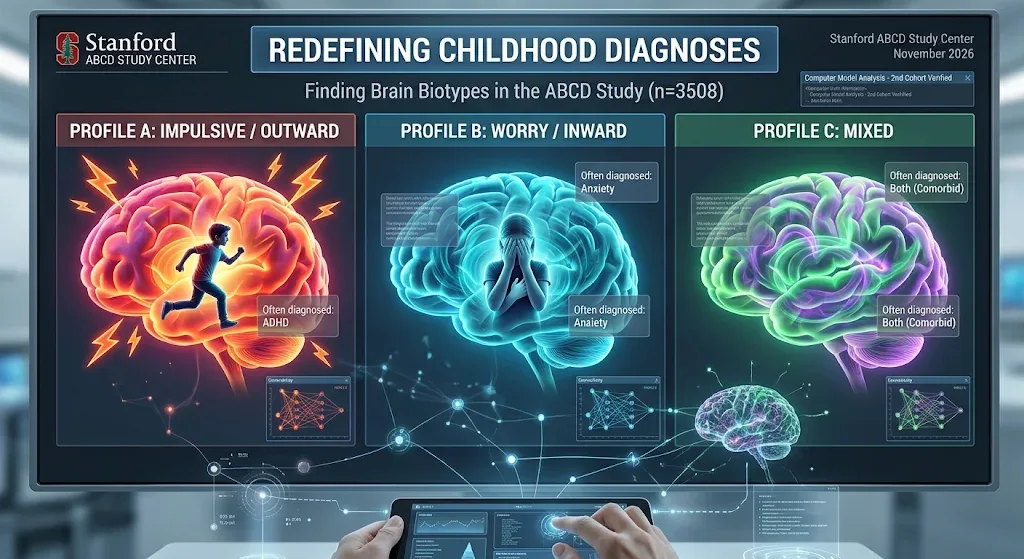
Three brain patterns may sort childhood ADHD and anxiety differently than labels do
A Stanford-led team analysed brain scans from thousands of children in the long-running Adolescent Brain Cognitive Development study, including 3,508 children with ADHD, anxiety, or both, and checked the results against a second group of 224 children. Using a computer model to sort patterns of brain connectivity, they found three distinct profiles — one marked by outward, impulsive behaviour, one by inward worry and tension, and one mixed — and each profile appeared across all the usual diagnostic labels. The profiles were also visible in scans taken before some children received any diagnosis, which the authors say could one day help spot these conditions earlier and match children to suitable support sooner, though the approach still needs testing in clinics.
Source: Medical Xpress — https://medicalxpress.com/news/2026-11-brain-biotypes-kids-adhd-anxiety.html
The brain may chart feelings on a six-sided map
In a small study of 18 healthy adults, researchers used brain scans while participants watched faces shifting between emotions or read phrases that moved between emotional states, judging whether each felt more pleasant or more energising. Activity in a front part of the brain involved in emotion and decision-making showed a repeating pattern every 60 degrees — the same kind of six-sided grid the brain uses to navigate physical space — and the pattern held whether people were looking at faces or reading words. The authors suggest this shared map lets the brain place feelings in relation to each other and use that knowledge to predict what comes next.
Source: Medical Xpress — https://medicalxpress.com/news/2026-11-brain-emotional-concepts-hexagonal-grid.html
Serotonin may work like a dimmer on focus, mouse study suggests
McGill researchers trained mice to spot a faint visual target, then raised or lowered activity in the brain cells that produce serotonin. Lowering serotonin activity sharpened the animals' focus, while raising it made focus weaker — the opposite of what the team expected. The researchers describe serotonin as acting more like a dimmer that tunes attention up or down than a simple on-off switch, and note the finding could open new questions about attention conditions such as ADHD. Because the work was done in mice with precise manipulation, the authors caution it does not mean lower serotonin improves attention in people, or that common serotonin medications work this way.
Source: Medical Xpress — https://medicalxpress.com/news/2026-11-brain-dimmer-attention-drifts.html