Abstract
Sudden lethal threat poses a distinctive scientific problem: some people act effectively despite intense fear, arousal, surprise, and severe time pressure, whereas others hesitate, freeze, or act ineffectively. Popular accounts often attribute this contrast to a rare capacity to remain calm. This article argues that such language conflates experiential, physiological, and functional composure and that the consequential outcome is functional composure: timely, goal-appropriate perception, decision, communication, and action under imminent high-consequence threat. It develops the Load–Capacity–Control (LCC) theory, restricted to acute threats that combine imminent serious harm, severe time pressure, uncertainty, and a meaningful opportunity for action. Effective responding is proposed to depend on the dynamic margin between stress-state capacity and effective load, conditional on control allocation and social/environmental scaffolds. The Rare Responder Hypothesis (RRH) is reformulated so that rarity is not defined by an arbitrary percentile: support requires converging evidence of low opportunity-adjusted prevalence, disproportionate concentration of effective actions, and reproducible person effects across materially different scenarios. LCC is specified as a multilevel variance-decomposition model that separates stable person propensity from scenario- and phase-specific capacity. The framework yields falsifiable propositions, operational measures for each construct, an opportunity-adjusted responder fraction with partial-identification bounds, repeated-scenario reliability requirements, and equivalence tests capable of supporting a situational account. The central claim is deliberately limited: rare effective action is observable, but whether it reflects rare people, rare circumstances, or their interaction remains an open empirical question.
Keywords: functional composure; rare responder hypothesis; acute stress; defensive behavior; challenge and threat; expertise; startle and surprise; social identity; aviation psychology
Public Significance Statement. After dramatic emergencies, observers often conclude that a few people have nerves of steel. This article argues that effective responders can be highly frightened and aroused yet still act well, and it sets out how to test whether unusually effective responders are a stable type of person or whether effective action mainly appears when training, position, information, role, and team support happen to line up.
Introduction
On September 30, 2026, flydubai Flight FZ1073, a Boeing 737 MAX 8 flying from Dubai toward Tel Aviv with 174 people aboard, suffered a severe in-flight emergency over Saudi Arabia. Reuters reporting based on flight-tracking data, passenger accounts, airline statements, and officials described a rapid descent of more than 14,000 feet, an injured captain, intervention by passengers and crew, and eventual control of the aircraft by other qualified pilots before an emergency landing in Tabuk (Reuters, 2026a, 2026b). The precise sequence, causal contribution of individual actions, and motive remained under investigation at the time of writing. The episode is used only as a motivating and methodological case; no psychological mechanism or trait is inferred from it.
The episode is interesting because people exposed to the same broad event diverged sharply. A few oriented, identified an actionable problem, coordinated, and acted; most were not reported to have acted. Public narratives compress this contrast into a dispositional story, and the same story runs through military thought. Clausewitz (1832/1976) treated presence of mind and strength of character as central to military genius, and later writers have described commanders and fighters whose composure under mortal danger seemed to set them apart (Keegan, 1987). The story contains three separable claims: that effective responders feel less fear, that their effectiveness reflects a stable personal quality rather than position, skill, role, or information, and that the quality is rare. None follows from the observation that only a few visible actors intervene in a single emergency.
This article therefore defines the Rare Responder Hypothesis (RRH) narrowly: among people with a meaningful opportunity to act during an abrupt life-threatening event, a small subset possesses a relatively stable propensity for effective action that generalizes across threat contexts. The RRH is a hypothesis, not a conclusion, and it is a reasonable one. Only a minority appear to act promptly and effectively in many emergencies (Leach, 2004); individual performance in many domains is heavy-tailed rather than normal (O’Boyle & Aguinis, 2012); and neuroendocrine markers differ between more and less effective performers in extreme-stress training (Morgan et al., 2000b, 2004; Van Cutsem et al., 2026). But no existing design can separate rare people from rare circumstances.
The article makes seven contributions. It (a) separates experiential, physiological, and functional composure; (b) defines the boundary conditions under which LCC is intended to apply; (c) shows what a prominent case can and cannot reveal, and why naive responder fractions are not prevalences; (d) replaces an arbitrary percentile definition of rarity with converging prevalence, concentration, and stability criteria; (e) integrates mechanisms across stress neuroscience, defensive behavior, psychophysiology, expertise, and collective action with explicit evidence grades; (f) specifies LCC as a multilevel variance-decomposition theory that distinguishes dynamic state capacity from stable person propensity and discriminates three rival accounts; and (g) provides operational measures, estimands, reliability arithmetic, and equivalence-testing criteria that make the RRH falsifiable in both directions.
Scope and Evidentiary Approach
This is a theory-building narrative synthesis, not a systematic review or meta-analysis, and its evidence grades (Table 2) reflect a narrative reading of the literature and should be subjected to formal review. Priority is given to meta-analyses, systematic reviews, influential mechanistic studies, and research in operational settings. Four distinctions guide interpretation: associations are not treated as selection-valid predictors without prospective incremental validity; physiological correlates of resilience are not assumed to be causal; performance in evaluative stress tasks is not assumed to generalize unchanged to lethal threat; and post hoc case narratives are treated as hypothesis generators, not prevalence evidence.
Boundary Conditions: What LCC Is and Is Not a Theory Of
LCC is intended for acute episodes in which (a) serious bodily harm or death is perceived as imminent or rapidly approaching, (b) the response window is short enough for stress-state constraints to matter, (c) uncertainty or surprise is substantial, and (d) at least one meaningful action is physically and informationally available. The theory is therefore narrower than a general theory of resilience, courage, leadership, or performance under pressure. It does not primarily explain chronic adversity, prolonged caregiving, routine occupational workload, anticipated examinations or competitions, post-event recovery, or situations in which no viable action exists.
The boundary also separates imminent-threat performance from strategic command under diffuse or extended uncertainty. Historical commanders and warriors can motivate hypotheses about composure, but their outcomes combine planning horizons, organizational resources, repeated exposure, authority, and retrospective selection. They should not be pooled empirically with cockpit, medical, firefighting, or civilian emergency responses unless the focal phase satisfies the acute-threat criteria above. This restriction protects LCC from becoming a catch-all account of performance under stress and makes its predictions more discriminating.
Defining Composure
Three levels
Experiential composure is low subjective fear or perceived loss of control. Physiological composure is low, contained, or rapidly recovering autonomic and neuroendocrine activation. Functional composure is preservation of goal-appropriate perception, decision, communication, and action despite acute threat. The levels can covary but are not interchangeable. Skilled performance under pressure often coexists with high anxiety and heart rate (Nieuwenhuys & Oudejans, 2012; Oudejans & Pijpers, 2009); challenge-type cardiovascular responses involve increased cardiac output rather than physiological quiet (Blascovich & Tomaka, 1996; Seery, 2011); and apparent stillness or detachment can reflect maladaptive defensive or dissociative states associated with worse functioning (Morgan et al., 2001; Ozer et al., 2003). Toughness accounts describe strong but efficient and rapidly recovering activation rather than blunted activation (Dienstbier, 1989).
Functional composure as the primary outcome
Functional composure is defined as the degree to which a person maintains or rapidly restores action appropriate to the dominant survival or rescue goal under imminent, high-consequence threat. It is not a moral category and need not imply heroism. Depending on the situation, the functionally composed response may be intervention, evacuation, concealment, procedure adherence, task shedding, or yielding control to a more qualified person. This definition avoids equating visible action with superior responding: a person who does not intervene may lack access, information, physical capability, or a viable action, and a very active person may worsen the situation. Effectiveness must therefore be scored against criteria fixed in advance by subject-matter experts, for example through cognitive task analysis (Crandall et al., 2006), and not against narrated outcomes.
What the FZ1073 Episode Can and Cannot Show
What the record supports
Table 1 summarizes the reported actions and the quality of evidence. Nearly all of it is self-report relayed through interviews and official statements. Sources also differ on basic quantities: the descent is reported as more than 14,000 feet in under 30 seconds in one account and about 17,000 feet in roughly two minutes in another; transponder-code times differ by about three minutes between outlets; and landing is placed between about 06:45 and 06:58 GMT (Al Jazeera Staff, 2026; The Jewish Chronicle, 2026). Flight-data and cockpit-voice records, held by investigators, are the authoritative sources.
Table 1. Reported actions in the FZ1073 episode and their evidential status
Actor | Reported action | Task structure | Evidence quality |
Captain | While seriously wounded, operated the door release | One motor act at a known location; 17 years’ experience | Captain’s own account; official statement |
Passengers (several) | Entered the cockpit, removed the attacker from the controls, restrained him | Physical restraint; no aircraft-specific knowledge required | Television interviews relayed by press |
One passenger | Returned to the cockpit and pulled on the controls until a pilot arrived | One-step schema, which he said he had learned from an air-crash documentary series | Self-report; causal contribution unestablished |
Dental professional | Controlled the captain’s bleeding | Trained first-aid skill in an unfamiliar setting | Interview relayed by press |
Pilot(s) travelling on board | Took control and landed at Tabuk | Professional procedural work under degraded conditions | Airline statement; passenger account |
Remaining passengers | No direct action reported | Unknown | Absence of report is not absence of contribution |
Why a responder fraction is not a prevalence
Dividing the number of passengers who reportedly acted (at least four) by the number aboard (174) yields roughly 2%, which seems to support the RRH. The ratio is uninterpretable as a prevalence for five reasons. Opportunity: the cockpit is at the front, and reports describe people thrown into the aisle and failure of cabin power, so physical capacity to act was unequally distributed independent of psychology. Information: passengers near the front heard a struggle; others had no cue that the cause was a fight. Adaptive inaction: remaining belted or protecting a child may be functionally appropriate but is not recorded as action. Reporting bias: the public record contains those who spoke, not silent contributors or ineffective actors. Chain structure: effective action depended on a sequence (door opened, attacker removed, controls held, pilot arrived), and a person who would have acted at a different link but lacked access to it is invisible.
The case also shows that effective response was distributed. Official statements credited different individuals, which illustrates the narrative pull toward a single hero. The case is compatible with all three accounts of rarity developed below, and it is retained for what it shows about the estimation problem.
Evaluating the Rarity Claim
Base rates and heavy tails
The common failure in emergencies is delay and inaction rather than frantic panic (Quarantelli, 1954; Clarke, 2002; Drury et al., 2009a, 2009b; Dezecache, 2015). Leach (2004) synthesized case reports into a frequently quoted partition in which roughly one in ten act promptly and rationally, most show impaired reasoning and delay, and a smaller group behave counterproductively. These are heuristic syntheses of heterogeneous case material, not population estimates, and they support the weak RRH (a minority) rather than the strong one (a few percent). Independently, individual output in many occupations follows heavy-tailed distributions in which a few individuals account for a disproportionate share (O’Boyle & Aguinis, 2012), which makes a thin right tail of effective responding plausible a priori, though not specific to lethal threat.
What would count as “rare”?
Rarity should not be defined by selecting an arbitrary upper percentile after observing the data. For the strong RRH, three distinct properties must converge. First, opportunity-adjusted prevalence must be low under a prespecified event class: only a minority of people with genuine access, adequate information, freedom of movement, and sufficient time perform the criterion action. Second, effective actions must be disproportionately concentrated among a comparatively small subset of people across repeated opportunities. Third, that concentration must reflect reproducible person effects across materially different scenarios rather than one scenario, one role, or one practiced response.
Accordingly, studies should preregister context-specific thresholds rather than assume that “rare” means 5%. Prevalence can be summarized with the opportunity-adjusted responder fraction; concentration can be summarized with Lorenz curves, concentration ratios, or a Gini-type index for effective actions; and stability can be summarized with person-level variance, intraclass correlation, and out-of-sample rank-order consistency. A trait-tail interpretation becomes persuasive only when all three point in the same direction. Low prevalence without stability is compatible with rare circumstances; stability without low prevalence describes individual differences but not rarity; and a heavy-tailed outcome distribution alone does not establish a rare psychological type.
Counter-evidence
Other evidence suggests that “rare” cannot be assumed when opportunity exists. A meta-analysis found that bystanders were more likely to intervene in dangerous than in non-dangerous emergencies, especially when the situation was clear and intervention required physical action (Fischer et al., 2011), and CCTV analyses of public conflicts across several countries found that at least one bystander intervened in the large majority of incidents (Philpot et al., 2020). Shared social identity strongly shapes who helps (Levine & Manning, 2013). These studies concern danger to others and seldom involve lethal threat to the helper, so they do not refute the RRH for abrupt self-involving threats, but they imply that apparent rarity may reflect opportunity and identity.
Warriors, commanders, and outcome-selected exemplars
The belief that a few individuals are unshaken by mortal danger has deep historical roots. Modern analogues point similarly: studies of bomb-disposal operators suggested that those regarded as most courageous were distinguished by how they managed fear and arousal, not by its absence (Cox et al., 1983; Rachman, 1990), and the air-combat literature is frequently cited for the observation that a small share of fighter pilots accounts for a large share of aerial victories (Spick, 1988). Four problems limit what exemplars can show. First, survivorship and outcome selection: those remembered are the ones who won and survived. Second, mediated sources: chronicles and biographies idealize composure as a literary and political virtue, and battle narratives are shaped by convention (Keegan, 1976). Third, confounding: a commander’s record reflects troops, logistics, intelligence, terrain, tactics, and chance, and the concentration of aerial victories is confounded by aircraft, opportunity, mentoring, and survival-dependent accumulation of opportunities; Collins (2008) argues that most people in violent confrontation are impaired by tension and fear and that the few who dominate do so through combined emotional control and situational advantage, which fits the hypothesis only partially. Fourth, cautionary history: the long-repeated claim that only a small fraction of soldiers fired their weapons in combat was later found to lack an empirical basis (Spiller, 1988), illustrating how a compelling “rare few” statistic can circulate without data. A commander’s composure under uncertainty and responsibility also differs from a fighter’s or cockpit crew member’s composure within imminent bodily threat; the two probably recruit different mechanisms and should not be pooled.
Mechanisms That Preserve or Disrupt Effective Action
Table 2. Evidence grading of mechanisms
Mechanism | Principal evidence | Limits | Grade |
Acute stress shifts control from prefrontal to salience and habit systems | Catecholamine and network work; meta-analyses | Mostly low-consequence laboratory stressors | Robust |
Defensive-mode selection and flexible transition from freezing to action | Human imaging and defense-cascade research | Few studies of real lethal threat | Moderate |
Challenge (vs. threat) appraisal predicts performance | Meta-analyses of challenge–threat | Small average effects; evaluative stressors | Moderate |
Arousal reappraisal and stress-mindset interventions help performance | Meta-analysis of randomized trials | Small effect; heterogeneous; transfer untested | Moderate (limited transfer) |
Vagal flexibility supports self-regulation | Meta-analyses of HRV and self-control | Correlational; measurement confounds; small effects | Moderate |
Neuroendocrine profile (NPY, DHEA-S, cortisol) differentiates performance | Survival-training cohorts; systematic review of military biomarkers | Small, selected, male samples; peripheral measures; no selection validity | Preliminary–Moderate |
Expertise and available schemas reduce effective load | Naturalistic decision making; skill acquisition | Benefits limited to practiced patterns; choking and surprise effects | Robust (with boundaries) |
Team, procedural, and social-identity scaffolds | Crew resource management; collective-behavior research | Observational designs | Moderate |
Stress reconfigures cognitive control
Acute uncontrollable stress degrades prefrontal functions that support working memory and flexible rule use, while catecholaminergic signaling strengthens salience and habit systems (Arnsten, 1998, 2009; Hermans et al., 2011, 2014). Meta-analytic evidence shows reliable impairment of working memory and cognitive flexibility, with more heterogeneous effects on inhibition (Shields et al., 2016), and a shift toward habitual decision strategies (Starcke & Brand, 2012). Glucocorticoids have suppressive and preparative actions, so cortisol is not simply harmful (Sapolsky et al., 2000; Joëls et al., 2006). Stress therefore changes which forms of control are available: actions that are simple, recognized, overlearned, externally cued, or schema-chunked place little demand on working memory, whereas novel multi-step reasoning becomes disproportionately fragile (Eysenck et al., 2007; Hockey, 1997).
Defensive mode and perceived controllability
Defensive responding is organized by threat imminence and perceived control (Fanselow, 1994; Mobbs et al., 2007, 2009). Freezing has adaptive forms, such as brief, attentive, bradycardic freezing that supports sensory sampling and action preparation (Roelofs, 2017; Hagenaars et al., 2014; Gladwin et al., 2016), and maladaptive forms, such as tonic immobility under inescapable threat (Bracha, 2004; Kozlowska et al., 2015). The critical property is flexible transition from information gathering to action once an effective response is available. Perceived controllability, action affordances, trained repertoires, and social cues plausibly determine whether defensive arousal becomes organized action or prolonged inhibition.
Appraisal and regulation
The biopsychosocial model proposes that performance depends partly on appraised demands relative to resources (Blascovich & Tomaka, 1996; Seery, 2013). An updated review and meta-analysis found that challenge states were associated with better performance than threat states across domains such as education and sport (Hase et al., 2025), with average effects small and the underlying studies not models of lethal threat. Reframing arousal as functional improved cardiovascular and performance outcomes in evaluative settings (Jamieson et al., 2010, 2012), and a meta-analysis of randomized trials found a small overall performance benefit of arousal-reappraisal and stress-is-enhancing interventions, with substantial heterogeneity (Bosshard & Gomez, 2024). Reappraisal is generally more adaptive than suppression (Gross, 1998; Gross & John, 2003; Webb et al., 2012), but people shift to distraction when emotional intensity is high (Sheppes et al., 2011) and stress hormones impair deliberate reappraisal (Raio et al., 2013). In the first seconds of an abrupt threat, schemas, attentional orientation, and action readiness are therefore more plausible determinants than verbal reappraisal.
Physiological flexibility, not simple low arousal
Neurovisceral integration models link cardiac vagal regulation with neural systems for executive and affective control (Thayer & Lane, 2000, 2009). Meta-analyses report small positive associations between heart-rate variability and top-down self-regulation (Holzman & Bridgett, 2017; Zahn et al., 2016), with heritability that is moderate (Singh et al., 1999; Wang et al., 2009) and measurement caveats that are substantial (Grossman & Taylor, 2007; Laborde et al., 2017). In military survival-training cohorts, Special Forces personnel showed higher neuropeptide Y responses, and higher NPY and DHEA-S relative to cortisol were associated with better performance and fewer dissociative symptoms (Morgan et al., 2000a, 2000b, 2001, 2004), but samples were small, male, and highly selected, and peripheral NPY is a distal proxy for central signaling. A 2026 systematic review of 40 studies concluded that neuroendocrine and related circulating markers may offer a window into performance resilience, especially when reactivity and recovery are considered together (Van Cutsem et al., 2026). Cortisol findings are heterogeneous: a stronger cortisol response to an experimental stressor predicted more resilient trajectories in one longitudinal police study (Galatzer-Levy et al., 2014), and reactivity depends on sex, age, and task features (Kudielka et al., 2009). The defensible inference is that adaptive regulation involves sufficiently mobilized but controlled activation with efficient recovery; no single biomarker identifies a rare-responder phenotype.
Expertise and schemas
Recognition-primed decision making shows that experienced actors recognize a situation as a familiar pattern, retrieve a workable action, and mentally simulate it, imposing little working-memory load (Klein et al., 1986; Klein, 1993). Intuitive expertise is reliable only in environments with valid cues and opportunities to learn them (Kahneman & Klein, 2009). Training has two functions: improving execution and improving recognition of when a procedure applies. Predictable training can yield competent execution of rehearsed abnormalities while recognition and diagnosis stay fragile when the same problem arises unexpectedly (Casner et al., 2013), and startle and surprise disrupt sensemaking even in trained pilots (Landman et al., 2017). Expertise is not invulnerability: pressure can disrupt proceduralized skill (Baumeister, 1984; Beilock & Carr, 2001), although training with anxiety improves later performance under pressure (Oudejans & Pijpers, 2009). FZ1073 suggests that knowledge acquired informally can be sufficient when the required act is a single step with a high-validity cue, whereas sustained flying required professional expertise: expertise has a graded, not binary, role.
Social and environmental scaffolds
Crew resource management converts individual capacities into system-level resilience through communication norms, distributed monitoring, and role clarity (Helmreich et al., 1999). Studies of emergency survivors document solidarity and shared identity, not simple panic (Drury et al., 2009a, 2009b), and social identity shapes whether others are treated as in-group and helped (Levine & Manning, 2013). Effective response can therefore be distributed: one person detects, another communicates, another creates access, another performs the technical act. Analyses that assign the outcome to the final visible actor risk mistaking a team process for an individual trait.
The Load–Capacity–Control Framework
Variables
Effective load (L) is the real-time cognitive, perceptual, and motor demand of the required action in a particular scenario and phase. It rises with novelty, uncertainty, time pressure, competing goals, injury, sensory degradation, and sequential subtasks, and falls with proceduralization, clear affordances, valid cues, automation, and task sharing. Stress-state capacity (C) is the usable cognitive and attentional capacity available to a particular person in a particular scenario and phase, not the person’s unstressed maximum or a fixed trait; it can change over seconds or minutes with arousal dynamics, fatigue, sleep loss, pain, injury, and regulatory flexibility. Control allocation (K) is how that available capacity is deployed: orienting to diagnostic cues, switching from monitoring to action, inhibiting an inappropriate dominant response, choosing satisficing strategies, and recruiting help. Scaffolds and access (S) are external resources and constraints that alter demands or action possibilities: other people, procedures, equipment, interface design, physical position, information, authority, and communication channels. Access belongs in S because a person who cannot reach or identify the point of action has effectively zero opportunity regardless of disposition.
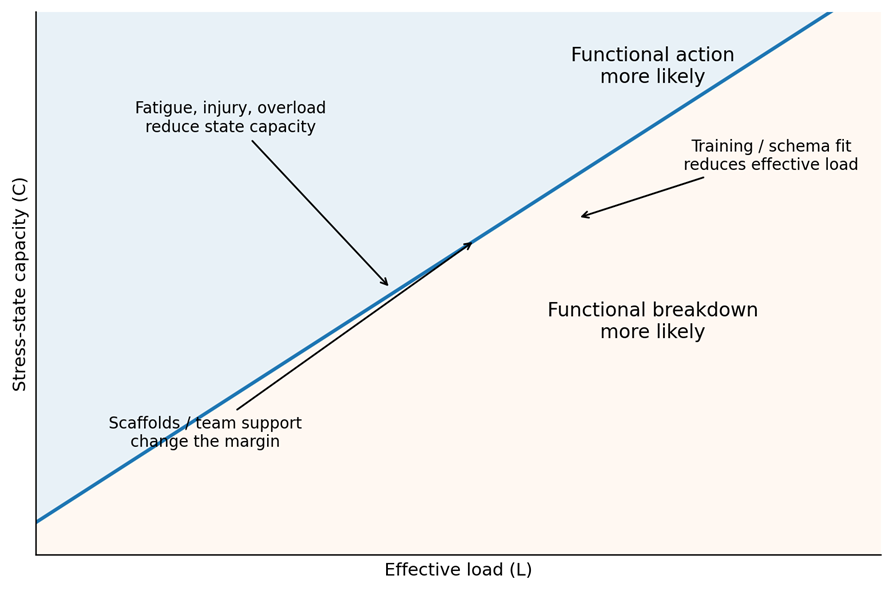
Figure 1. Conceptual LCC margin. Functional action becomes less likely when effective load approaches or exceeds momentary stress-state capacity. Training, schema fit, and scaffolds can change the margin without requiring a change in a stable personal trait. The boundary is conceptual, not an estimated universal function.
Table 5. Operationalization of the LCC constructs and outcome
Construct | Operational definition | Candidate indicators | Temporal level | Key confounds / controls |
Functional composure (E) | Goal-appropriate action relative to a task criterion fixed before outcome is known | Critical-action latency; accuracy; error detection/recovery; prioritization; communication; expert ratings | Phase and scenario | Opportunity; role; physical capability; outcome knowledge; rater expectancy |
Effective load (L) | Demand imposed by the required action after accounting for task structure and available proceduralization | Number of subtasks; branching; novelty; ambiguity; time pressure; dual-task burden; cue validity | Scenario × phase | Expertise; automation; interface design; task familiarity |
Stress-state capacity (C) | Momentary usable cognitive/attentional capacity under acute threat | Working-memory probes where feasible; attention-control indices; response variability; physiological state/recovery indices | Person × scenario × phase | Baseline ability; sleep; fatigue; pain; medication; injury; respiration in HRV measures |
Control allocation (K) | Deployment of available capacity toward diagnostically useful cues and viable actions | Orienting latency; gaze allocation; switching; inhibition errors; help-seeking; task shedding | Person × scenario × phase | Cue salience; role instructions; prior rehearsal |
Scaffolds/access (S) | External resources and constraints that alter opportunity or effective demand | Physical access; information; checklist/automation; teammate availability; role clarity; communication channels | Scenario × person | Seat/position; authority; equipment availability; team composition |
Stable person propensity (uᵢ) | Residual cross-scenario tendency toward effective action after measured state and situation terms are modeled | Empirical Bayes/random-effect estimate; cross-scenario rank consistency | Person | Training history; repeated exposure; general ability; selection into occupation |
Structural and statistical forms
At the theoretical level, effective action for person i in scenario j during phase t is a threshold-crossing of a dynamic latent margin:
Mᵢⱼₜ = Cᵢⱼₜ − Lⱼₜ + Kᵢⱼₜ + Sᵢⱼₜ, with Pr(Eᵢⱼₜ = 1) = Φ[(Mᵢⱼₜ − τ)/σ].
The margin captures a nonlinear threshold idea: failure risk rises sharply as effective load approaches usable capacity, and the terms can compensate for one another within limits. Crucially, C is indexed by person, scenario, and phase because it is a state quantity. Stable individual differences are not smuggled into C; they are estimated separately in the statistical model. Because C, K, L, and S are imperfectly observed, empirical tests require measured indicators and experimental manipulation rather than literal estimation of each latent term from a single event.
logit Pr(Eᵢⱼₜ = 1) = α + xᵢⱼₜ′β + uᵢ + θᵢLⱼₜ + vⱼ + qₜ + wᵢⱼ,
where x contains measured state and situational indicators (including proxies for C, K, L, and S), uᵢ is a stable person-specific propensity after those measured factors are controlled, θᵢ is a person-specific sensitivity to load, vⱼ is a scenario effect, qₜ is a phase effect, and wᵢⱼ captures person-by-scenario specificity (Brennan, 2001; Bates et al., 2015). The identification logic is therefore explicit: repeated scenarios and experimental variation in L and S are needed to distinguish stable person propensity from momentary capacity and circumstance. The strong RRH requires non-negligible, replicable uᵢ variance plus evidence that opportunity-adjusted success is both uncommon and concentrated across repeated opportunities. No universal top-5% cutoff is assumed. The situational account predicts that measured situational terms, vⱼ, and wᵢⱼ absorb most apparent person differences; the compensatory account predicts modest uᵢ variance plus non-zero var(θᵢ), such that person differences become more consequential as load rises.
How LCC differs from earlier models
Table 3. Relation of the LCC framework to earlier accounts
Model | Core idea | What LCC adds |
Arousal–performance laws (Yerkes & Dodson, 1908; Easterbrook, 1959) | Performance is an inverted-U function of arousal; attention narrows | Replaces a single arousal axis with a load–capacity margin; arousal is neither necessary nor sufficient (Hanoch & Vitouch, 2004) |
Attentional control and processing efficiency (Eysenck & Calvo, 1992; Eysenck et al., 2007) | Anxiety taxes inhibition and shifting; effort can compensate | Adds action complexity, schema fit, access, and scaffolds as determinants of whether compensation is possible |
Compensatory control (Hockey, 1997) | Performers protect primary tasks at a cost | Specifies observable load and access manipulations and treats person variance as an estimand |
Dynamic adaptability under stress (Hancock & Warm, 1989) | Adaptation degrades gracefully, then collapses at extremes | Adds phase structure and the question of who sits where on the margin |
Challenge–threat (Blascovich & Tomaka, 1996) | Appraised resources versus demands | Adds objective load and access, and distinguishes appraisal from capacity |
Neurovisceral integration (Thayer & Lane, 2000) | Vagal regulation indexes prefrontal control | Treats vagal flexibility as one input to C, not a trait of rare responding |
Recognition-primed decision (Klein, 1993) | Experts match patterns and simulate | Extends to lay schemas of partial depth and to novelty |
Three accounts of apparent rarity
Table 4. Rival accounts of apparent rarity
Account | Core claim | Discriminating prediction | Evidence against |
Trait tail | A stable latent propensity concentrated in a thin right tail | ui variance replicates across dissimilar scenarios after opportunity, training, and role are controlled; tail concentration is high | Person variance indistinguishable from zero (equivalence test) |
Situational capture | Capacity is broadly similar; visible responders are those whose position, information, schema, or role fits | Responder fractions change sharply with access and schema availability; person variance small | Large reproducible person effects across dissimilar scenarios |
Compensatory person × situation | Stable differences exist but training, load reduction, access, and teams can substitute or amplify | Modest ui plus non-zero var(θi); person effects increase with novelty and load | Almost purely stable or almost purely situational variance |
Propositions
Table 6. Propositions of the LCC framework
# | Proposition | Example test | Disconfirming result |
P1 | Composure dissociation. Fear, physiological activation, and functional performance correspond only partially; some top performers report substantial fear and marked arousal. | Simulation with continuous cardiac data, impedance cardiography, self-reported fear, and blinded performance coding | Performance rises monotonically as fear and arousal fall, with no challenge-pattern advantage |
P2 | Capacity–load threshold. Performance decrements accelerate as effective load approaches stress-state capacity. | Graded load manipulation; nonlinear fits | A simple linear stress–performance slope fits as well |
P3 | Schema fit. For simple, familiar, strongly cued actions, access explains more variance and person differences shrink; person effects grow with novelty and multi-step integration. | Randomized one-step versus multi-step required actions | Person variance equal across action complexity |
P4 | Phase specificity. Early performance depends on orienting, recognition, and practiced repertoires; reflective control predicts later performance. | Time-resolved coding; phase-specific instruction | Reappraisal training improves phase 1 as much as later phases |
P5 | Flexible defensive transition. Brief freezing does not predict failure; prolonged failure to transition after a viable response appears does. | Heart-rate deceleration, sway, and response latency | No difference in downstream action latency |
P6 | Cross-scenario stability. A rare-responder trait is supported only if person effects generalize across materially different threat scenarios after training, role, access, and prior exposure are controlled. | Repeated varied scenarios; crossed random-effects models | Equivalence to a negligible person variance |
P7 | Distributed resilience. Team composition, shared identity, communication structure, and role clarity explain substantial variance beyond individual physiology. | Multilevel models of crews and groups | Team terms explain negligible variance |
P8 | Trainability. Surprise training, pressure exposure, schema development, and team rehearsal improve functional composure mainly by reducing L and improving K and S; biomarker-only selection adds little incremental prediction unless prospectively validated. | Randomized training trials; incremental-validity analyses | Biomarkers outperform training exposure out of sample |
P9 | Opportunity-adjusted rarity. Estimated prevalence of effective responders is higher when the denominator is restricted to people with real access, information, and freedom of action. | Opportunity-coded event reconstructions | Low prevalence occurs without cross-scenario concentration or stable person effects |
Estimands and Research Program
Opportunity-adjusted responder fraction
The first target estimand is the proportion of people who had credible opportunity (physical access, adequate information, freedom of movement, and sufficient time) to perform a defined effective action and who then did so: EAF = A/Nopp. Because opportunity is rarely observed completely, EAF is only partially identified. Following partial-identification logic (Manski, 2003), a lower bound counts documented effective actors over all people present, whereas an upper bound depends on explicit assumptions about cases with uncertain opportunity. Reporting bounds and sensitivity analyses is more informative than a point estimate. Event reconstruction should code access, line of sight, information state, mobility, role restrictions, prior knowledge, and time available, using video, voice recordings, seat maps, sensor logs, and structured interviews with blinded coders. Wilson intervals are preferred for simple proportions (Brown et al., 2001; Wilson, 1927). For a proportion near .05, a 95% interval half-width of 1.5 percentage points requires roughly 800 people with opportunity and 1 point roughly 1,800; natural events rarely provide such denominators, so archival work must be combined with controlled studies (Flanagan, 1954).
A strong rarity claim additionally requires a concentration estimand across repeated opportunities. Researchers should report the share of effective actions attributable to prespecified quantiles of the person-effect distribution and a concentration curve or Gini-type index, with uncertainty obtained by bootstrap or hierarchical posterior intervals. These quantities answer a different question from EAF: EAF asks how common effective action is when opportunity exists; concentration asks whether effective action repeatedly accrues to the same small subset of people. Both are needed before the label rare responder is warranted.
Repeated-scenario designs and the reliability arithmetic
The strongest test of the RRH exposes the same participants to multiple high-fidelity scenarios that vary in threat modality, novelty, action complexity, role clarity, and social structure, with blinded performance coding. The arithmetic matters. If the single-scenario intraclass correlation (the share of variance due to stable person differences; Shrout & Fleiss, 1979) is .15, the reliability of a person’s mean over k scenarios is k(.15)/[1 + (k − 1)(.15)], which equals about .51 for six scenarios and about .70 for thirteen. Individual “responder scores” therefore require many scenarios, which is rarely feasible. The practical implication is to estimate variance components (is there stable person variance, and how much?) rather than to classify individuals, and to treat any individual-level classification as a later step requiring out-of-sample validation. With N persons and k scenarios, the standard error of an ICC near .15 is approximately .02 for N = 300 and k = 6, and approximately .03 for N = 300 and k = 4 (using the balanced one-way approximation), so person-count, not scenario-count, dominates precision for variance components; preregistered simulation-based power analyses should refine these figures.
Equivalence testing
Most published designs can only fail to reject the null of no person effect. The RRH is falsifiable in both directions only if a smallest effect size of interest is specified in advance (for example, a person-level variance share of .05) and an equivalence test is used to support a negligible person effect when the interval falls inside the bounds (Lakens, 2017; Lakens et al., 2018). Such a result would favor situational capture; a lower bound above the threshold with tail concentration would favor a trait tail.
Manipulating load and scaffolds
LCC makes situational variables experimentally tractable. Researchers can randomize one-step versus multi-step actions, explicit versus ambiguous cues, solo versus team response, checklist availability, role assignment, and prior schema training. If a supposedly rare capacity becomes common when load is reduced or scaffolds improve, rarity was partly engineered by the environment. This is theoretically decisive.
Prospective cohorts and interventions
Military, emergency medicine, firefighting, law enforcement, and aviation training offer ethically accessible settings to observe consequential performance prospectively. Studies should oversample women and other groups under-represented in older military resilience work, measure sleep and fatigue, distinguish selection from training effects, and test biomarker panels for incremental validity beyond experience, ability, fitness, sleep, and performance history. Interventions should be evaluated against mechanisms: pressure exposure and anxiety-compatible practice (Oudejans & Pijpers, 2009; Low et al., 2021), surprise-based training (Casner et al., 2013; Landman et al., 2017), stress exposure and inoculation (Saunders et al., 1996; Driskell et al., 2001), and arousal reappraisal (Jamieson et al., 2012; Bosshard & Gomez, 2024), with transfer to lethal-threat simulations tested, not assumed.
Ethics and transparency
Immersive threat paradigms raise concerns about induced distress, deception, and debriefing that require careful review. Physiological and performance data from professionals carry risks of employment misuse. All studies should be preregistered with analysis plans that prevent biomarker fishing (Nosek et al., 2018), with materials and code shared.
Measurement and Construct Validation
A science of functional composure needs stronger measurement than retrospective labels such as “calm” or “heroic.” Table 5 provides a minimum operationalization scheme. Primary outcomes should include critical-action latency and accuracy, error detection and recovery, communication quality, task shedding, prioritization, and expert global ratings with demonstrated inter-rater reliability. Subjective fear and perceived control should be measured separately. Convergent relations among behaviorally grounded indices should be established while preserving discriminant validity from subjective calmness, sensation seeking, trait anxiety, resilience questionnaires, and general ability; resilience scales in particular index adaptation or recovery more than intra-event function. Criterion contamination is a major risk, since raters who know who “saved the day” may retrospectively score that person as calmer or more decisive; blinding is essential. Measurement should be phase-specific: orienting and anomaly detection, goal selection, execution and communication, and monitoring and recovery. A person can perform well in one phase and poorly in another, which may reveal that composure is not unitary and that training targets different failure points.
Practical Implications
The framework shifts emphasis from finding fearless people to designing conditions in which more people can function effectively. In public settings, clear affordances, accessible emergency equipment, concise instructions, and role cues can reduce L and increase S. In professional settings, training should include unexpected onset, incomplete information, competing tasks, and realistic pressure, not only predictable procedure execution, and team systems should distribute sensing, decision, and action so that one person’s temporary capacity loss does not become system failure. The framework also counsels restraint in selection: stable individual differences may exist, but current evidence does not support selecting people on the basis of a single stress task, a single biomarker, or observers’ impressions of calm. For public communication, describing effective responders as people who acted despite fear and within enabling structures is more accurate, and more imitable, than a story of innate calm.
Limitations
This is a conceptual synthesis, not a systematic review, and the evidence grades should be tested in formal evidence syntheses. Most experimental stress research uses social-evaluative, cognitive, or performance stressors rather than imminent lethal threat, so transfer is an empirical question rather than an assumption. Operational cohorts are highly selected, and some candidate mechanisms, especially biomarkers, have small and heterogeneous literatures. The FZ1073 case analysis rests on early public reporting during an ongoing investigation and is illustrative rather than evidentiary. Functional composure is culturally and normatively contextual, and LCC presently emphasizes individual and small-group action even though infrastructure and organizational safety culture can alter the same balance at larger scales. The theory is deliberately bounded to acute imminent threats with a meaningful action opportunity; evidence from chronic adversity, post-event resilience, or strategic leadership should not be treated as direct tests. Finally, the LCC equations are identification scaffolds, not claims that all processes are additive, directly observed, or governed by a universal threshold.
Conclusion
Some people plainly perform unusually well in acute, high-consequence emergencies, and the belief that a rare few do so because of an exceptional psychological quality is plausible enough to deserve a stringent test. The language of “staying calm” obscures the scientific problem because effective responders may be frightened, physiologically activated, and dependent on training and other people. The strong Rare Responder Hypothesis should survive only if three forms of evidence converge: effective action is uncommon among those with genuine opportunity, effective actions are disproportionately concentrated among a small subset across repeated opportunities, and stable person effects generalize across materially different threats after momentary capacity, role, training, information, and scaffolds are modeled. If these criteria are met, the field will have evidence for a genuine rare-responder disposition. If stable person effects are demonstrably negligible or concentration dissolves after opportunity is modeled, the stronger conclusion will be that apparently exceptional behavior is largely produced by ordinary capacity matched to the right schemas, access, team structure, and environmental support. Either result would advance the science more than the untested claim that some people simply have nerves of steel.
References
Al Jazeera Staff. (2026, October 2). 12 minutes of madness: How Flydubai pilot, passengers saved plane midfall. Al Jazeera. https://www.aljazeera.com/news/2026/10/2/12-minutes-of-madness-how-flydubai-pilot-passengers-saved-plane-midfall
Al Jazeera, & Reuters. (2026, September 30). Netanyahu calls stabbed Indian pilot a hero; Flydubai halts Israel flights. Al Jazeera. https://www.aljazeera.com/news/2026/9/30/netanyahu-praises-indian-pilot-for-saving-lives-on-flydubai-flight
Arnsten, A. F. T. (1998). The biology of being frazzled. Science, 280(5370), 1711–1712.
Arnsten, A. F. T. (2009). Stress signalling pathways that impair prefrontal cortex structure and function. Nature Reviews Neuroscience, 10(6), 410–422.
Bates, D., Mächler, M., Bolker, B., & Walker, S. (2015). Fitting linear mixed-effects models using lme4. Journal of Statistical Software, 67(1), 1–48.
Baumeister, R. F. (1984). Choking under pressure: Self-consciousness and paradoxical effects of incentives on skillful performance. Journal of Personality and Social Psychology, 46(3), 610–620.
Beilock, S. L., & Carr, T. H. (2001). On the fragility of skilled performance: What governs choking under pressure? Journal of Experimental Psychology: General, 130(4), 701–725.
Blascovich, J., & Tomaka, J. (1996). The biopsychosocial model of arousal regulation. Advances in Experimental Social Psychology, 28, 1–51.
Bosshard, M., & Gomez, P. (2024). Effectiveness of stress arousal reappraisal and stress-is-enhancing mindset interventions on task performance outcomes: A meta-analysis of randomized controlled trials. Scientific Reports, 14, Article 7923. https://doi.org/10.1038/s41598-024-58408-w
Bracha, H. S. (2004). Freeze, flight, fight, fright, faint: Adaptationist perspectives on the acute stress response spectrum. CNS Spectrums, 9(9), 679–685.
Brennan, R. L. (2001). Generalizability theory. Springer.
Brown, L. D., Cai, T. T., & DasGupta, A. (2001). Interval estimation for a binomial proportion. Statistical Science, 16(2), 101–133.
Casner, S. M., Geven, R. W., & Williams, K. T. (2013). The effectiveness of airline pilot training for abnormal events. Human Factors, 55(3), 477–485.
Clarke, L. (2002). Panic: Myth or reality? Contexts, 1(3), 21–26.
Clausewitz, C. von. (1976). On war (M. Howard & P. Paret, Eds. & Trans.). Princeton University Press. (Original work published 1832)
Collins, R. (2008). Violence: A micro-sociological theory. Princeton University Press.
Cox, D., Hallam, R., O’Connor, K., & Rachman, S. (1983). An experimental analysis of fearlessness and courage. British Journal of Psychology, 74(1), 107–117.
Crandall, B., Klein, G., & Hoffman, R. R. (2006). Working minds: A practitioner’s guide to cognitive task analysis. MIT Press.
Dezecache, G. (2015). Human collective reactions to threat. Wiley Interdisciplinary Reviews: Cognitive Science, 6(3), 209–219.
Dienstbier, R. A. (1989). Arousal and physiological toughness: Implications for mental and physical health. Psychological Review, 96(1), 84–100.
Driskell, J. E., Johnston, J. H., & Salas, E. (2001). Does stress training generalize to novel settings? Human Factors, 43(1), 99–110.
Drury, J., Cocking, C., & Reicher, S. (2009a). Everyone for themselves? A comparative study of crowd solidarity among emergency survivors. British Journal of Social Psychology, 48(3), 487–506.
Drury, J., Cocking, C., & Reicher, S. (2009b). The nature of collective resilience: Survivor reactions to the 2005 London bombings. International Journal of Mass Emergencies and Disasters, 27(1), 66–95.
Easterbrook, J. A. (1959). The effect of emotion on cue utilization and the organization of behavior. Psychological Review, 66(3), 183–201.
Eysenck, M. W., & Calvo, M. G. (1992). Anxiety and performance: The processing efficiency theory. Cognition and Emotion, 6(6), 409–434.
Eysenck, M. W., Derakshan, N., Santos, R., & Calvo, M. G. (2007). Anxiety and cognitive performance: Attentional control theory. Emotion, 7(2), 336–353.
Fanselow, M. S. (1994). Neural organization of the defensive behavior system responsible for fear. Psychonomic Bulletin & Review, 1(4), 429–438.
Fischer, P., Krueger, J. I., Greitemeyer, T., Vogrincic, C., Kastenmüller, A., Frey, D., Heene, M., Wicher, M., & Kainbacher, M. (2011). The bystander-effect: A meta-analytic review on bystander intervention in dangerous and non-dangerous emergencies. Psychological Bulletin, 137(4), 517–537.
Flanagan, J. C. (1954). The critical incident technique. Psychological Bulletin, 51(4), 327–358.
Galatzer-Levy, I. R., Steenkamp, M. M., Brown, A. D., Qian, M., Inslicht, S., Henn-Haase, C., Otte, C., Yehuda, R., Neylan, T. C., & Marmar, C. R. (2014). Cortisol response to an experimental stress paradigm prospectively predicts long-term distress and resilience trajectories in response to active police service. Journal of Psychiatric Research, 56, 36–42.
Gladwin, T. E., Hashemi, M. M., van Ast, V., & Roelofs, K. (2016). Ready and waiting: Freezing as active action preparation under threat. Neuroscience Letters, 619, 182–188.
Gross, J. J. (1998). The emerging field of emotion regulation: An integrative review. Review of General Psychology, 2(3), 271–299.
Gross, J. J., & John, O. P. (2003). Individual differences in two emotion regulation processes: Implications for affect, relationships, and well-being. Journal of Personality and Social Psychology, 85(2), 348–362.
Grossman, P., & Taylor, E. W. (2007). Toward understanding respiratory sinus arrhythmia: Relations to cardiac vagal tone, evolution and biobehavioral functions. Biological Psychology, 74(2), 263–285.
Hagenaars, M. A., Oitzl, M., & Roelofs, K. (2014). Updating freeze: Aligning animal and human research. Neuroscience & Biobehavioral Reviews, 47, 165–176.
Hancock, P. A., & Warm, J. S. (1989). A dynamic model of stress and sustained attention. Human Factors, 31(5), 519–537.
Hanoch, Y., & Vitouch, O. (2004). When less is more: Information, emotional arousal and the ecological reframing of the Yerkes–Dodson law. Theory & Psychology, 14(4), 427–452.
Hase, A., Nietschke, M., Kłoskowski, M., Szymański, K., Moore, L., Jamieson, J. P., & Behnke, M. (2025). The effects of challenge and threat states on performance outcomes: An updated review and meta-analysis of recent findings. EXCLI Journal, 24, 151–176. https://doi.org/10.17179/excli2024-7995
Helmreich, R. L., Merritt, A. C., & Wilhelm, J. A. (1999). The evolution of crew resource management training in commercial aviation. International Journal of Aviation Psychology, 9(1), 19–32.
Hermans, E. J., Henckens, M. J. A. G., Joëls, M., & Fernández, G. (2014). Dynamic adaptation of large-scale brain networks in response to acute stressors. Trends in Neurosciences, 37(6), 304–314.
Hermans, E. J., van Marle, H. J. F., Ossewaarde, L., Henckens, M. J. A. G., Qin, S., van Kesteren, M. T. R., Schoots, V. C., Cousijn, H., Rijpkema, M., Oostenveld, R., & Fernández, G. (2011). Stress-related noradrenergic activity prompts large-scale neural network reconfiguration. Science, 334(6059), 1151–1153.
Hockey, G. R. J. (1997). Compensatory control in the regulation of human performance under stress and high workload: A cognitive-energetical framework. Biological Psychology, 45(1–3), 73–93.
Holzman, J. B., & Bridgett, D. J. (2017). Heart rate variability indices as bio-markers of top-down self-regulatory mechanisms: A meta-analytic review. Neuroscience & Biobehavioral Reviews, 74, 233–255.
Jamieson, J. P., Mendes, W. B., Blackstock, E., & Schmader, T. (2010). Turning the knots in your stomach into bows: Reappraising arousal improves performance on the GRE. Journal of Experimental Social Psychology, 46(1), 208–212.
Jamieson, J. P., Nock, M. K., & Mendes, W. B. (2012). Mind over matter: Reappraising arousal improves cardiovascular and cognitive responses to stress. Journal of Experimental Psychology: General, 141(3), 417–422.
The Jewish Chronicle. (2026). Timeline of events on Tel Aviv-bound Flydubai flight FZ1073. https://www.thejc.com/news/world/timeline-of-events-on-tel-aviv-bound-flydubai-flight-fz1073-jvkdymzg
Joëls, M., Pu, Z., Wiegert, O., Oitzl, M. S., & Krugers, H. J. (2006). Learning under stress: How does it work? Trends in Cognitive Sciences, 10(4), 152–158.
Kahneman, D., & Klein, G. (2009). Conditions for intuitive expertise: A failure to disagree. American Psychologist, 64(6), 515–526.
Keegan, J. (1976). The face of battle. Viking Press.
Keegan, J. (1987). The mask of command. Viking.
Klein, G. A. (1993). A recognition-primed decision (RPD) model of rapid decision making. In G. A. Klein, J. Orasanu, R. Calderwood, & C. E. Zsambok (Eds.), Decision making in action: Models and methods (pp. 138–147). Ablex.
Klein, G. A., Calderwood, R., & Clinton-Cirocco, A. (1986). Rapid decision making on the fireground. Proceedings of the Human Factors Society Annual Meeting, 30(6), 576–580.
Kozlowska, K., Walker, P., McLean, L., & Carrive, P. (2015). Fear and the defense cascade: Clinical implications and management. Harvard Review of Psychiatry, 23(4), 263–287.
Kudielka, B. M., Hellhammer, D. H., & Wüst, S. (2009). Why do we respond so differently? Reviewing determinants of human salivary cortisol responses to challenge. Psychoneuroendocrinology, 34(1), 2–18.
Laborde, S., Mosley, E., & Thayer, J. F. (2017). Heart rate variability and cardiac vagal tone in psychophysiological research: Recommendations for experiment planning, data analysis, and data reporting. Frontiers in Psychology, 8, Article 213.
Lakens, D. (2017). Equivalence tests: A practical primer for t tests, correlations, and meta-analyses. Social Psychological and Personality Science, 8(4), 355–362.
Lakens, D., Scheel, A. M., & Isager, P. M. (2018). Equivalence testing for psychological research: A tutorial. Advances in Methods and Practices in Psychological Science, 1(2), 259–269.
Landman, A., Groen, E. L., van Paassen, M. M., Bronkhorst, A. W., & Mulder, M. (2017). Dealing with unexpected events on the flight deck: A conceptual model of startle and surprise. Human Factors, 59(8), 1161–1172.
Leach, J. (2004). Why people “freeze” in an emergency: Temporal and cognitive constraints on survival responses. Aviation, Space, and Environmental Medicine, 75(6), 539–542.
Levine, M., & Manning, R. (2013). Social identity, group processes, and helping in emergencies. European Review of Social Psychology, 24(1), 225–251.
Low, W. R., Sandercock, G. R. H., Freeman, P., Winter, M. E., Butt, J., & Maynard, I. (2021). Pressure training for performance domains: A meta-analysis. Sport, Exercise, and Performance Psychology, 10(1), 149–163.
Manski, C. F. (2003). Partial identification of probability distributions. Springer.
Mobbs, D., Marchant, J. L., Hassabis, D., Seymour, B., Tan, G., Gray, M., Petrovic, P., Dolan, R. J., & Frith, C. D. (2009). From threat to fear: The neural organization of defensive fear systems in humans. Journal of Neuroscience, 29(39), 12236–12243.
Mobbs, D., Petrovic, P., Marchant, J. L., Hassabis, D., Weiskopf, N., Seymour, B., Dolan, R. J., & Frith, C. D. (2007). When fear is near: Threat imminence elicits prefrontal-periaqueductal gray shifts in humans. Science, 317(5841), 1079–1083.
Morgan, C. A., III, Hazlett, G., Wang, S., Richardson, E. G., Jr., Schnurr, P., & Southwick, S. M. (2001). Symptoms of dissociation in humans experiencing acute, uncontrollable stress: A prospective investigation. American Journal of Psychiatry, 158(8), 1239–1247.
Morgan, C. A., III, Southwick, S., Hazlett, G., Rasmusson, A., Hoyt, G., Zimolo, Z., & Charney, D. (2004). Relationships among plasma dehydroepiandrosterone sulfate and cortisol levels, symptoms of dissociation, and objective performance in humans exposed to acute stress. Archives of General Psychiatry, 61(8), 819–825.
Morgan, C. A., III, Wang, S., Mason, J., Southwick, S. M., Fox, P., Hazlett, G., Charney, D. S., & Greenfield, G. (2000a). Hormone profiles in humans experiencing military survival training. Biological Psychiatry, 47(10), 891–901.
Morgan, C. A., III, Wang, S., Rasmusson, A., Hazlett, G., Anderson, G., & Charney, D. S. (2001b). Relationship among plasma cortisol, catecholamines, neuropeptide Y, and human performance during exposure to uncontrollable stress. Psychosomatic Medicine, 63(3), 412–422.
Morgan, C. A., III, Wang, S., Southwick, S. M., Rasmusson, A., Hazlett, G., Hauger, R. L., & Charney, D. S. (2000b). Plasma neuropeptide-Y concentrations in humans exposed to military survival training. Biological Psychiatry, 47(10), 902–909.
Nieuwenhuys, A., & Oudejans, R. R. D. (2012). Anxiety and perceptual-motor performance: Toward an integrated model of concepts, mechanisms, and processes. Psychological Research, 76(6), 747–759.
Nosek, B. A., Ebersole, C. R., DeHaven, A. C., & Mellor, D. T. (2018). The preregistration revolution. Proceedings of the National Academy of Sciences, 115(11), 2600–2606.
O’Boyle, E., Jr., & Aguinis, H. (2012). The best and the rest: Revisiting the norm of normality of individual performance. Personnel Psychology, 65(1), 79–119.
Oudejans, R. R. D., & Pijpers, J. R. (2009). Training with anxiety has a positive effect on expert perceptual–motor performance under pressure. Quarterly Journal of Experimental Psychology, 62(8), 1631–1647.
Ozer, E. J., Best, S. R., Lipsey, T. L., & Weiss, D. S. (2003). Predictors of posttraumatic stress disorder and symptoms in adults: A meta-analysis. Psychological Bulletin, 129(1), 52–73.
Philpot, R., Liebst, L. S., Levine, M., Bernasco, W., & Lindegaard, M. R. (2020). Would I be helped? Cross-national CCTV footage shows that intervention is the norm in public conflicts. American Psychologist, 75(1), 66–75.
Quarantelli, E. L. (1954). The nature and conditions of panic. American Journal of Sociology, 60(3), 267–275.
Rachman, S. J. (1990). Fear and courage (2nd ed.). W. H. Freeman.
Raio, C. M., Orederu, T. A., Palazzolo, L., Shurick, A. A., & Phelps, E. A. (2013). Cognitive emotion regulation fails the stress test. Proceedings of the National Academy of Sciences, 110(37), 15139–15144.
Reuters. (2026a, October 2). What do we know about flydubai flight 1073? Reuters. https://www.reuters.com/world/middle-east/what-do-we-know-about-flydubai-flight-1073-2026-10-02/
Reuters. (2026b, October 2). Minutes from disaster: Inside the flydubai flight as it plunged from the sky. Reuters. https://www.reuters.com/world/middle-east/minutes-disaster-inside-flydubai-1073s-plunge-2026-10-02/
Roelofs, K. (2017). Freeze for action: Neurobiological mechanisms in animal and human freezing. Philosophical Transactions of the Royal Society B, 372(1718), Article 20160206.
Sapolsky, R. M., Romero, L. M., & Munck, A. U. (2000). How do glucocorticoids influence stress responses? Integrating permissive, suppressive, stimulatory, and preparative actions. Endocrine Reviews, 21(1), 55–89.
Saunders, T., Driskell, J. E., Johnston, J. H., & Salas, E. (1996). The effect of stress inoculation training on anxiety and performance. Journal of Occupational Health Psychology, 1(2), 170–186.
Seery, M. D. (2011). Challenge or threat? Cardiovascular indexes of resilience and vulnerability to potential stress in humans. Neuroscience & Biobehavioral Reviews, 35(7), 1603–1610.
Seery, M. D. (2013). The biopsychosocial model of challenge and threat: Using the heart to measure the mind. Social and Personality Psychology Compass, 7(9), 637–653.
Sheppes, G., Scheibe, S., Suri, G., & Gross, J. J. (2011). Emotion-regulation choice. Psychological Science, 22(11), 1391–1396.
Shields, G. S., Sazma, M. A., & Yonelinas, A. P. (2016). The effects of acute stress on core executive functions: A meta-analysis and comparison with cortisol. Neuroscience & Biobehavioral Reviews, 68, 651–668.
Shrout, P. E., & Fleiss, J. L. (1979). Intraclass correlations: Uses in assessing rater reliability. Psychological Bulletin, 86(2), 420–428.
Singh, J. P., Larson, M. G., O’Donnell, C. J., Tsuji, H., Evans, J. C., & Levy, D. (1999). Heritability of heart rate variability: The Framingham Heart Study. Circulation, 99(17), 2251–2254.
Spick, M. (1988). The ace factor: Air combat and the role of situational awareness. Naval Institute Press.
Spiller, R. J. (1988). S. L. A. Marshall and the ratio of fire. RUSI Journal, 133(4), 63–71.
Starcke, K., & Brand, M. (2012). Decision making under stress: A selective review. Neuroscience & Biobehavioral Reviews, 36(4), 1228–1248.
Thayer, J. F., & Lane, R. D. (2000). A model of neurovisceral integration in emotion regulation and dysregulation. Journal of Affective Disorders, 61(3), 201–216.
Thayer, J. F., & Lane, R. D. (2009). Claude Bernard and the heart–brain connection: Further elaboration of a model of neurovisceral integration. Neuroscience & Biobehavioral Reviews, 33(2), 81–88.
Thayer, J. F., Hansen, A. L., Saus-Rose, E., & Johnsen, B. H. (2009). Heart rate variability, prefrontal neural function, and cognitive performance: The neurovisceral integration perspective on self-regulation, adaptation, and health. Annals of Behavioral Medicine, 37(2), 141–153.
Van Cutsem, J., van den Berg, N. H., Flores, B., Aïdara, Y., Martin, A., Musat, A., Pattyn, N., & Simonelli, G. (2026). Circulating biomarkers of military-specific performance resilience: A systematic review. Current Psychiatry Reports, 28(1), Article 14. https://doi.org/10.1007/s11920-025-01652-2
Wang, X., Ding, X., Su, S., Li, Z., Riese, H., Thayer, J. F., Treiber, F., & Snieder, H. (2009). Genetic influences on heart rate variability at rest and during stress. Psychophysiology, 46(3), 458–465.
Webb, T. L., Miles, E., & Sheeran, P. (2012). Dealing with feeling: A meta-analysis of the effectiveness of strategies derived from the process model of emotion regulation. Psychological Bulletin, 138(4), 775–808.
Wilson, E. B. (1927). Probable inference, the law of succession, and statistical inference. Journal of the American Statistical Association, 22(158), 209–212.
Yerkes, R. M., & Dodson, J. D. (1908). The relation of strength of stimulus to rapidity of habit-formation. Journal of Comparative Neurology and Psychology, 18(5), 459–482.
Zahn, D., Adams, J., Krohn, J., Wenzel, M., Mann, C. G., Gomille, L. K., Jacobi-Scherbening, V., & Kubiak, T. (2016). Heart rate variability and self-control: A meta-analysis. Biological Psychology, 115, 9–26.