Abstract
Many marriages endure years of dissatisfaction, yet some become untenable after a single discovery. Why, and what can people do before that point? This critical narrative synthesis argues that serious violations of three foundational expectations (fidelity, safety and autonomy, and basic respect) change whether continued reliance on a spouse is justified, which is a different question from how satisfied a spouse is. We link this idea to evidence on attachment injury, trust repair, and commitment, and propose a process framework running from circumstances and interpretations through conduct, violation, and response. After a violation, repair burdens are asymmetric: the responsible partner owes an end to the harm and credible evidence of change, while the injured partner bears involuntary costs and keeps the freedom to decide whether to rely again. We state two testable propositions: that recurrence and continued deception predict poorer trust beyond initial severity, and that, among couples with comparably low trust, strong exit constraints predict staying without gains in safety or well-being. Practical guidance is graded by evidence: some elements rest on randomized relationship-education trials, others on adjacent experiments or theory. Where coercion is present, safety and specialist support take precedence over joint exercises or reconciliation.
Keywords: marital boundaries; prevention; asymmetric repair burden; attachment injury; trust repair; relationship education; coercive control
1 Why Discovery Can End What Dissatisfaction Did Not
Consider two hypothetical marriages. In the first, a couple of twenty years share a home but little else. They rarely talk, expect little from each other, and have settled into parallel lives. The marriage is stable. In the second, a couple is moderately happy and quarrels no more than most. Then one spouse discovers that the other has kept a romantic relationship hidden for two years, and within months the marriage is over. These contrasting cases suggest that satisfaction alone may be insufficient to explain marital continuation. We must also ask whether a spouse still has good reason to rely on the other.
Our answer is that serious boundary violations change the conditions of reliance. Marital cooperation rests on expectations that spouses will honor their commitments, refrain from endangering one another, and treat each other as people whose interests count. A serious violation makes those expectations doubtful. The injured spouse must then decide whether continued dependence is justified, often while still emotionally attached and practically entangled. The question is no longer what the couple wants but whether cooperation itself can be trusted.
We develop three claims. First, infidelity, violence and coercive control, and persistent contemptuous degradation each threaten an identifiable foundation of marital cooperation. Second, these violations create asymmetric repair obligations: the responsible partner must change the conduct that made reliance hazardous, while the injured partner remains free to decide whether to rely again. Third, commitment and constraints can hold a marriage together after trust has eroded, so duration is an unreliable measure of resilience. None of this implies that every betrayal ends a marriage. It implies that a continuing marriage and a repaired marriage are different outcomes.
The practical question is prospective as well as retrospective: how can people recognize and interrupt conduct that threatens these foundations before repair becomes necessary? Section 2 defines the concept. Section 3 presents a process framework. Sections 4 to 6 develop the evidence on injury, repair, and persistence. Section 7 states two testable propositions, and Sections 8 and 9 translate the argument into guidance for couples and clinicians. Throughout, better relationship functioning, personal recovery, and continued marriage are treated as distinct outcomes.
1.1 Approach and Evidence
This article is a critical narrative synthesis, not a systematic review. We drew on targeted searches of research indexes, publisher records, and public repositories, with reference tracing, and brought together divorce accounts, prospective studies, treatment research, and clinical guidance. We asked of each kind of evidence only the question it can answer: retrospective accounts show perceived reasons for leaving, longitudinal studies show temporal associations, and intervention studies show outcomes for selected, help-seeking couples. The article offers no pooled effect and no population estimate of repair. We added targeted searches on randomized relationship-education trials and on experimental work on reactive aggression; these are not exhaustive updates of those fields.
2 What Makes a Boundary a Red Line
2.1 Foundational Expectations and Personal Limits
We define a marital red-line violation as a serious breach of a foundational expectation that calls into question whether continued reliance on the spouse is justified. The definition concerns the significance of the conduct, not a predetermined outcome. A marriage may end, persist without repair, or develop a different and more credible basis for cooperation. Defining red lines as necessarily irreversible would make recovery logically impossible and turn the framework into a conclusion assumed in advance. This differs from the everyday sense of a red line as a limit a person has vowed never to tolerate; what people actually do after a breach is an empirical question, not part of the definition.
Personal boundaries and foundational protections warrant different treatment. Agreements about exclusivity or contact with former partners vary across marriages, and a disagreement about an unspoken preference is not the same as knowingly violating an understood commitment. Protection from assault and coercion, by contrast, does not depend on prior negotiation. Cultural acceptance, financial support, and marital status do not make the absence of meaningful consent irrelevant. This distinction keeps the language of boundaries from reducing safety to a matter of individual preference.
The proposed taxonomy organizes violations by the expectation most directly threatened (Table 1). Infidelity concerns fidelity to an understood sexual or romantic agreement. Violence and coercive control concern bodily safety and self-determination. Persistent contemptuous degradation concerns recognition of the spouse as a person entitled to basic respect. The categories overlap: an affair may involve humiliation or financial exploitation, and contempt may be one tactic within coercive control. Their purpose is to identify what requires protection and repair, not to assign each marriage a single label.
Table 1
A conceptual taxonomy of foundational marital violations
Violation | Foundation threatened | Threshold question | Priority in response |
Infidelity | Fidelity and trust | Was an understood sexual or romantic agreement knowingly breached, through concealment or unauthorized involvement? | End the breach; provide credible disclosure and accountable conduct; then a free decision about the marriage |
Violence and coercive control | Safety and autonomy | Can the spouse stay safe, and decline, disagree, or seek help, without fear of retaliation? | Safety and specialist support first; joint work only if and when it is safe |
Persistent contemptuous degradation | Respect and standing | Is there a persistent pattern of humiliation or dismissal that undermines the spouse’s dignity and ability to participate as an equal? | End the degradation; then mutual problem-solving on equal terms |
Note. The categories overlap and are not exhaustive. They organize the argument by the expectation threatened; they are not diagnoses or validated prognostic groups.
2.2 Dissatisfaction and the Justification for Reliance
A spouse can be dissatisfied yet reasonably expect honesty, safety, and consideration. Conversely, a spouse can remain affectionate toward someone whose behavior makes dependence dangerous. Satisfaction is an evaluation of the relationship; warranted trust is a judgment about whether the available evidence supports relying on the partner. Trust is also multidimensional. Rempel et al. (1985) identified predictability, dependability, and faith, and Camanto and Campbell (2025) revisited the framework, finding support for a multidimensional account along with qualifications across relationship stages. Both lines of work support measuring trust directly rather than treating it as another name for marital happiness.
We use warranted trust as an evaluative term, not a clinical score. It separates feeling reassured from having good reason to be reassured. Reduced distress may reflect real improvement, but it may also reflect avoidance or suppression. Continued vigilance after a breach may reflect persistent danger or ordinary caution, so by itself it shows neither danger nor failure to recover. Assessment must weigh conduct, experience, and context together.
The framework also has limits. Marriages end through incompatibility, waning affection, or changing life goals without any serious violation. The red-line account explains a subset of pathways to dissolution and persistence. It adds a question about the legitimacy of reliance to existing accounts of marital quality and does not replace them.
3 An Integrated Account of Boundary Crossing and Repair
A useful account must explain both how harmful conduct becomes possible and why its discovery changes the relationship. Figure 1 shows the process we propose. Its arrows are hypotheses to be specified and tested, not established paths.
Figure 1
Proposed process framework and points of intervention
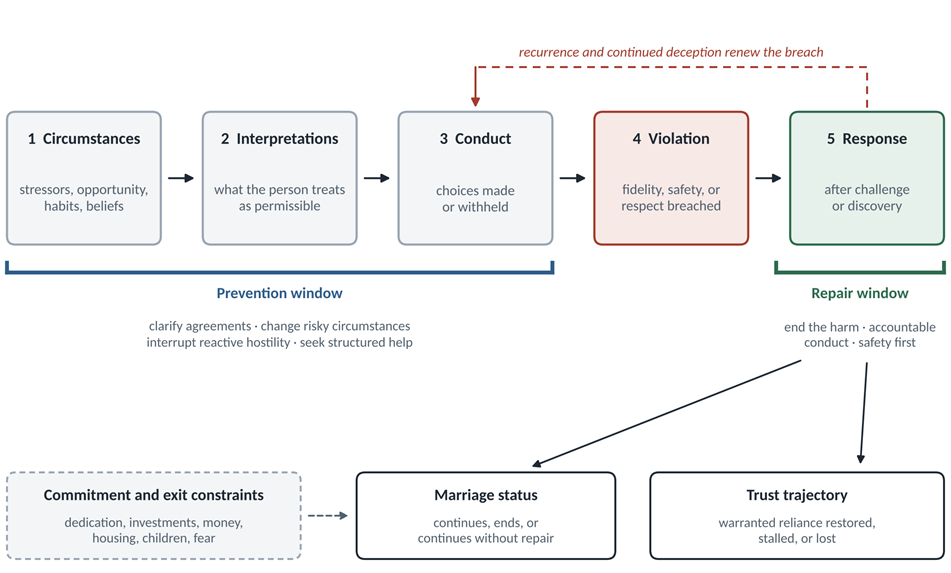
Note. Arrows are hypothesized links. The dashed red arrow marks the feedback loop proposed for testing through Proposition 1 (Section 7); the dashed gray arrow marks the constraint pathway proposed for testing through Proposition 2.
3.1 Conditions Influence Risk Without Removing Agency
The vulnerability–stress–adaptation framework places marital functioning within enduring vulnerabilities, external stressors, and adaptive processes (Karney & Bradbury, 1995). Financial insecurity, illness, or caregiving can strain attention and resources. Opportunity for concealed involvement, habitual hostility, or beliefs that license domination can add different risks. None of these conditions is a sole cause, and none shifts responsibility for a violation to the other spouse.
Figure 1 asks five connected questions: what circumstances are present; how does the person interpret them; what conduct follows; which foundational expectation does that conduct threaten; and what happens once it is challenged or discovered? A violation can be deliberate and abrupt, and some harmful patterns predate the marriage. No sequence of minor warning signs is necessary, and seeing one risk condition does not predict that someone will cross a red line.
3.2 Interpretations Can Permit or Restrain Harm
Between experiencing a difficulty and acting on it lies a decision about what is permissible. Compare “I feel neglected and need to address this” with “Being neglected entitles me to conceal a romantic involvement.” Likewise, frustration can be voiced as a specific complaint or used to justify humiliation. These illustrations show how explaining dissatisfaction differs from authorizing a response. We propose this permission process as a connecting mechanism. The examples are not a validated measure, and we do not claim that conscious rationalization precedes every harmful act.
A person can also behave harmfully without strong momentary anger. Coercive control may involve planned restrictions on money, movement, or contact, so an account centered on poor emotional regulation would be inadequate. Prevention must address both the conduct and the claimed entitlement to control; calming down will not resolve a problem of entitlement. Likewise, an affair cannot be reduced to a communication failure or an inevitable response to unmet needs.
3.3 Different Violations Require Different Interruption Points
For fidelity, the relevant choices concern understood agreements, concealed involvement, and responses to attraction or dissatisfaction. For degradation, they concern repeated humiliation and whether a spouse’s concerns receive legitimate consideration. For coercion, they concern the use of fear or restriction to override another person’s choices. The common element is conduct that compromises justified reliance. We do not claim that the three pathways share one psychology or respond to the same intervention.
The practical implication is to act on controllable conduct before relying on good intentions. Clarifying an agreement addresses ambiguity. Ending a concealed involvement addresses an ongoing breach. Interrupting reactive hostility addresses one form of immediate risk. When intimidation or domination makes ordinary negotiation unsafe, specialist intervention is required. Evidence for one of these approaches cannot be generalized to the others.
3.4 The Response to Harm Creates the Next Feedback Loop
After a breach, discovery can alter the meaning of earlier events and the credibility of future promises. Attachment theory explains why the partner may become both a desired source of comfort and a source of distress. Subsequent conduct then supplies new information: recurrence and deception sustain reasons for distrust, while cessation, accountability, and consistent follow-through can provide a basis for reconsidering reliance. The complete loop is a proposed synthesis; its constituent literatures offer different levels of support.
Commitment and constraints influence whether the marriage continues along either path, but they do not show that the violation has stopped. Prevention and repair therefore share a standard: examine safety, autonomy, respect, and conduct alongside feelings and relationship status. A person’s continued presence is neither consent to harm nor evidence that a prevention strategy worked.
4 Attachment Injury and Asymmetric Repair Burden
4.1 When the Source of Security Becomes Unreliable
Attachment theory explains why betrayal by a spouse can carry unusual psychological force. Hazan and Shaver’s (1987) account of romantic attachment describes the partner as a potential source of comfort and security. A serious violation can undermine both the relationship and the person’s expected means of coping with distress: the spouse whose support would ordinarily help contain a crisis may now be implicated in producing it.
Johnson et al. (2001) defined an attachment injury more specifically as abandonment or betrayal during a critical moment of need that becomes a recurring obstacle to repair. Its importance lies in the event’s meaning for future dependability. An affair discovered during illness, or a humiliating refusal of help during a crisis, may become evidence that vulnerability will not be met with care. Not every red-line violation meets this definition, and attachment injury is not a psychiatric trauma diagnosis.
The distinction matters clinically. If the injured partner’s question is whether vulnerability will again invite harm, advice to communicate more positively misses the central problem; the couple must address the evidence on which fear and distrust rest. In a process study of 24 couples, Makinen and Johnson (2006) identified 15 as having resolved an attachment injury after emotionally focused therapy, and resolved couples showed more favorable interaction and outcome patterns. This supports the relevance of specific repair processes. A small study cannot supply a population recovery rate or establish causality.
4.2 Unequal Responsibility and Unequal Costs
We use asymmetric repair burden to distinguish responsibility for making repair possible from the costs of living through it. The responsible partner bears primary obligations to stop the violating conduct, acknowledge what occurred, address preventable consequences, and provide credible evidence of change. The injured partner bears involuntary costs that may include uncertainty, distress, practical disruption, and the effort of judging whether renewed dependence is safe. A person can therefore bear less responsibility for the injury while carrying a substantial share of its aftermath.
The scope of this account varies by violation. It applies most directly to infidelity and degradation. For violence and coercive control, repair is conditional on safety and sustained cessation of harm, and joint repair may never be appropriate (Section 5.2).
The allocation of responsibility is a normative claim: accountability follows from the conduct for which each person is responsible. Claims about which behaviors predict recovery are empirical and need evidence. Giacobbi and Lalot’s (2025) systematic review of 13 articles identified themes including proactive transparency, remorse and accountability, shared activities, and explanations for betrayal, along with methodological and sample limitations. It supports examining accountable conduct but leaves the relative contribution of individual repair components unresolved.
Asymmetry does not cast a marriage as one innocent person and one uniformly culpable person. Partners may have contributed differently to longstanding difficulties, and each remains responsible for separate harmful acts. But dissatisfaction or a partner’s shortcomings do not divide responsibility equally for a particular deception or assault. Context can explain how a crisis developed without excusing the decision that crossed the boundary.
Some clinicians worry that naming one partner as responsible entrenches blame and impedes joint work. The asymmetry claimed here is narrow: it concerns who must stop a particular act and demonstrate change, not who is to blame for the marriage as a whole. Staged approaches to infidelity, such as Gordon et al.’s (2005), pair managing the impact of the affair with joint work on understanding it. The two are compatible so long as understanding context never becomes excusing conduct.
Once both partners freely choose repair, cooperation becomes necessary. The injured partner may eventually communicate needs, reconsider interpretations, and experiment with renewed vulnerability. These contributions are not advance payments owed before the responsible partner changes, and successful change creates no entitlement to forgiveness or continued marriage.
4.3 Why Reassurance Can Fail
An apology expresses a present position; trust concerns expectations about future conduct. After deception, the credibility of the apology itself is in question. The responsible partner thus faces a problem that reassurance alone cannot solve: the person asking to be believed is the person whose conduct made belief uncertain.
Experimental research offers adjacent evidence. Schweitzer et al. (2006) found that consistent trustworthy actions could restore trust after untrustworthy behavior in a laboratory task, whereas accompanying deception impeded recovery. A brief experiment cannot show whether a marriage will recover, and incomplete recovery in the laboratory does not imply permanent marital damage. The finding does support distinguishing an apology from a sequence of observable actions, and it motivates direct research on deception after marital disclosure.
This is the basis for Proposition 1 (Section 7). If the responsible partner continues to conceal material information or repeats the violation, the injured spouse receives new evidence relevant to future reliance, and trust should vary accordingly beyond the initial event. A refusal to trust under those conditions should not automatically be read as an inability to forgive.
5 Three Forms of Foundational Violation
5.1 Infidelity and the Credibility of Commitment
Infidelity violates an understood agreement about sexual or romantic involvement. The relevant breach is deception or unauthorized involvement under that agreement, not nonmonogamy in itself. Snyder and Doss (2005) emphasize individual and cultural variation in defining infidelity and the ethical demands of treatment. Establishing what the partners understood is therefore part of assessment, although disagreement about definitions should not become a device for dismissing clear deception.
Divorce accounts show betrayal’s salience without establishing a universal ranking of causes. Amato and Previti (2003) analyzed open-ended accounts from 208 divorced respondents in a national panel and found infidelity the most commonly reported reason; respondents tended to attribute responsibility to former spouses. Wolcott and Hughes (1999), using an Australian survey that asked for the main reason, found communication problems and incompatibility or drifting apart more prominent. The contrast shows how question format and population shape apparent rankings.
Scott et al. (2013) distinguish major contributors from a final straw. Among 52 divorced individuals who had received premarital education, lack of commitment, infidelity, and conflict were common contributors, while infidelity, domestic violence, and substance use were frequent final straws. A final event can give a longer history its decisive meaning. It need not be the first problem, the most frequent problem, or the only reason a marriage ends.
Prospective evidence complicates the chronology. Previti and Amato (2004), following 1,475 respondents over 17 years, found that divorce proneness preceded extramarital sex and that extramarital sex predicted subsequent deterioration and divorce. Instability can precede an affair and be intensified by it. This reciprocal pattern challenges single-cause explanations while preserving responsibility for the affair itself.
The injury also extends beyond relationship status. Whisman (2016) found an association between discovering a partner’s affair and major depression among relatively dissatisfied married or cohabiting adults in a probability-based sample, although the cross-sectional design and the small number reporting discovery limit inference about timing and magnitude. Distress deserves assessment, but neither its presence nor its intensity determines whether a person should reconcile.
Recovery studies contradict the claim that infidelity makes a satisfactory marriage almost impossible. Atkins et al. (2005) examined 19 couples with infidelity within a larger randomized treatment trial and found substantial improvement among couples whose affairs were disclosed before or during therapy. Atkins et al. (2010) documented improvement in a community treatment sample. These findings establish recovery as a credible possibility for selected help-seeking couples; they do not estimate the proportion of all marriages that recover after affairs.
Marín et al. (2014) followed the earlier trial’s small infidelity subgroup for up to five years. Divorce outcomes were less favorable for the infidelity group, particularly where affairs had remained secret, while continuing marriages could show favorable functioning. Because the two reports describe the same subgroup, they are not independent replications. The contrast between divorce outcomes and functioning among continuing couples also shows why recovery must be evaluated alongside attrition from the marriage itself.
Affair-specific intervention research supports a process account. Gordon et al. (2004) reported improvement for most participants in a six-couple case-study series, and their treatment account organized recovery around managing the impact, understanding the affair, and deciding how to proceed (Gordon et al., 2005). Together these studies support accountable engagement rather than a fixed prognosis. They give no warrant for promising recovery, declaring it exceptional, or requiring it of the injured partner.
5.2 Violence and Coercive Control
Violence and coercive control place a limit on any account centered on restoring attachment. Attachment can remain strong while the relationship is dangerous. The relevant task is therefore broader than restoring felt closeness: it includes protecting bodily integrity and the ability to decide without intimidation. Stark (2007) describes coercive control as a pattern of domination, not a series of discrete incidents, that restricts autonomy through intimidation, isolation, and control of resources.
Johnson and Leone (2005) distinguished intimate terrorism from situational couple violence and documented different consequences. The distinction directs attention to control, fear, and the setting in which acts occur. Counting incidents alone can obscure who is able to refuse, leave a conversation, obtain money, or seek help without retaliation. Categories inform assessment, but a clinician may not infer safety from a label or dismiss an apparently isolated act.
Economic abuse shows how violation and constraint can reinforce one another. Postmus et al. (2020) reviewed its definition and measurement across countries and found substantial inconsistency, and Johnson et al. (2022) reviewed 35 studies linking economic abuse with financial, health, and other consequences. Restricting access to money or sabotaging employment both undermines autonomy and reduces the resources available for departure. Under these conditions, continued marriage is especially weak evidence that harm has been repaired.
Anderson and Saunders (2003) describe leaving abuse as a process shaped by material and psychological conditions, with support needs continuing after departure. Campbell et al. (2003), in a multisite case-control study of intimate partner femicide, identified estrangement, particularly from a controlling partner, among associated risk factors. These findings support individualized assessment and safety planning. They do not justify a universal instruction to confront the abusive partner or to leave immediately.
Conjoint treatment also requires discrimination. Karakurt et al.’s (2016) meta-analysis of six studies found preliminary benefits for selected couples, with conclusions particularly relevant to situational violence. The evidence cannot support couple therapy under coercive domination or severe danger. Where disclosure can provoke retaliation, asking partners to negotiate more openly may increase exposure to harm. Responsibility for violence stays with the person using it, even when both partners have other relationship difficulties.
World Health Organization (2014) guidance places immediate emotional and physical needs alongside continuing safety and support. The clinical implication is concrete: establish conditions in which the harmed person can seek help and exercise choice before considering joint repair. The guidance was developed for women subjected to violence, and applying it to other populations requires appropriate expertise. A closer marriage is not an adequate outcome if autonomy and safety remain compromised.
5.3 Persistent Contemptuous Degradation
Contempt threatens a different foundation by presenting a spouse as inferior, ridiculous, or unworthy of serious consideration. The category concerns persistent degradation, not ordinary anger, disagreement, or an isolated sarcastic remark. Its relevance is partly cumulative: repeated humiliation can make a partner’s standing in the relationship conditional on submission or silence. Where it operates through intimidation, it overlaps with coercive control.
Direct evidence for degradation as a distinct, independently harmful pattern is thinner than for the other two categories, and this category rests partly on conceptual grounds. The studies below concern broader negative interaction. Prospective research supports concern about destructive interaction but does not show that contempt alone determines divorce. Gottman and Levenson (2000) found different patterns associated with earlier and later divorce across a 14-year follow-up: negative affect was relevant to earlier dissolution, whereas low positive affect characterized later dissolution. Emotional disengagement therefore belongs alongside overt hostility in an account of marital deterioration.
Birditt et al. (2010) followed 373 Black and White American couples over 16 years and found that destructive behaviors and certain combinations of partners’ responses predicted divorce. Yet Lavner et al. (2016) found that longitudinal links between observed communication and satisfaction were less consistent than their concurrent associations, and Karney and Bradbury’s (2020) broader review likewise challenges the assumption that communication uniformly drives marital change.
Context can alter the function of a behavior. Ross et al. (2019) found that the association between demand–withdraw interaction and wives’ satisfaction differed with socioeconomic resources, and withdrawal can sometimes limit escalation when requested changes are hard to achieve. This does not suggest any benefit of contempt. It shows why an assessment of degradation must examine repeated meaning, power, and consequences rather than classify all negative behavior alike.
The clinical task is to distinguish dissatisfaction expressed badly from a pattern that denies the partner legitimate standing. Useful questions include whether disagreement is permitted, whether humiliation or dismissal is persistent, and whether attempts to seek help provoke ridicule or retaliation. A spouse’s silence should not be read as agreement or as evidence of less harm, because fear or learned punishment can suppress objection. These questions translate the conceptual distinction into assessment; they are not a validated diagnostic test. Ending degradation is a prerequisite for credible mutual problem-solving, because a person whose concerns are routinely disqualified cannot participate on equal terms.
6 Why Damaged Marriages Persist
6.1 Commitment Can Support Repair or Delay Departure
Attachment explains why a violation hurts; commitment research helps explain why the injured spouse may stay. Rusbult’s (1980) investment model relates commitment to satisfaction, investments, and alternatives. Rusbult et al. (1998) developed measures distinguishing these constructs, and Le and Agnew’s (2003) meta-analysis supported their relationships with commitment and breakup. The model allows continued attachment to a marriage whose current rewards have deteriorated, because leaving would sacrifice valued investments or lead to unattractive alternatives.
Stanley and Markman’s (1992) distinction between dedication and constraint sharpens the point. Choosing to build a better relationship differs from feeling unable to end it. Previti and Amato (2003) similarly distinguish rewards and barriers in explanations for remaining married. Neither practical dependence nor strong dedication tells us whether current trust is warranted. Both can coexist with unresolved injury, and both can sustain a demanding but freely chosen repair process.
Identical relationship status can therefore conceal different trajectories. In one marriage, the violation has stopped, accountability is sustained, and trust is recovering. In another, the couple remains affectionate but avoids the injury. In a third, fear or material dependence constrains departure. These are analytic possibilities, not fixed types of people or diagnoses, and repeated assessment, not a couple’s decision to stay, is what distinguishes them.
The vulnerability–stress–adaptation framework supplies the surrounding context (Karney & Bradbury, 1995). Illness, employment insecurity, and caregiving demands affect the resources available for repair or separation. Such conditions help explain trajectories without excusing harmful conduct. A theory of marital boundaries that ignores resources risks attributing persistence entirely to love or weakness when it may also reflect housing, care, and financial realities.
6.2 Duration Does Not Establish Repair
The rise of later-life divorce makes the distinction between endurance and resilience unavoidable. Brown and Lin (2012) documented increasing US divorce among adults aged 50 and older between 1990 and 2010, and their later historical analysis showed different trends for middle-aged and older adults (Brown & Lin, 2022). These findings show that long-term commitment and older age do not guarantee continuation. They do not identify accumulated boundary violations as the cause of changing divorce rates.
A life-course account must distinguish the date of the conduct, its discovery, the decision to separate, and legal divorce. A marriage ending after decades may involve a recent violation, a late discovery of earlier conduct, a longstanding injury, or no identifiable red line. Age also differs from marital duration, since an older adult may be in a recent remarriage. These distinctions keep demographic patterns from being used as evidence for mechanisms they did not measure.
We suggest that late discovery can change the interpretation of shared history, and that accumulated investments can make responding difficult. These are plausible mechanisms that need direct study, not established explanations for gray divorce. Comparisons with shorter marriages must also address selection, because unions that ended earlier are absent from the group of long-married couples. A long marriage demonstrates persistence; evidence of repair requires information about what occurred during that persistence.
7 A More Discriminating Account of Repair
7.1 Separate the Initial Violation From the Continuing Response
The model distinguishes the initial conduct, discovery, subsequent behavior, and constraints on response. Initial severity includes injury, coercion, duration of concealment, and the commitments violated. Subsequent behavior includes recurrence, disclosure of materially relevant information, responses to distress, and whether agreed changes persist. Constraints include practical barriers and threats that restrict choice. Treating these as separate variables is more precise than a single score for how bad the marriage has become.
Return to the second marriage in Section 1, and imagine two versions of it after the disclosure. In one, the involvement ends and agreed boundaries are kept. In the other, new concealment repeatedly emerges. A measure recording only that both marriages experienced an affair would miss a difference directly relevant to future trust. The model predicts different trajectories without assuming that either injured partner must stay or that either marriage is certain to end.
Table 2 states the two propositions that follow. Proposition 1 is incremental: recurrence and continued material deception should predict poorer trust trajectories beyond initial severity and prior relationship quality. Initial severity remains consequential; the claim concerns the added explanatory value of what happens afterward. Proposition 2 concerns persistence: among marriages with comparably low trust, stronger exit constraints should predict continued marriage without corresponding improvement in safety or well-being. It draws on commitment research and needs direct testing after violations.
Table 2
Testable propositions
Proposition | Predictor | Outcome | Held constant | What would count against it |
P1: Conduct after the violation matters | Recurrence; continued material deception after disclosure | Trust trajectory across repeated waves | Initial severity, initial trust, earlier deception, prior relationship quality | No added prediction, or prediction only through correlation with initial severity |
P2: Constraint is not repair | Strength of exit constraints (money, housing, children, threats) | Remaining married without gains in safety or well-being | Level of trust, initial severity | Constraints predict staying only alongside improved safety and well-being, or not at all |
Note. Both propositions are observational; support would establish prediction, not causation.
Both propositions require attention to measurement. Self-reported accountability may reflect a favorable self-description rather than demonstrated change. High trust may reflect genuine reliability, incomplete information, or pressure to report improvement. Researchers should combine partners’ accounts where safe, specify indicators in advance, distinguish reports from corroborated events, and examine disagreement without assuming that the less powerful partner is mistaken. No research design should make disclosure to investigators a new source of danger.
7.2 Recovery Has More Than One Outcome
A marriage can continue without recovering, and a person can recover without continuing the marriage. A useful outcome set therefore includes relationship status, trust, safety, autonomy, and personal functioning, and improvement in one cannot substitute for evidence about the others. The distinction also stops a clinician from treating separation as treatment failure when the client becomes safer or regains the ability to choose.
General couple-therapy evidence supports the possibility of improvement. Roddy et al. (2020) synthesized 58 studies representing 40 unique samples and 2,092 couples and found substantial gains in satisfaction and other relationship domains. Those pooled findings do not establish efficacy for every violation or safety under coercive control. Their contribution here is to challenge fatalism about distressed relationships while preserving the need to match interventions to circumstances.
Forgiveness is a separate outcome. McNulty (2011) found that a greater tendency to forgive was associated with continued psychological and physical aggression over time in newlyweds. The study does not show that forgiveness causes abuse, and it does not make survivors responsible for recurrence. It does undermine the assumption that a forgiving response signals successful repair. The clinically relevant question remains whether the harmful conduct and its consequences have changed.
8 Practical Guidance for Preventing Harm
This section is written to adults who want to protect their own conduct and, where it is safe and voluntary, work together on the relationship; for that reason it addresses the reader directly. The guidance does not make one spouse responsible for preventing the other’s betrayal or abuse. Because the evidence behind each recommendation differs, Table 3 states it once, so that the sections below can stay brief. The suggested wording and schedules are examples, not a tested treatment package.
Table 3
Evidence status of the practical guidance
Guidance | Basis | Evidence status |
8.1 Separate strain from fear and coercion; seek specialist help when afraid | Violence research; WHO (2014) clinical guidance | Clinical guidance |
8.2 Make agreements concrete | Boundary framework; Snyder & Doss (2005) on defining infidelity | Theory-derived; untested as stand-alone prevention |
8.3 Treat self-justification as a cue to change conduct | Proposed permission mechanism (Section 3.2) | Theory-derived; not independently validated |
8.4 Pause before acting when provoked | McCurry et al. (2024) laboratory experiment | Adjacent experiment (5–15 second pauses only) |
8.5 Use structured relationship support | Rhoades (2015); Doss et al. (2020) | Randomized trials of specific programs |
8.6 Review conduct weekly | Practical scheduling suggestion | Untested |
8.7 Respond to a breach without adding harm | Giacobbi & Lalot (2025) themes | Systematic review of mostly observational work |
Note. “Evidence status” describes the support for the practice as proposed here, not the quality of the cited studies.
8.1 Choose the Appropriate Kind of Help
Begin by distinguishing relationship strain from fear and coercion. If either person fears retaliation for disagreeing, declining sex, accessing money, or seeking help, joint boundary exercises are not the starting point. Seek confidential specialist assessment and safety support through a safe means of contact. In the United States, the National Domestic Violence Hotline (1-800-799-7233; text START to 88788; thehotline.org) offers confidential support at any hour, and elsewhere national helplines and local services can be found online. If your devices or accounts may be monitored, use one your spouse cannot access. Immediate danger requires emergency assistance. Safety planning should fit individual circumstances and not prescribe confrontation or immediate departure (World Health Organization, 2014).
If you are using threats, force, sexual pressure, surveillance, or financial restriction, responsibility begins with stopping those actions and obtaining specialist help for your own conduct. Do not require your spouse to participate, reassure you, or remain married. A harmed partner’s silence, compliance, or reluctance to disclose does not show that the behavior is acceptable.
8.2 Make Agreements Concrete While Protecting Autonomy
Where conversation is safe, choose one situation that could create misunderstanding: private romantic messages, contact with a former partner, significant spending, or sharing intimate information with others. Ask each person to describe what they understand the agreement to be, what conduct would violate it, and how an emerging concern should be raised. Record only agreements both freely accept, and revisit them when circumstances change.
For example: “We agree that romantic or sexual messaging with someone else would breach our agreement. If either of us wants to change the agreement, we discuss it before acting.” Agreements differ across couples, but neither partner can negotiate away the other’s right to meaningful consent or safety. Nor does marriage confer an unlimited right to devices, passwords, location data, or private conversations; privacy and autonomy remain relevant even when trust has been damaged.
8.3 Treat Self-Justification as a Cue to Change Conduct
When considering an action that may breach an agreement, separate three statements: what I am feeling, what I need to address, and what I am choosing to do. “I feel lonely” can identify a real problem, but it does not authorize deception. Ask: Which agreement or protection applies here? What would I have to conceal or misrepresent? What action could address the problem without overriding another person’s choice?
Change the situation as well as the explanation. If an involvement is becoming romantic and conflicts with your agreement, stop the boundary-crossing contact and seek help addressing the decision and its consequences. Where contact is unavoidable, such as at work, obtain guidance on maintaining clear limits. Legitimate privacy should not be confused with deception about a relevant breach, and decisions about disclosure must account for safety rather than follow a blanket demand for confrontation.
8.4 Interrupt Reactive Hostility and Return to the Issue
McCurry et al. (2024) randomly assigned couples to wait 5, 10, or 15 seconds, or not at all, before choosing how loud a noise blast to send their partner in a competitive reaction-time task. Forced delays reduced aggressive responding when the person showed high negative emotion, the effect did not differ across the three delay lengths, and participants who chose to wait longer also responded less aggressively. The study involved 104 participants and a replication with 58. It is adjacent evidence about reactive responding, not evidence about longer breaks, real arguments, or domestic violence. The experiment provides a limited rationale for delaying an impulsive response; it does not establish the optimal duration or effectiveness of breaks during real disagreements.
In safe, noncoercive conflict, you might try a short pause before replying. If you need longer, agree in advance that either person can request a break, with a specific plan to resume: “I am getting too angry to discuss this well. Can we pause and return at 7 tonight?” Longer breaks are a common clinical convention, not something this study tested. During the pause, avoid hostile messages and rehearsing retaliation; on returning, take one concrete concern and one feasible request. A pause must not become punishment or an indefinite refusal to address the issue. Threats, blocked exits, stalking, or fear call for the safety route in Section 8.1, not this exercise.
8.5 Use Structured Support Before Repeating the Same Pattern
Relationship education has direct intervention evidence, although findings depend on the program and outcome. In a randomized evaluation using data from the Supporting Healthy Marriage project, Within Our Reach and associated services produced generally small improvements across several domains, including less reported infidelity, but the proportion remaining married did not differ significantly from the control group (Rhoades, 2015). In a separate trial of 742 low-income couples, coached OurRelationship and ePREP improved several relationship-functioning outcomes relative to a waitlist but did not significantly reduce breakups at six months (Doss et al., 2020). Structured help is therefore worth offering, without promising that the marriage will be preserved.
These findings concern specific programs and selected participants. They do not show that self-directed summaries are equivalent, that every couple will benefit, or that joint treatment is safe under coercive control. If the same harmful interaction keeps returning despite sincere attempts to change, seek qualified relationship support rather than waiting for a major discovery or crisis. Ask how the provider assesses coercion, which approach they use, what evidence supports it, and how progress will be evaluated. Where joint work is unsuitable or a spouse declines, individual help can clarify your own conduct, choices, and support needs.
8.6 Review Conduct and Daily Life Rather Than Promises Alone
For couples who can participate safely, a brief weekly review is a practical suggestion. Each person identifies one agreement kept, one unresolved concern, and one action they themselves will take before the next review. Ask whether concerns can be raised without punishment and whether both people retain the freedom to disagree. Reduce an unmanageable problem to a specific change, such as reallocating a caregiving task, and address material barriers that conversation alone cannot remove.
Then ask whether life is getting better: fewer humiliating incidents, commitments kept, more freedom to make decisions, and less disruption to daily functioning. A pleasant meeting does not offset continuing deception or intimidation. If conduct worsens, concerns cannot be raised safely, or agreed changes repeatedly fail, reassess the kind of help required. These questions are prompts for reflection, not a diagnostic score or a prediction of divorce.
8.7 Respond to a Breach Without Adding Further Harm
If you crossed a boundary, end the conduct, acknowledge specifically what you did, and address preventable consequences. Discuss materially relevant information with professional support when needed, and do not demand forgiveness in exchange for accountability. The repair literature identifies transparency and accountable conduct among recurring themes but offers no universal disclosure script or timetable (Giacobbi & Lalot, 2025). Section 9 sets out the underlying principles.
If you were harmed, you are entitled to support and to time to consider your options without committing to reconciliation. You do not have to become more accommodating to earn an end to the conduct. Personal recovery and a safe, freely chosen decision remain valid goals whether the marriage continues or ends.
9 Clinical Implications of Asymmetric Repair
9.1 Establish Safety and Freedom to Choose
Assessment should begin with private opportunities to disclose fear, coercion, threats, and retaliation. Clinicians should determine whether seeking help, disagreeing, or discussing separation creates danger and should connect clients with specialist support. These priorities follow from violence research and clinical guidance, not from a general preference for reconciliation or separation. Where danger is present, immediate care and safety planning come first (World Health Organization, 2014).
Freedom of choice must be assessed practically. Saying that reconciliation is voluntary means little if refusing it threatens access to money, housing, children, or essential care. A clinician cannot eliminate every constraint but can identify it, avoid mislabeling compliance as consent, and help clients obtain information and support. Decisions should be revisited as circumstances change.
9.2 Name the Violation and Locate Responsibility
Develop a clear account of the conduct, the expectation violated, and the present consequences. Distinguish the problem that preceded the violation from responsibility for the act itself. A couple may need help with sexual dissatisfaction, for example, while the person who concealed an affair remains responsible for the concealment. An explanation should make conduct intelligible without turning its consequences into the injured partner’s fault.
Where both partners have committed harmful acts, assess each rather than imposing a single global division of blame. Distinguish capacity to change from willingness to take responsibility. The clinician’s role is to clarify what is occurring and what would need to change, not to persuade the injured spouse that the other partner’s intentions should be enough.
9.3 Translate Accountability Into Observable Conduct
Accountability requires actions relevant to the specific breach. Following infidelity, this can include ending the violating involvement, agreeing on boundaries for unavoidable contact, providing materially relevant information, and following through on commitments. Following degradation, it includes stopping humiliation and responding to disagreement without renewed punishment. Where violence or coercion is present, specialized assessment and sustained cessation of harmful conduct are essential; reassurance and communication exercises do not establish safety.
Giacobbi and Lalot (2025) identify transparency and accountability among recurring themes in trust repair. These themes should guide specific, reviewable agreements, not an unlimited demand to prove innocence. Monitoring arrangements require consent and periodic reassessment and should not become coercive surveillance. The aim is a relationship in which credible conduct reduces the need for checking, while the injured partner remains able to ask questions or change course.
9.4 Support Recovery Without Making It a Performance Requirement
The injured partner may need help with sleep, concentration, intrusive thoughts, depression, or decision-making. Support should address impairment and distress without requiring a commitment to reconciliation, and improvement should not be judged by how quickly the person stops mentioning the violation. At the same time, distress should be assessed individually rather than assumed from the label of betrayal.
Review progress at agreed intervals with concrete questions. Has the conduct stopped? Can concerns be raised without retaliation? Are commitments being kept? Is daily functioning improving? Does the person feel increasingly able to make an independent decision? A mixed answer calls for reassessment, not an automatic verdict. Persistent deception or coercion, however, should change the treatment formulation and not be absorbed indefinitely into a narrative of slow healing.
9.5 Keep Reconciliation Separate From Discharging Responsibility
An injured spouse may decide that demonstrated change is insufficient for renewed marriage. That decision does not retroactively make accountable conduct pointless. Ending harm, accepting consequences, and reducing practical damage remain obligations whether or not the relationship continues, and a repair obligation can be discharged through safer conduct and practical restitution even when reconciliation is declined. Conversely, willingness to remain does not certify that those obligations have been met. This is the practical meaning of asymmetric repair: accountability must not depend on securing a desired response from the person harmed.
10 Limits and Research Priorities
10.1 Limits of the Evidence
The framework assembles evidence from literatures with different constructs, samples, and outcomes. Divorce accounts do not directly measure trust repair; therapy studies select for help-seeking couples; observational studies cannot fully separate reciprocal influence from confounding. Small clinical samples deserve particular caution, and follow-ups of the same couples must not be counted as replications. The conceptual coherence of the argument is stronger than the direct empirical support for the complete model. The pre-violation pathway and the reader exercises in Section 8 also need direct evaluation: evidence that a complete program improves average relationship functioning does not show that a particular worksheet prevents a particular violation.
Evidence is weakest for degradation (Section 5.3). Generalization is further limited by the predominance of heterosexual couples and Western settings in this literature, and by gendered patterns in violence research. Agreements, social sanctions, and access to separation vary across cultures and relationship structures, and these variations require direct study rather than the assumption that the same conduct carries the same meaning or that restricted exit signals greater marital success.
10.2 Limits of the Taxonomy
Infidelity, coercion, and degradation may share mechanisms without forming a single statistical construct. Researchers should test whether “red line” adds explanatory value beyond established measures of abuse, dissatisfaction, commitment, and divorce intention. A useful operationalization would specify the conduct, the expectation threatened, its perceived significance, and the opportunities for response. The taxonomy should be revised if its categories fail to distinguish clinically or empirically meaningful processes.
10.3 Research Priorities
The most informative next studies would follow couples from discovery through attempted repair or separation, distinguish event dates, and measure subsequent conduct repeatedly, which is the design Propositions 1 and 2 require. They would retain participants who leave the marriage, examine safety and personal recovery alongside satisfaction, and test whether instruments measure trust comparably across groups. Treatment research should evaluate specific components of accountability without withholding safety support or exposing participants to harmful reconciliation attempts. Prevention trials should test whether clarifying agreements or interrupting specific risk processes reduces incident violations, measure unintended consequences such as surveillance, and assess safety, autonomy, and functioning as well as marital continuation.
11 Conclusion
Protecting a marriage requires attention to the choices that preserve its foundations before a serious violation occurs, and to the conduct that makes repair credible afterward. The proposed framework connects circumstances, interpretations, boundary-relevant actions, and responses to harm. Its practical value lies in identifying opportunities to act, and its scientific limits require distinguishing tested programs from untested applications.
Asymmetric repair remains central: responsibility for ending harm belongs primarily to the person committing it, while the injured partner keeps the freedom to decide whether to rely again. Research supports the possibility of better relationship functioning through structured help, without guaranteeing reconciliation or continued marriage. The goal is a safer, more respectful life in which commitment can be chosen freely and trust is supported by conduct.
References
Amato, P. R., & Previti, D. (2003). People’s reasons for divorcing: Gender, social class, the life course, and adjustment. Journal of Family Issues, 24(5), 602–626. https://doi.org/10.1177/0192513X03254507
Anderson, D. K., & Saunders, D. G. (2003). Leaving an abusive partner: An empirical review of predictors, the process of leaving, and psychological well-being. Trauma, Violence, & Abuse, 4(2), 163–191. https://doi.org/10.1177/1524838002250769
Atkins, D. C., Eldridge, K. A., Baucom, D. H., & Christensen, A. (2005). Infidelity and behavioral couple therapy: Optimism in the face of betrayal. Journal of Consulting and Clinical Psychology, 73(1), 144–150. https://doi.org/10.1037/0022-006X.73.1.144
Atkins, D. C., Marín, R. A., Lo, T. T. Y., Klann, N., & Hahlweg, K. (2010). Outcomes of couples with infidelity in a community-based sample of couple therapy. Journal of Family Psychology, 24(2), 212–216. https://doi.org/10.1037/a0018789
Birditt, K. S., Brown, E., Orbuch, T. L., & McIlvane, J. M. (2010). Marital conflict behaviors and implications for divorce over 16 years. Journal of Marriage and Family, 72(5), 1188–1204. https://doi.org/10.1111/j.1741-3737.2010.00758.x
Brown, S. L., & Lin, I.-F. (2012). The gray divorce revolution: Rising divorce among middle-aged and older adults, 1990–2010. The Journals of Gerontology: Series B, 67(6), 731–741. https://doi.org/10.1093/geronb/gbs089
Brown, S. L., & Lin, I.-F. (2022). The graying of divorce: A half century of change. The Journals of Gerontology: Series B, 77(9), 1710–1720. https://doi.org/10.1093/geronb/gbac057
Camanto, O. J., & Campbell, L. (2025). Trust in close relationships revisited. Journal of Social and Personal Relationships, 42(9), 2516–2544. https://doi.org/10.1177/02654075251346105
Campbell, J. C., Webster, D., Koziol-McLain, J., Block, C., Campbell, D., Curry, M. A., Gary, F., Glass, N., McFarlane, J., Sachs, C., Sharps, P., Ulrich, Y., Wilt, S. A., Manganello, J., Xu, X., Schollenberger, J., Frye, V., & Laughon, K. (2003). Risk factors for femicide in abusive relationships: Results from a multisite case control study. American Journal of Public Health, 93(7), 1089–1097. https://doi.org/10.2105/AJPH.93.7.1089
Doss, B. D., Knopp, K., Roddy, M. K., Rothman, K., Hatch, S. G., & Rhoades, G. K. (2020). Online programs improve relationship functioning for distressed low-income couples: Results from a nationwide randomized controlled trial. Journal of Consulting and Clinical Psychology, 88(4), 283–294. https://doi.org/10.1037/ccp0000479
Giacobbi, M., & Lalot, F. (2025). Unpacking trust repair in couples: A systematic literature review. Journal of Family Therapy, 47(1), Article e12483. https://doi.org/10.1111/1467-6427.12483
Gordon, K. C., Baucom, D. H., & Snyder, D. K. (2004). An integrative intervention for promoting recovery from extramarital affairs. Journal of Marital and Family Therapy, 30(2), 213–231. https://doi.org/10.1111/j.1752-0606.2004.tb01235.x
Gordon, K. C., Baucom, D. H., & Snyder, D. K. (2005). Treating couples recovering from infidelity: An integrative approach. Journal of Clinical Psychology, 61(11), 1393–1405. https://doi.org/10.1002/jclp.20189
Gottman, J. M., & Levenson, R. W. (2000). The timing of divorce: Predicting when a couple will divorce over a 14-year period. Journal of Marriage and Family, 62(3), 737–745. https://doi.org/10.1111/j.1741-3737.2000.00737.x
Hazan, C., & Shaver, P. (1987). Romantic love conceptualized as an attachment process. Journal of Personality and Social Psychology, 52(3), 511–524. https://doi.org/10.1037/0022-3514.52.3.511
Johnson, L., Chen, Y., Stylianou, A., & Arnold, A. (2022). Examining the impact of economic abuse on survivors of intimate partner violence: A scoping review. BMC Public Health, 22, Article 1014. https://doi.org/10.1186/s12889-022-13297-4
Johnson, M. P., & Leone, J. M. (2005). The differential effects of intimate terrorism and situational couple violence: Findings from the National Violence Against Women Survey. Journal of Family Issues, 26(3), 322–349. https://doi.org/10.1177/0192513X04270345
Johnson, S. M., Makinen, J. A., & Millikin, J. W. (2001). Attachment injuries in couple relationships: A new perspective on impasses in couples therapy. Journal of Marital and Family Therapy, 27(2), 145–155. https://doi.org/10.1111/j.1752-0606.2001.tb01152.x
Karakurt, G., Whiting, K., van Esch, C., Bolen, S. D., & Calabrese, J. R. (2016). Couples therapy for intimate partner violence: A systematic review and meta-analysis. Journal of Marital and Family Therapy, 42(4), 567–583. https://doi.org/10.1111/jmft.12178
Karney, B. R., & Bradbury, T. N. (1995). The longitudinal course of marital quality and stability: A review of theory, method, and research. Psychological Bulletin, 118(1), 3–34. https://doi.org/10.1037/0033-2909.118.1.3
Karney, B. R., & Bradbury, T. N. (2020). Research on marital satisfaction and stability in the 2010s: Challenging conventional wisdom. Journal of Marriage and Family, 82(1), 100–116. https://doi.org/10.1111/jomf.12635
Lavner, J. A., Karney, B. R., & Bradbury, T. N. (2016). Does couples’ communication predict marital satisfaction, or does marital satisfaction predict communication? Journal of Marriage and Family, 78(3), 680–694. https://doi.org/10.1111/jomf.12301
Le, B., & Agnew, C. R. (2003). Commitment and its theorized determinants: A meta-analysis of the Investment Model. Personal Relationships, 10(1), 37–57. https://doi.org/10.1111/1475-6811.00035
Makinen, J. A., & Johnson, S. M. (2006). Resolving attachment injuries in couples using emotionally focused therapy: Steps toward forgiveness and reconciliation. Journal of Consulting and Clinical Psychology, 74(6), 1055–1064. https://doi.org/10.1037/0022-006X.74.6.1055
Marín, R. A., Christensen, A., & Atkins, D. C. (2014). Infidelity and behavioral couple therapy: Relationship outcomes over 5 years following therapy. Couple and Family Psychology: Research and Practice, 3(1), 1–12. https://doi.org/10.1037/cfp0000012
McCurry, A. G., May, R. C., & Donaldson, D. I. (2024). Both partners’ negative emotion drives aggression during couples’ conflict. Communications Psychology, 2, Article 73. https://doi.org/10.1038/s44271-024-00122-4
McNulty, J. K. (2011). The dark side of forgiveness: The tendency to forgive predicts continued psychological and physical aggression in marriage. Personality and Social Psychology Bulletin, 37(6), 770–783. https://doi.org/10.1177/0146167211407077
Postmus, J. L., Hoge, G. L., Breckenridge, J., Sharp-Jeffs, N., & Chung, D. (2020). Economic abuse as an invisible form of domestic violence: A multicountry review. Trauma, Violence, & Abuse, 21(2), 261–283. https://doi.org/10.1177/1524838018764160
Previti, D., & Amato, P. R. (2003). Why stay married? Rewards, barriers, and marital stability. Journal of Marriage and Family, 65(3), 561–573. https://doi.org/10.1111/j.1741-3737.2003.00561.x
Previti, D., & Amato, P. R. (2004). Is infidelity a cause or a consequence of poor marital quality? Journal of Social and Personal Relationships, 21(2), 217–230. https://doi.org/10.1177/0265407504041384
Rempel, J. K., Holmes, J. G., & Zanna, M. P. (1985). Trust in close relationships. Journal of Personality and Social Psychology, 49(1), 95–112. https://doi.org/10.1037/0022-3514.49.1.95
Rhoades, G. K. (2015). The effectiveness of the Within Our Reach relationship education program for couples: Findings from a federal randomized trial. Family Process, 54(4), 672–685. https://doi.org/10.1111/famp.12148
Roddy, M. K., Walsh, L. M., Rothman, K., Hatch, S. G., & Doss, B. D. (2020). Meta-analysis of couple therapy: Effects across outcomes, designs, timeframes, and other moderators. Journal of Consulting and Clinical Psychology, 88(7), 583–596. https://doi.org/10.1037/ccp0000514
Ross, J. M., Karney, B. R., Nguyen, T. P., & Bradbury, T. N. (2019). Communication that is maladaptive for middle-class couples is adaptive for socioeconomically disadvantaged couples. Journal of Personality and Social Psychology, 116(4), 582–597. https://doi.org/10.1037/pspi0000158
Rusbult, C. E. (1980). Commitment and satisfaction in romantic associations: A test of the investment model. Journal of Experimental Social Psychology, 16(2), 172–186. https://doi.org/10.1016/0022-1031(80)90007-4
Rusbult, C. E., Martz, J. M., & Agnew, C. R. (1998). The Investment Model Scale: Measuring commitment level, satisfaction level, quality of alternatives, and investment size. Personal Relationships, 5(4), 357–387. https://doi.org/10.1111/j.1475-6811.1998.tb00177.x
Schweitzer, M. E., Hershey, J. C., & Bradlow, E. T. (2006). Promises and lies: Restoring violated trust. Organizational Behavior and Human Decision Processes, 101(1), 1–19. https://doi.org/10.1016/j.obhdp.2006.05.005
Scott, S. B., Rhoades, G. K., Stanley, S. M., Allen, E. S., & Markman, H. J. (2013). Reasons for divorce and recollections of premarital intervention: Implications for improving relationship education. Couple and Family Psychology: Research and Practice, 2(2), 131–145. https://doi.org/10.1037/a0032025
Snyder, D. K., & Doss, B. D. (2005). Treating infidelity: Clinical and ethical directions. Journal of Clinical Psychology, 61(11), 1453–1465. https://doi.org/10.1002/jclp.20194
Stanley, S. M., & Markman, H. J. (1992). Assessing commitment in personal relationships. Journal of Marriage and the Family, 54(3), 595–608. https://doi.org/10.2307/353245
Stark, E. (2007). Coercive control: How men entrap women in personal life. Oxford University Press.
Whisman, M. A. (2016). Discovery of a partner affair and major depressive episode in a probability sample of married or cohabiting adults. Family Process, 55(4), 713–723. https://doi.org/10.1111/famp.12185
Wolcott, I., & Hughes, J. (1999). Towards understanding the reasons for divorce (Working Paper No. 20). Australian Institute of Family Studies. https://aifs.gov.au/all-research/research-reports/towards-understanding-reasons-divorce
World Health Organization. (2014). Health care for women subjected to intimate partner violence or sexual violence: A clinical handbook (WHO/RHR/14.26). https://www.who.int/publications/i/item/WHO-RHR-14.26