Abstract
Research on play is divided by age, disciplinary tradition, and the distinction between playful activities and a playful disposition. These divisions invite two unwarranted inferences: that benefits observed in one activity generalize to play as a whole, and that findings from one age group establish a lifelong developmental function. This critical integrative review examines selected learning, socioemotional, relational, occupational, and cognitive evidence, including studies published in 2025 and 2026, according to the inference each design permits. Guided play shows selected learning advantages; pretend-play associations need not translate into intervention effects; and evidence across adolescence, adulthood, and later life remains uneven. A developmental framework distinguishes opportunity, activity demands, experienced processes, and outcomes across timescales. Its contribution is to specify the transitions requiring explanation when evidence moves between activities and age groups. Five propositions address experiential agency, developmental change, transfer specificity, opportunity constraints, and cumulative effects, each paired with an informative design and a potentially disconfirming result. The framework does not presume benefits unique to play. It identifies tests of when particular playful experiences matter, how their effects arise, and whether existing motivational explanations suffice.
Keywords: play; playfulness; lifespan development; agency; developmental mechanisms; wellbeing
Introduction
Play is studied as a developmental context in childhood, a personality characteristic in adulthood, a possible source of innovation at work, and an intervention target for cognitive and social functioning in later life. These traditions often converge on one conclusion: play matters throughout life. Yet convergence in vocabulary is not convergence in evidence. A classroom trial comparing instructional approaches, a questionnaire study of romantic partners, and an experiment with older adults do not measure the same exposure or support the same kind of inference. Treating them as cumulative demonstrations of a single lifelong benefit hides the developmental questions that a lifespan account should answer.
The central difficulty is that play names both organized forms of activity and ways of experiencing an activity. A game can be absorbing, obligatory, humiliating, or socially connecting. Conversely, a conversation or an intellectual task can become playful without acquiring the formal structure of a game. Comparative accounts of play and reviews of playfulness have long recognized this diversity (Burghardt, 2005; Masek & Stenros, 2021). The task is therefore not to find one activity that stays beneficial from infancy to old age. It is to identify which features of engagement recur, how access to them changes, and which outcomes can reasonably follow under different developmental conditions.
Existing approaches supply essential foundations. Play-as-spectrum accounts distinguish the contributions of participant initiative and adult guidance to learning (Zosh et al., 2018). Adult personality models distinguish playfulness from its behavioral expression (Proyer, 2017; Shen et al., 2014). Interactionist theory links dispositions, situations, and playful states (Shen, 2020), and intervention research treats playfulness as a moderator, a process, and an outcome (Shen & Masek, 2024). A lifespan synthesis should build on these distinctions, not replace them with a new general claim about the importance of play.
This review makes a more specific argument: developmental continuity in play is best examined in the relations among opportunity, activity demands, experiential processes, and outcomes. Continuity in those relations is compatible with large changes in preferred activities and valued consequences. An infant’s reciprocal exchange, an adolescent’s improvised performance, and an older adult’s collaborative game may each offer an occasion for voluntary engagement and mutual adjustment. Whether such occasions improve language, social confidence, or cognitive performance is a separate empirical question. Similarity of experience does not establish equivalence of developmental function. A general engagement explanation remains a live alternative throughout: play need not confer benefits beyond equally engaging activities with comparable demands. The proposed framework is useful only if its distinctions clarify when outcomes occur or improve their prediction.
Three questions organize the review. First, what does the evidence from each life stage license, given the designs that produced it? Second, how can constructs be organized so that findings are comparable across ages without being assumed equivalent? Third, which tests would distinguish the resulting account from simpler alternatives, including the view that any engaging, meaningful activity would do as well? The contribution is correspondingly threefold. The review separates constructs that are routinely merged when evidence crosses age groups; it compares findings according to the inference each design permits, including recent results that complicate uniformly positive accounts; and it derives propositions that expose the account to disconfirmation. The intended explanation is neither that play has one invariant mechanism nor that it necessarily outperforms other meaningful activities. It is that a particular organization of engagement may help explain why some activities are chosen, sustained, and experienced as worthwhile, with benefits that depend on what participants actually do.
Review Approach
Evidence Identification
This article is a critical integrative review, a form that combines diverse empirical and theoretical sources to generate new conceptual understanding (Whittemore & Knafl, 2005), directed here at conceptual clarification and theory development. Evidence was identified through targeted web searches of PubMed and PubMed Central records, publisher websites, and university repositories, updated through October 17, 2026. Searches combined play, playfulness, guided play, pretend play, adventurous or outdoor play, improvisation, games, adolescence, adult relationships, workplace, aging, and cognitive or mental-health outcomes. Foundational conceptual works and recent reviews provided starting points; further searches sought original reports, measurement research, and findings inconsistent with broad benefit claims.
Selection was purposive and directed toward conceptual relevance. Interpretive-synthesis methodology provides a precedent for selecting literature to develop and challenge an explanation rather than to enumerate every eligible study (Dixon-Woods et al., 2006). This rationale informs the present selection; it does not imply that the full critical interpretive synthesis procedure, theoretical saturation, or independent appraisal was performed. Sources were included for their contribution to construct definition, developmental interpretation, a consequential empirical contrast, or research design. Peer-reviewed reviews and original studies anchor empirical claims; books supply conceptual background; conference abstracts do not support efficacy claims. Sources were read in accessible full text where possible, and otherwise through abstracts and bibliographic records; access to an abstract was not treated as access to a complete methods report. Citation metadata were cross-checked against publisher or indexing records and, where available, Crossref deposits. The Supplementary Material gives representative search strings, access limitations, and checks on the principal evidence claims.
Appraisal Frame and Boundaries
Findings are examined through four complementary questions: what experience is described, which measures covary, whether exposure precedes an outcome, and what a comparison between conditions identifies. These are dimensions of interpretation rather than a hierarchy of study quality. Qualitative inquiry can explain meaning and implementation; cross-sectional and longitudinal studies can characterize associations and temporal patterns; assigned or naturally occurring comparisons can address specified causal contrasts under additional assumptions. Temporal order alone does not remove confounding, and a comparison alone does not establish causation. Syntheses are interpreted in light of their constituent designs; reviews are not counted as independent replications of the studies they summarize.
The procedure does not establish exhaustive coverage. There was no preregistered protocol, independent duplicate screening, pooled reanalysis, or formal study-level risk-of-bias scoring. The review therefore does not estimate an overall effect of play or the prevalence of positive findings. It evaluates what selected, theoretically informative findings establish, and which further assumptions are needed to carry them across activities, ages, and timescales. These boundaries matter especially because the literatures integrated here define both play and successful development differently.
Constructs That Travel Across Age Groups
Activities Dispositions and Episodes
An activity classification describes what someone does, a dispositional measure describes a relatively enduring tendency, and an episode describes an experience unfolding in a particular setting. These levels are related but not interchangeable. Burghardt’s (2005) framework identifies play behavior comparatively, including its altered relation to immediate functionality. Bateson and Martin (2013) connect playful exploration with the generation of novel possibilities. Neither framework licenses inferring a participant’s state from the presence of toys, games, laughter, or an observer’s judgment that an activity looks playful.
Adult measurement traditions sharpen the distinction. The Adult Playfulness Trait Scale emphasizes motivational and cognitive qualities, including fun-seeking, spontaneity, and uninhibitedness (Shen et al., 2014). The OLIW model distinguishes other-directed, lighthearted, intellectual, and whimsical playfulness (Proyer, 2017). These differences are theoretically consequential: an association found with one operationalization cannot be read as evidence about every quality in another. A highly competitive player, a person who enjoys unusual ideas, and someone skilled at easing interpersonal tension may score differently across measures.
In this review, playful engagement refers to an episode in which a participant gives substantial priority to involvement in the activity and keeps some latitude to explore, vary, or imaginatively frame what is happening. The definition draws on the engagement emphasis of Masek and Stenros (2021) and on the distinction between situations and states in Shen (2020). It is an organizing choice, not a proposed universal definition. Positive emotion, social interaction, and physical movement are possible features, not necessary conditions. The definition admits effort, frustration, and seriousness within play, and it prevents researchers from inferring benefit from classification alone.
Playful engagement overlaps with neighboring constructs. Flow emphasizes absorption and the relation between challenge and skill (Csikszentmihalyi, 1990); interest includes both situational engagement and a developing disposition to reengage with particular content (Hidi & Renninger, 2006). The organizing definition used here emphasizes experienced latitude to explore, vary, or imaginatively frame an activity. This latitude can concern interpretation or interaction within stable rules; it does not require permission to change the rules themselves. It should not be assumed absent from flow or interest, or established as a unique property of play. Distinctiveness requires evidence: measures of playful latitude should be distinguishable from absorption, interest, and perceived autonomy, and should explain theoretically relevant variation beyond them. If they do not, a broader engagement account may be sufficient.
Opportunity Participation and Experiential Quality
Opportunity comprises material access, available time, social permission, accessible design, and an invitation a person can accept. Participation records whether and how often someone takes part. Experiential quality concerns what that participation is like. A setting can offer opportunities that remain inaccessible in practice, and attendance can occur without meaningful engagement. These distinctions matter when low participation is read as low playfulness, or when provision of an activity is treated as proof that its intended psychological process occurred.
Guided play shows how external aims and participant agency can coexist. A facilitator may hold an instructional objective while the child keeps initiative within a prepared environment (Weisberg et al., 2016). School-oriented frameworks likewise separate activity design, facilitation, participant experience, and learning outcomes (Parker et al., 2022). The relevant contrast is therefore not adult involvement versus freedom but whether support expands participation and exploration or replaces them with compliance. Observational work on how teachers signal playfulness shows the need to examine the relation between an adult’s presentation and the child’s experience (Sproule et al., 2021).
Recent measurement work makes these distinctions empirically tractable. A 2026 study derived a Play Qualities Inventory from reports of good and bad play among 504 children, with dimensions that included inclusion, social coordination, and feeling able to participate (Lieberoth et al., 2026). This is an initial measurement contribution, not evidence that the dimensions have the same structure at every age. It does show why minutes of exposure may be less informative than the conditions within an episode.
A Developmental Account of Playful Engagement
Existing Explanations and the Proposed Extension
Three theoretical traditions explain different parts of the problem. Interactionist playfulness research locates expression in transactions between a person and a situation (Shen, 2020). Self-determination theory explains why autonomy, competence, and relatedness may sustain intrinsically motivated participation (Ryan & Deci, 2000). Lifespan developmental theory emphasizes contextual dependence, plasticity, and the coexistence of gains and losses (Baltes, 1987). The approaches are compatible, but combining their vocabularies does not itself yield a developmental mechanism.
The proposed extension concerns the transitions between levels of explanation. It asks when access becomes participation, when participation affords exploration or connection, and when repeated experience changes functioning beyond the episode. Figure 1 depicts these transitions as hypotheses, not as pathways validated together. The contribution is an organizing specification for developmental research: opportunity must be separated from uptake, activity demands from experience, and immediate states from accumulated change. These distinctions extend compatible theories rather than establish a rival theory with uniquely different predictions. Table 1 identifies the foundations adopted and the empirical questions the synthesis makes explicit. Its value must ultimately be judged by whether these distinctions improve explanation, measurement, or intervention design.
Figure 1 A developmental account of playful engagement
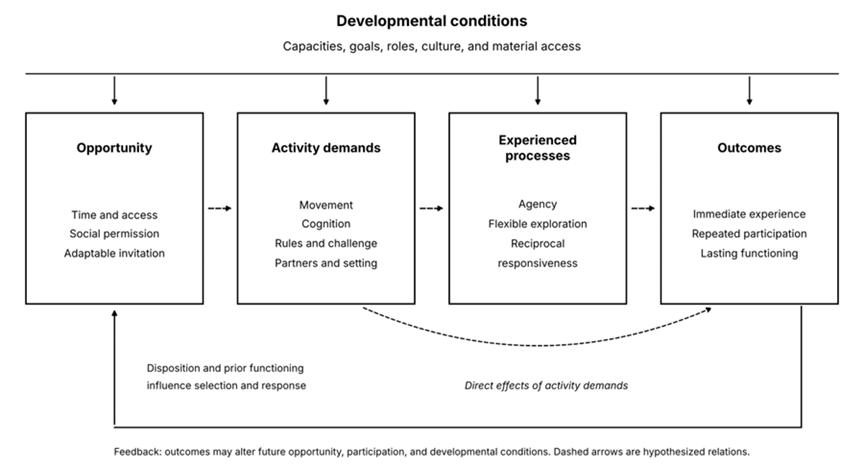
Note. This is an organizing framework, not a fitted causal model. Arrows denote proposed relations; activity demands can also affect outcomes directly. Disposition and prior functioning can influence selection and response. Feedback may change later opportunities.
Table 1 Theoretical foundations and questions specified by the synthesis
Theoretical foundation | Contribution adopted | Question specified for developmental research | Example of an informative test |
Interactionist playfulness (Shen, 2020) | Disposition, situation, and playful state jointly shape expression | How accessible opportunity affects uptake and the expression of disposition | Manipulate access and measure within-person participation and experience (Proposition 4) |
Play as a spectrum (Weisberg et al., 2016; Zosh et al., 2018) | Participant initiative and adult guidance can coexist | How assigned structure relates to experienced agency and learning | Separate content and facilitation from measured agency (Proposition 1) |
Self-determination theory (Ryan & Deci, 2000) | Autonomy, competence, and relatedness support motivation | Whether playful latitude adds explanatory value beyond general motivational processes | Compare playful and equally engaging alternatives with distinct construct measures (Proposition 3) |
Lifespan theory (Baltes, 1987; Carstensen et al., 1999) | Development reflects changing capacities, goals, and contexts | Which measured changes explain variation in the function of play | Repeatedly measure goals, capacities, and participation around transitions (Proposition 2) |
Note. These are compatible extensions and applications, not predictions demonstrated to conflict with the cited theories. Propositions are developed in Five Propositions for Developmental Research.
Four Components and Three Candidate Processes
The account distinguishes opportunity, activity demands, experiential processes, and outcomes. Opportunities specify what a setting makes possible. Activity demands specify what participants practice, such as coordinating movement, remembering rules, generating alternatives, or interpreting another person. Experiential processes specify how participants engage. Outcomes specify what changes, for whom, and over what interval. A trait can influence selection into an episode and responsiveness during it, but constraints on participation can also prevent its expression.
Three candidate processes merit investigation. Agency concerns experienced willingness and influence, including consequential choices, adaptation, and the ability to decline. It is not equivalent to the number of options supplied: an assigned activity may be willingly endorsed, while a nominal choice can feel pressured (Ryan & Deci, 2000). Flexible exploration concerns trying alternatives while tolerating manageable uncertainty. Reciprocal responsiveness concerns adjustment to another participant’s contributions. These processes can overlap, and not all need occur in every playful episode. Each should be measured separately from the activity label and from later outcomes. Their role in play does not establish that they are exclusive to it.
Activity demands and experiential processes should jointly constrain interpretation. A word game may exercise retrieval whether it is playful or anxious, and enjoyable participation may make repeated practice more likely without adding a distinct cognitive mechanism. Improvisation may require rapid coordination and acceptance of unexpected contributions; any resulting social connection could arise from those demands, from the quality of facilitation, or from both. The account therefore treats playfulness as potentially shaping access to effective practice and the experience of that practice, not as a generic benefit added to every activity.
How Development Changes the Relations Among Components
Age is an imperfect proxy for the conditions that make play possible or valuable. Developing motor and language capacities alter which activities an infant can enter. School transitions change adult control over time. Adolescents face shifting peer expectations and opportunities for autonomy. Employment and caregiving constrain adult discretion. Sensory or mobility changes can reduce later-life access without eliminating interest. These are candidate sources of developmental variation, not a fixed sequence through which everyone passes.
Socioemotional selectivity theory offers one explanation for changing preferences: perceived time horizons can shift the relative priority of knowledge-oriented and emotionally meaningful goals (Carstensen et al., 1999). Applied here, the same activity may serve different purposes for different participants, including people of the same age. The theory does not imply that older adults stop valuing novelty or that younger people play only to acquire skills. The explanatory variable is a changing goal or constraint, which must be measured rather than assigned from chronological age.
The account also separates immediate enjoyment from developmental change. An episode can be worthwhile without improving a transferable skill, and demanding practice can contribute to learning even when momentary pleasure fluctuates. Broaden-and-build theory proposes a route from positive emotion to a wider range of action and accumulated resources (Fredrickson, 2001), but a beneficial state during play is not evidence that accumulation has occurred. Testing accumulation requires longitudinal measurement at the timescale of the outcome.
What the Evidence Establishes Across Developmental Contexts
Infancy and Childhood
Responsive early play offers a setting for shared attention, movement, and communication. The American Academy of Pediatrics’ clinical report places play within developmentally supportive relationships (Yogman et al., 2018). This relational context bears on interpretation: benefits attributed to play may partly reflect responsive interaction, opportunities to communicate, and the wider conditions in which activity occurs. An infant’s enjoyment of a reciprocal exchange is an immediate outcome; evidence that the exchange changes later functioning requires a different design.
Learning
For educational outcomes, guided-play research is the most informative empirical benchmark. Skene et al. (2022) reviewed 39 studies, 17 of them in meta-analysis. Relative to direct instruction, guided play favored early mathematics (g = 0.24, 95% CI [0.12, 0.35]), shape knowledge (g = 0.63, [0.17, 1.09]), and task switching (g = 0.40, [0.05, 0.74]). Other comparisons did not consistently favor guided play. The pattern supports outcome-specific advantages under particular teaching arrangements. It does not show that free play, guided play, and games have interchangeable educational effects.
Social and Emotional Development
Pretend play poses a harder causal question. Lillard et al. (2013) challenged strong claims that pretense uniquely causes a broad set of developmental gains, and Weisberg et al. (2013) replied by stressing the complexity of relations between play and learning. Measurement analysis further separates elements of pretense and their developmental progression (Thompson & Goldstein, 2019). A fair test must therefore identify the proposed active component, rather than compare vaguely defined play with an equally vague absence of play.
Recent findings preserve that distinction. A 2024 meta-analysis of 34 studies found a positive relation between pretend play and social competence, stronger for measures of play quality than of amount, with a predominance of cross-sectional designs limiting causal interpretation (Smits-van der Nat et al., 2024). In a 2026 study, 15 schools and 333 children aged three to seven were assigned by school to an eight-week social pretend-play intervention or to an active control that also included pretend-play opportunities. No significant intervention effect emerged on the assessed social-cognitive or social-emotional outcomes, and teacher-rated involvement was lower in the intervention condition (Smits-van der Nat et al., 2026). The result concerns an enriched program relative to existing play, not play relative to its absence. It also illustrates why prescribed content and experienced engagement must be distinguished.
Emotional outcomes call for similar specificity. A 2025 review of 33 studies of non-therapeutic play in children aged three to seven reported promising findings across heterogeneous activities and emotional measures (Veraksa et al., 2025). A 2026 mixed-methods review identified 24 studies in 23 articles on free play and mental wellbeing and summarized favorable findings as directions of impact, not a pooled effect (Smith et al., 2026). Such syntheses identify useful possibilities, but counts of positive findings cannot establish a common magnitude, an optimal dose, or equivalence among intervention formats.
Outdoor and Adventurous Play
Outdoor play combines environmental exposure, movement, social opportunity, and variable challenge. An earlier systematic review of risky play reported generally favorable associations alongside substantial evidence limitations (Brussoni et al., 2015). Dodd and Lester (2021) proposed that adventurous play may provide opportunities to meet uncertainty and arousal in manageable circumstances, and a later study using two parent-report samples found small associations with internalizing problems and positive affect (Dodd et al., 2023). These contributions link a proposed experiential pathway to observational evidence without showing that the pathway prevents clinical anxiety.
A 2026 analysis of 4,151 children from Growing Up in Scotland strengthened the temporal evidence. More frequent parent-reported outdoor play at about ages two to four predicted lower odds of membership in elevated internalizing and externalizing symptom-trajectory groups through about age eight (Dodd et al., 2026). The comparison involved both increasing and decreasing elevated-symptom groups relative to a low, stable group, so it should not be simplified to a demonstrated reduction in later deterioration. Shared reporters and unmeasured family or neighborhood factors remain alternative explanations.
A 2026 umbrella review encompassed six reviews and 381 articles (de Lannoy et al., 2026). It found predominantly favorable associations but rated four constituent reviews critically low in methodological quality, and evidence for physical and social outcomes was concentrated in childhood and adolescence. The distribution matters: a lifespan title does not guarantee comparable evidence at every age. A demanding developmental test would separate the contributions of movement, environmental opportunity, and experienced challenge, and ask whether the relevant relation changes with capacities or goals.
Adolescence
Adolescent evidence is comparatively sparse and often concerns leisure or a specific activity rather than playful engagement itself. In a mixed-method study of 290 adolescents aged 12 to 19, playfulness showed context-dependent relations with perceived stress and coping (Staempfli, 2007). More recent qualitative research with Stockholm youth aged 16 to 19 describes leisure as an arena of connection and identity exploration that can also be constrained by academic demands and expectations of self-improvement (Wasserman & Lögdberg, 2026). These findings make social permission and experienced autonomy plausible research targets; they do not demonstrate a universal adolescent play deficit.
School-based improvisation illustrates both promise and an inferential gap. Felsman et al. (2019) studied 268 students in a ten-week program. Students who initially screened positive for social phobia reported reduced symptoms afterward, but the single-group design could not isolate an intervention effect. The study motivates controlled tests of supported social experimentation; it cannot tell whether improvement arose from improvisation, contact with supportive adults, ordinary group participation, or the passage of time.
The developmental question is therefore more precise than whether teenagers should play more. It concerns which arrangements permit experimentation without unwanted exposure or loss of belonging. The account predicts that the same performance activity could foster engagement when mistakes are acceptable and suppress it when evaluation threatens social standing. This is a proposition for research, not a conclusion established by existing adolescent studies.
Adult Relationships Coping and Work
Adult evidence increasingly connects playfulness with relational functioning, but a disposition is not a treatment. Brauer et al. (2021) synthesize associations with romantic interaction and distinguish facets of playfulness. The relevant unit may be the dyad, because one partner’s attempt at play can be welcomed, misunderstood, or unwanted, and relationship quality may enable playful interaction as well as follow from it. A developmental account therefore requires observation of mutual responsiveness and repeated measurement of both partners, not reliance on an individual’s global self-description.
Stress research raises a similar distinction. A cross-sectional study of 898 university students connected playfulness with perceived stress and coping (Magnuson & Barnett, 2013). In a 2025 study of 503 U.S. adults, groups differing in playfulness differed in experienced quality and adaptive engagement despite similar reported activity patterns (Shen & Crawley, 2025). This supports studying experience beyond frequency, while selection, measurement overlap, and reverse influence remain viable explanations: perceived competence or a favorable response style could affect reports of both playfulness and wellbeing.
Intervention evidence says more about malleability. Proyer et al. (2021) compared brief playfulness exercises with a placebo activity and reported changes in self-reported playfulness and small wellbeing-related effects. The final sample of 533 complete participants was substantially smaller than the 1,275 randomized eligible participants, which limits generalization from adherent completers to everyone offered an exercise. The trial supports further investigation of trainable habits and experiences; it does not establish that playfulness exercises treat depressive disorders.
Creative activity raises the question of transfer. Experimental improvisation research reported advantages in divergent thinking, uncertainty tolerance, and affective wellbeing (Felsman et al., 2020), whereas a critical review of scientific creativity describes a literature that remains largely descriptive and context-dependent (Shen, 2023). Generating alternatives during a task differs from producing a useful scientific or organizational innovation. March’s (1991) distinction between exploration and exploitation clarifies why playful variation may generate possibilities while evaluation, selection, and sustained execution remain necessary.
Workplace research distinguishes employee-initiated changes to a task from an employer’s provision of entertainment. Scharp et al. (2023) developed and validated a measure of playful work design addressing fun and competition, and a 2026 review emphasizes context, voluntary participation, and unresolved long-term effects (Proyer & Sendatzki, 2026). Research on psychological safety supplies a related, independently developed account of whether teams can take interpersonal risks (Edmondson, 1999). The account predicts that discretionary play should be evaluated together with these conditions, and that a compulsory event cannot be assumed to reproduce the experience of self-initiated play at work.
Middle and Later Life
Playfulness does not disappear when work or family responsibilities change. In 210 adults aged 50 to 98, playfulness was associated with positive psychological functioning and appeared similar in expression to younger adult samples (Brauer et al., 2024). Because the study was not a longitudinal examination of within-person aging, it cannot establish developmental stability. Shen and Masek’s (2024) review of adult interventions likewise identifies preliminary promise while stressing uncertainty about the roles of disposition and process. Together these sources support studying older adults’ actual opportunities and experiences, rather than presuming either natural decline or age-invariant benefit.
Longitudinal cognitive evidence is suggestive. Altschul and Deary (2020) linked analog game-playing to less cognitive decline in a Scottish birth cohort of 1,091 participants, adjusting for childhood ability and other covariates. Game-playing was measured in older adulthood; the study did not follow a continuous trajectory of play from childhood to old age. Prior ability, health, social opportunity, and early cognitive change could still shape who continues to play. The association is informative but is not equivalent to randomized evidence for dementia prevention.
A 2026 board-game review included 24 studies, 16 of them in meta-analysis. It found benefits for selected outcomes, including processing speed in older adults, but judged the evidence insufficient to recommend board games for improving executive function (Estrada-Plana et al., 2026). The conclusion is consistent with the distinction among improvement on a trained task, near transfer, and far transfer in cognitive-training research (Simons et al., 2016). A participant can improve at a game without improving general cognition, and a cognitive test score can improve without changing everyday independence.
Social interventions allow a finer-grained comparison. In a 2025 within-group study, 34 adults aged 74 to 91 completed brief online playful interactions and a comparison activity. An advantage emerged for digit span, and closeness and affiliation increased, whereas the condition-by-time interactions for Stroop performance and affect were not significant (Benjamini et al., 2025). These selective, immediate findings argue for measuring distinct outcomes. Neither generalized enhancement nor sustained protection follows.
Research in dementia care broadens the outcome question. A five-week playwork pilot used interviews and reflective accounts to examine feasibility and perceived experience; it identified possibilities for agency and engagement alongside difficulty sustaining the approach after the project ended (Bradwell et al., 2026). This is evidence about implementation and perceived value, not cognitive recovery. It highlights an outcome beyond the cognitive measures emphasized here: participation can matter because it enables recognition and expression in the present.
Digital Play Across Developmental Settings
Digital games expose the limits of a simple exposure model. Vuorre et al. (2022) followed 38,935 adult players of seven games for six weeks using recorded play time and found little evidence of meaningful effects on wellbeing. Egami et al. (2024) used pandemic-era console lotteries in Japan as a natural experiment within a larger survey; the lottery subgroup comprised 8,192 respondents. Their analyses supported wellbeing benefits that varied across consoles and participant characteristics. The studies differ in exposure, context, and causal assumptions, so the contrast cannot be settled by classifying gaming as uniformly good or bad.
For developmental research, the implication is to distinguish time, activity content, motivation, social setting, and displaced alternatives. An adolescent’s cooperative game with friends and an adult’s solitary game after work may share a platform while differing in experienced purpose. A console lottery also changes ownership and access, not merely momentary playfulness. The account predicts that these distinctions will explain some of the apparent disagreement among studies, though not that experiential measures will remove every remaining difference. Table 2 summarizes illustrative contrasts across the literatures reviewed and the inference each can support.
Table 2 Illustrative evidence contrasts and inferential scope
Evidence | Interpretive dimension | Design | Signal | Scope |
Guided learning (Skene et al., 2022) | Comparative (synthesis) | Review and meta-analysis | Selected advantages over direct instruction | Specific learning outcomes; not superiority across domains |
Pretend play (Smits-van der Nat et al., 2024, 2026) | Associational; comparative | Predominantly correlational synthesis and school-randomized intervention | Association alongside a null incremental intervention effect | Intervention control also contained pretend play |
Outdoor play (Dodd et al., 2026) | Temporal | Population cohort | Early exposure preceded symptom-trajectory classification | Temporal prediction with shared reporting and residual confounding |
Playfulness exercises (Proyer et al., 2021) | Comparative | Randomized placebo comparison | Reported changes among retained participants | Attrition and self-report limit population inference |
Game-playing and aging (Altschul & Deary, 2020; Estrada-Plana et al., 2026) | Temporal; comparative (synthesis) | Cohort and intervention synthesis | Associations and selected cognitive outcomes | Neither establishes dementia prevention |
Online social play (Benjamini et al., 2025) | Comparative (within-group) | Small within-group comparison | Some immediate cognitive and social outcomes | Other assessed outcomes were null; durability unknown |
Digital gaming (Egami et al., 2024; Vuorre et al., 2022) | Temporal; comparative (natural experiment) | Recorded-time panel and natural experiment | Different exposure contrasts yield different findings | Context and causal assumptions constrain transportability |
Synthesis Across Life Stages
Four patterns recur among the studies examined here. First, reported benefits are outcome-specific: guided play favors particular early learning outcomes, board games selected cognitive measures, and brief online play some outcomes but not others. Second, prescribed activity, exposure, and experience require separate measurement. In the school-randomized pretend-play study, the enriched program produced no incremental advantage on assessed social outcomes and lower teacher-rated involvement; this does not identify involvement as the cause of the null result. Third, the developmental coverage of this selection is uneven. It includes substantial childhood syntheses, relatively sparse adolescent and midlife evidence, and later-life studies with varied observational and intervention designs. Because the search was purposive, this distribution cannot establish the relative maturity of each field. Fourth, interpretation depends on the specific comparison, measurement, attrition, and plausible alternative explanations. Together these patterns motivate an account of relations among components rather than a single estimate of lifelong benefit.
From Cross-Sectional Convergence to Developmental Explanation
Three Inferential Gaps
The first gap lies between people and episodes. People who report greater playfulness may have better health or relationships while any given playful episode has little effect; conversely, a beneficial episode may occur in someone with low dispositional playfulness. Within-person and between-person relations can differ, and measuring one does not establish the other. The account treats this distinction as essential to explaining how a relatively enduring disposition becomes consequential in a particular context.
The second gap lies between episodes and trajectories. Immediate affect, task performance, accumulated competence, and clinical disease unfold on different timescales. Repeated enjoyable participation might sustain an effective practice regimen, but that mediating chain must be demonstrated. Neurobiological accounts do not close the gap on their own. Golland et al. (2025) propose a locus coeruleus–noradrenaline pathway connecting uncertainty and social playfulness with cognitive aging; the article is a hypothesis, not evidence that play restores that system or prevents neurodegeneration. Mechanistic claims require measurements that connect the proposed process to later functioning.
The third gap lies between developmental contexts. A benefit identified in one age group is not automatically transportable to another, because capacity, social meaning, available alternatives, and the relevance of an outcome can all change. The generalizability problem concerns people, tasks, and settings, not sample size alone (Yarkoni, 2022). A large study of one game or educational system cannot show that the same process operates in another. A lifespan claim should state which relation is expected to remain comparable and which is expected to change.
Measurement and Causal Identification
Comparable scores require more than identical questionnaires. Measurement invariance concerns whether a construct has sufficiently equivalent meaning across groups or occasions (Putnick & Bornstein, 2016). Culture-sensitive adaptation of the Adult Playfulness Trait Scale shows that translating items can reveal the need for an alternative measurement model (Shen et al., 2021). Cross-age research should therefore ask whether apparent differences reflect developmental change, differential opportunity, or changes in what items mean. Questions about spontaneous social activity, for example, may index mobility or available companions in one group and preference in another.
Attention to experience does not remove reporting bias. Masek (2026) analyzed 125 remembered playful experiences from 82 young adults of 42 national backgrounds and identified the connections participants attributed to wellbeing. These accounts widen the range of meanings researchers should consider. Their retrospective selection and interpretation, however, cannot estimate an experimental causal effect, despite the causal language in the article’s title. Participant interpretation and causal identification answer different questions and can supply complementary evidence.
Causal models should specify the intervention and the alternative against which it is compared. Background resources can influence both play participation and outcomes; prior wellbeing can influence selection into play; and successful participation can shape later opportunities. Adjusting for every available variable can introduce rather than remove bias, as graphical approaches to observational inference make clear (Rohrer, 2018). Adjusting for social connection, for instance, may block part of an effect if connection is a mediator, whereas failing to measure prior connection may leave confounding. Temporal ordering and the estimand, not convenience, should determine analytic choices.
Generalization also requires broader sampling. The long-standing critique of reliance on Western, educated, industrialized, rich, and democratic populations applies to any claim about universal play processes (Henrich et al., 2010). The remedy is not to treat a count of nationalities as proof of cultural representativeness. Researchers need to describe local meanings, recruitment, material conditions, and who could participate. The same sensitivity applies to disability and neurodivergence: an operational definition should not treat one culturally familiar style of social performance as the universal form of successful engagement.
Five Propositions for Developmental Research
The propositions below are deductions from the synthesis, not findings established by the review. Each specifies a contrast that could weaken the account, and Table 3 pairs each with an informative design and a disconfirming observation. Their purpose is to replace a general expectation of benefit with tests that distinguish competing explanations.
Proposition 1 Experiential agency contributes beyond the activity label
When activity content and demands are held constant, meaningful influence over participation should increase experienced agency and playful engagement. Where sustained practice or relational participation matters, the hypothesis is that this change in experience contributes to relevant proximal outcomes. A useful design would randomize an autonomy-supportive invitation or meaningful choice against a yoked assignment of the same content, matching facilitator contact, difficulty, and expectations. Perceived agency and engagement should be measured before the outcome; an assigned condition must not simply be presumed controlling. The proposed pathway would be weakened if a successful manipulation of agency did not change playful engagement, or if changed engagement failed to account for the target outcome in an adequately powered, temporally ordered analysis. A failed manipulation would not test that pathway. Randomizing the invitation does not itself randomize the mediator, so mediation claims require additional assumptions or a design that addresses mediator–outcome confounding. Unrestricted choice is not predicted to improve every outcome.
Proposition 2 Developmental change is explained by changing goals and capacities
Within-person changes in the function and preferred form of play should be partly explained by measured changes in goals, capacities, and role constraints, not by age alone. Cohort-sequential studies could combine common process measures with activities suited to each group, with repeated measurement around school transitions, caregiving changes, retirement, or mobility changes. The account would be weakened if chronological age robustly predicted functional change while well-measured moderators added little. It would also need revision if no comparable experiential dimensions could be identified across adjacent developmental periods.
Proposition 3 Transfer follows the practiced demands and the experienced process
Benefits should be most evident for outcomes aligned with what an activity requires participants to practice. Broader transfer requires additional evidence of generalization. A factorial design could vary cognitive demand and playful framing while matching social contact, duration, difficulty, and expected benefit. For example, one activity could emphasize updating information and another withholding responses, with both working-memory and inhibitory-control outcomes measured. The predicted contrast concerns gains aligned with these demands; improvement on a game alone would not establish transfer. Relational outcomes should be tested separately by manipulating reciprocal coordination rather than inferred from cognitive task content. The online study of older adults, with selective digit-span and social findings but no significant Stroop interaction (Benjamini et al., 2025), illustrates outcome specificity but cannot identify the active demand. If a nonplayful, equally engaging condition produced equivalent outcomes within prespecified informative bounds, a general engagement or practice explanation would be favored. A nonsignificant difference alone would not establish equivalence. Replicated broad transfer under strong controls would challenge the proposed specificity constraint.
Proposition 4 Opportunity constraints moderate the expression of playfulness
The relation between dispositional playfulness and participation should vary with accessible opportunities. Within-person diary studies combined with randomized changes in scheduling, materials, transport, or facilitation could test whether reduced constraints increase expression among people previously unable to participate. The account predicts that a low participation count is an especially poor indicator of disposition when constraints are substantial. It would be weakened if improving relevant access did not affect participation or engagement among those who wanted the opportunity. Preference should be measured so that declining an unwanted activity is not classified as a failed intervention. The proposition also carries the cultural and disability concerns raised above: if the meaning or form of an accessible opportunity differs across groups, as the critique of narrowly sampled populations implies (Henrich et al., 2010), then access should be defined and manipulated with the groups concerned, and a style of participation familiar to the researchers should not serve as the criterion for expression.
Proposition 5 Sustained effects require demonstrated accumulation
If playful engagement changes lasting functioning through sustained practice or social participation, repeated measured episodes should precede and contribute to that change. Trials should compare single and repeated opportunities with credible alternatives and assess outcomes beyond the immediate posttest. Exposure, engagement, and adherence require separate measurement. The dose, engagement criterion, follow-up interval, and smallest meaningful later benefit should be justified before data collection for the proposed mechanism and outcome; no schedule should be treated as universally adequate. The cumulative pathway would be weakened if successfully implemented repeated engagement yielded only transient effects and informative estimates excluded that later benefit. Failed engagement instead tests implementation. Sustained effects alone do not establish mediation; analyses must address prior functioning, alternative activities, attrition, and selection into continued participation.
Table 3 Tests of the developmental account
Proposition | Informative design | Observation that would challenge the account |
1 Experiential agency | Randomized choice versus yoked content; agency measured before outcome | Successfully changed agency does not change engagement, or informative tests do not support the proposed outcome pathway |
2 Developmental change | Cohort-sequential panels; measure goals, capacities, and transitions | Proposed moderators add little beyond age, or comparable process measures cannot be established |
3 Specificity and transfer | Factorial manipulation of demand, social contact, and playful framing | Replicated broad transfer despite demand mismatch, or equivalence with a general engagement alternative within informative bounds |
4 Opportunity constraints | Diary measurement plus randomized improvements in relevant access | Access changes do not affect engagement among people who wanted the opportunity |
5 Accumulation | Single versus repeated episodes with post-intervention follow-up | Adequate repeated engagement yields only transient effects and excludes a prespecified meaningful later benefit |
Implications for Intervention and Public Provision
The account supports a shift from prescribing a generic dose of play to designing opportunities whose processes and outcomes can be evaluated. In education, an intervention should state its learning target, describe the child’s actual choices, and compare against a credible instructional alternative. Recess and self-directed activity can also be valued for participation and enjoyment without being required to outperform instruction on every academic measure; confusing these purposes creates avoidable conflict between protecting play and evaluating teaching.
For adolescent and community provision, consultation should establish which activities people want, what prevents participation, and whether the setting permits experimentation without unwanted evaluation. Availability and acceptability should be measured separately: an activity can be well attended because alternatives are absent, and a valued activity can be poorly attended because transport or timing makes it hard to reach. These possibilities call for different responses and different readings of uptake.
For workplaces, discretion and interpersonal conditions deserve at least as much attention as visible entertainment. Evaluations should distinguish voluntary activity from expectations attached to employment and ask whether competition or public participation excludes particular workers. For later-life care, programs should preserve adult recognition and the option to opt out, adapt, or observe, and pilots should be judged on continuity, staffing, and the ability to accommodate changing capacities as well as on feasibility.
These implications are design principles derived from the synthesis, not proven effects of a universal program. Evaluations should measure enjoyment, distress, exclusion, participation, and burden alongside the targeted skill or health outcome. If benefits arise from movement or supportive social contact, that remains useful knowledge; it changes the explanation and the comparison with alternative provision. The scientific goal is to identify effective and acceptable arrangements, not to show that play is always the unique active ingredient.
Limitations
The review’s breadth permits comparison across research traditions at the cost of exhaustive coverage within any one of them. Purposive, English-language discovery through accessible web sources may favor indexed and readily available work, and several of the most recent studies are single reports that have not yet been independently replicated. The absence of duplicate screening, formal bias scoring, and pooled reanalysis limits claims about the balance and magnitude of the evidence. The account should therefore be evaluated as a theoretically informed synthesis and research agenda, not as a clinical guideline or a comprehensive effectiveness review.
The proposed processes are deliberately narrower than the full range of meanings attached to play. Agency, exploration, and responsiveness may also characterize music, conversation, learning, or craft that participants do not call play. This overlap is a substantive question, not a definitional defect to be dismissed: future comparisons may show that some benefits belong to meaningful engagement generally and others depend on features of particular playful practices. The framework earns explanatory value only if its distinctions improve prediction or intervention beyond existing motivational and interactionist approaches.
Finally, the developmental evidence remains uneven. Childhood learning studies and adult disposition studies do not yet form a longitudinal account connecting the same people and constructs across life. Adolescence, midlife, disability, and cultural variation need stronger representation, and evidence from community-dwelling older adults does not establish effects in populations receiving intensive care. These gaps limit transportability and mark where the account’s predictions are most informative.
Conclusion
A scientifically useful lifespan account of play must explain continuity without assuming uniformity. The literature supports selected educational advantages, meaningful relational experiences, and promising intervention possibilities. It also contains null findings, measurement differences, selection effects, and substantial uncertainty about persistence and transfer. These features are central to the explanation, not exceptions to be set aside.
Distinguishing opportunities, activity demands, experiential processes, and outcomes provides a way to examine that variation. It connects existing accounts of playfulness with developmental questions about changing goals, capacities, and environments, and it yields tests that can favor competing explanations. The resulting task is to establish which playful experiences people can enter, what occurs within them, and which consequences follow. The five propositions turn that task into testable form, and their results, whether supportive or not, would show where the account holds and where it must be revised. Pursued in this way, the approach can protect the immediate value of participation while making claims about development and health more precise.
References
Altschul, D. M., & Deary, I. J. (2020). Playing analog games is associated with reduced declines in cognitive function: A 68-year longitudinal cohort study. The Journals of Gerontology: Series B, 75(3), 474–482.
https://doi.org/10.1093/geronb/gbz149
Baltes, P. B. (1987). Theoretical propositions of life-span developmental psychology: On the dynamics between growth and decline. Developmental Psychology, 23(5), 611–626.
https://doi.org/10.1037/0012-1649.23.5.611
Bateson, P., & Martin, P. (2013). Play, playfulness, creativity and innovation. Cambridge University Press.
https://doi.org/10.1017/CBO9781139057691
Benjamini, H., Keisari, S., Golland, Y., & Ben-David, B. M. (2025). Connecting screens: The effect of online playful interactions on social, emotional, and cognitive functioning among older adults. Humanities and Social Sciences Communications, 12(1), Article 1848.
https://doi.org/10.1057/s41599-025-05935-0
Bradwell, C., Wragg, M., & Everett, N. (2026). The value of playwork for care home residents living with dementia: A pilot study. Dementia, 25(3), 576–595.
https://doi.org/10.1177/14713012251362271
Brauer, K., Proyer, R. T., & Chick, G. (2021). Adult playfulness: An update on an understudied individual differences variable and its role in romantic life. Social and Personality Psychology Compass, 15(4), Article e12589.
https://doi.org/10.1111/spc3.12589
Brauer, K., Stumpf, H. S. C., & Proyer, R. T. (2024). Playfulness in middle- and older age: Testing associations with life satisfaction, character strengths, and flourishing. Aging & Mental Health, 28(11), 1540–1549.
https://doi.org/10.1080/13607863.2024.2372471
Brussoni, M., Gibbons, R., Gray, C., Ishikawa, T., Sandseter, E. B. H., Bienenstock, A., Chabot, G., Fuselli, P., Herrington, S., Janssen, I., Pickett, W., Power, M., Stanger, N., Sampson, M., & Tremblay, M. S. (2015). What is the relationship between risky outdoor play and health in children? A systematic review. International Journal of Environmental Research and Public Health, 12(6), 6423–6454.
https://doi.org/10.3390/ijerph120606423
Burghardt, G. M. (2005). The genesis of animal play: Testing the limits. MIT Press.
https://mitpress.mit.edu/9780262524698/the-genesis-of-animal-play/
Carstensen, L. L., Isaacowitz, D. M., & Charles, S. T. (1999). Taking time seriously: A theory of socioemotional selectivity. American Psychologist, 54(3), 165–181.
https://doi.org/10.1037/0003-066X.54.3.165
Csikszentmihalyi, M. (1990). Flow: The psychology of optimal experience. Harper & Row.
de Lannoy, L., James, M. E., Badruddin, Z., Thankarajah, A., Bakalár, P., Barnett, L. M., Bentsen, P., Brazo-Sayavera, J., Carson, V., Down, M. J. A., Duncan, S., Fahey, R., Harper, N. J., Johnstone, A., Lang, J. J., Larouche, R., Lee, E.-Y., Lopes, O., Manyanga, T., ... Tremblay, M. S. (2026). Association between active outdoor play and health among children, adolescents, and adults: An umbrella review. Journal of Physical Activity and Health, 23(4), 452–467.
https://doi.org/10.1123/jpah.2025-0391
Dixon-Woods, M., Cavers, D., Agarwal, S., Annandale, E., Arthur, A., Harvey, J., Hsu, R., Katbamna, S., Olsen, R., Smith, L., Riley, R., & Sutton, A. J. (2006). Conducting a critical interpretive synthesis of the literature on access to healthcare by vulnerable groups. BMC Medical Research Methodology, 6, Article 35.
https://doi.org/10.1186/1471-2288-6-35
Dodd, H. F., Cordwell, K., Hesketh, K., Johnstone, A., de la Torre-Luque, A., & McCrorie, P. (2026). Early outdoor play predicts trajectories of child mental health in a population-based cohort. Journal of Child Psychology and Psychiatry, 67(11), 1820–1830.
https://doi.org/10.1111/jcpp.70175
Dodd, H. F., & Lester, K. J. (2021). Adventurous play as a mechanism for reducing risk for childhood anxiety: A conceptual model. Clinical Child and Family Psychology Review, 24(1), 164–181.
https://doi.org/10.1007/s10567-020-00338-w
Dodd, H. F., Nesbit, R. J., & FitzGibbon, L. (2023). Child's play: Examining the association between time spent playing and child mental health. Child Psychiatry & Human Development, 54(6), 1678–1686.
https://doi.org/10.1007/s10578-022-01363-2
Edmondson, A. (1999). Psychological safety and learning behavior in work teams. Administrative Science Quarterly, 44(2), 350–383.
https://doi.org/10.2307/2666999
Egami, H., Rahman, M. S., Yamamoto, T., Egami, C., & Wakabayashi, T. (2024). Causal effect of video gaming on mental well-being in Japan 2020–2022. Nature Human Behaviour, 8(10), 1943–1956.
https://doi.org/10.1038/s41562-024-01948-y
Estrada-Plana, V., Vita-Barrull, N., March-Llanes, J., Badia Bafalluy, A., Ayesa-Arriola, R., & Moya-Higueras, J. (2026). Can executive functions be improved by playing board games across the lifespan? A systematic review and meta-analysis. Applied Psychology: Health and Well-Being, 18(4), Article e70194.
https://doi.org/10.1111/aphw.70194
Felsman, P., Gunawardena, S., & Seifert, C. M. (2020). Improv experience promotes divergent thinking, uncertainty tolerance, and affective well-being. Thinking Skills and Creativity, 35, Article 100632.
https://doi.org/10.1016/j.tsc.2020.100632
Felsman, P., Seifert, C. M., & Himle, J. A. (2019). The use of improvisational theater training to reduce social anxiety in adolescents. The Arts in Psychotherapy, 63, 111–117.
https://doi.org/10.1016/j.aip.2018.12.001
Fredrickson, B. L. (2001). The role of positive emotions in positive psychology: The broaden-and-build theory of positive emotions. American Psychologist, 56(3), 218–226.
https://doi.org/10.1037/0003-066X.56.3.218
Golland, Y., Ben-David, B. M., Mather, M., & Keisari, S. (2025). Playful brains: A possible neurobiological pathway to cognitive health in aging. Frontiers in Human Neuroscience, 19, Article 1490864.
https://doi.org/10.3389/fnhum.2025.1490864
Henrich, J., Heine, S. J., & Norenzayan, A. (2010). The weirdest people in the world? Behavioral and Brain Sciences, 33(2-3), 61–83.
https://doi.org/10.1017/S0140525X0999152X
Hidi, S., & Renninger, K. A. (2006). The four-phase model of interest development. Educational Psychologist, 41(2), 111–127.
https://doi.org/10.1207/s15326985ep4102_4
Lieberoth, A., Strand, P., Lehrmann, A., Skovbjerg, H. M., Jørgensen, H. H., Jensen, J.-O., Hansen, J. H., Sand, A.-L., & Roepstorff, A. (2026). Seven core qualities of good vs. bad play? A principal component analysis of 504 children's play memories and development of a Play Qualities Inventory. Frontiers in Psychology, 17, Article 1690952.
https://doi.org/10.3389/fpsyg.2026.1690952
Lillard, A. S., Lerner, M. D., Hopkins, E. J., Dore, R. A., Smith, E. D., & Palmquist, C. M. (2013). The impact of pretend play on children's development: A review of the evidence. Psychological Bulletin, 139(1), 1–34.
https://doi.org/10.1037/a0029321
Magnuson, C. D., & Barnett, L. A. (2013). The playful advantage: How playfulness enhances coping with stress. Leisure Sciences, 35(2), 129–144.
https://doi.org/10.1080/01490400.2013.761905
March, J. G. (1991). Exploration and exploitation in organizational learning. Organization Science, 2(1), 71–87.
https://doi.org/10.1287/orsc.2.1.71
Masek, L. (2026). Playfulness causes meaningful wellbeing: An investigation of 125 global playful memories. Frontiers in Psychology, 17, Article 1818085.
https://doi.org/10.3389/fpsyg.2026.1818085
Masek, L., & Stenros, J. (2021). The meaning of playfulness: A review of the contemporary definitions of the concept across disciplines. Eludamos: Journal for Computer Game Culture, 12(1), 13–37.
https://doi.org/10.7557/23.6361
Parker, R., Thomsen, B. S., & Berry, A. (2022). Learning through play at school – a framework for policy and practice. Frontiers in Education, 7, Article 751801.
https://doi.org/10.3389/feduc.2022.751801
Proyer, R. T. (2017). A new structural model for the study of adult playfulness: Assessment and exploration of an understudied individual differences variable. Personality and Individual Differences, 108, 113–122.
https://doi.org/10.1016/j.paid.2016.12.011
Proyer, R. T., Gander, F., Brauer, K., & Chick, G. (2021). Can playfulness be stimulated? A randomised placebo-controlled online playfulness intervention study on effects on trait playfulness, well-being, and depression. Applied Psychology: Health and Well-Being, 13(1), 129–151.
https://doi.org/10.1111/aphw.12220
Proyer, R. T., & Sendatzki, R. (2026). Examining play and playfulness at work: Current knowledge, practical applications, and future research directions. Annual Review of Organizational Psychology and Organizational Behavior, 13(1), 251–276.
https://doi.org/10.1146/annurev-orgpsych-020924-064249
Putnick, D. L., & Bornstein, M. H. (2016). Measurement invariance conventions and reporting: The state of the art and future directions for psychological research. Developmental Review, 41, 71–90.
https://doi.org/10.1016/j.dr.2016.06.004
Rohrer, J. M. (2018). Thinking clearly about correlations and causation: Graphical causal models for observational data. Advances in Methods and Practices in Psychological Science, 1(1), 27–42.
https://doi.org/10.1177/2515245917745629
Ryan, R. M., & Deci, E. L. (2000). Self-determination theory and the facilitation of intrinsic motivation, social development, and well-being. American Psychologist, 55(1), 68–78.
https://doi.org/10.1037/0003-066X.55.1.68
Scharp, Y. S., Bakker, A. B., Breevaart, K., Kruup, K., & Uusberg, A. (2023). Playful work design: Conceptualization, measurement, and validity. Human Relations, 76(4), 509–550.
https://doi.org/10.1177/00187267211070996
Shen, X. (2020). Constructing an interactionist framework for playfulness research: Adding psychological situations and playful states. Journal of Leisure Research, 51(5), 536–558.
https://doi.org/10.1080/00222216.2020.1748551
Shen, X. (2023). Play and scientific creativity: A critical review and an integrative theoretical framework. The Journal of Creative Behavior, 57(4), 503–515.
https://doi.org/10.1002/jocb.596
Shen, X. S., Chick, G., & Zinn, H. (2014). Playfulness in adulthood as a personality trait: A reconceptualization and a new measurement. Journal of Leisure Research, 46(1), 58–83.
https://doi.org/10.1080/00222216.2014.11950313
Shen, X., & Crawley, Z. (2025). How does playfulness (re)frame the world? Evidence for selective cognitive and behavioral redirecting in times of adversity. Frontiers in Psychology, 15, Article 1462980.
https://doi.org/10.3389/fpsyg.2024.1462980
Shen, X., Liu, H., & Song, R. (2021). Toward a culture-sensitive approach to playfulness research: Development of the Adult Playfulness Trait Scale–Chinese version and an alternative measurement model. Journal of Leisure Research, 52(4), 401–423.
https://doi.org/10.1080/00222216.2020.1850193
Shen, X., & Masek, L. (2024). The playful mediator, moderator, or outcome? An integrative review of the roles of play and playfulness in adult-centered psychological interventions for mental health. The Journal of Positive Psychology, 19(6), 1037–1050.
https://doi.org/10.1080/17439760.2023.2288955
Simons, D. J., Boot, W. R., Charness, N., Gathercole, S. E., Chabris, C. F., Hambrick, D. Z., & Stine-Morrow, E. A. L. (2016). Do "brain-training" programs work? Psychological Science in the Public Interest, 17(3), 103–186.
https://doi.org/10.1177/1529100616661983
Skene, K., O'Farrelly, C. M., Byrne, E. M., Kirby, N., Stevens, E. C., & Ramchandani, P. G. (2022). Can guidance during play enhance children's learning and development in educational contexts? A systematic review and meta-analysis. Child Development, 93(4), 1162–1180.
https://doi.org/10.1111/cdev.13730
Smith, G. M. G., Long, A. M., Wragg, M., & Kent, L. (2026). The impact of free play on school-aged children's mental wellbeing: A mixed-methods systematic review. Mental Health & Prevention, 43, Article 200520.
https://doi.org/10.1016/j.mhp.2026.200520
Smits-van der Nat, M., van der Wilt, F., Meeter, M., & van der Veen, C. (2024). The value of pretend play for social competence in early childhood: A meta-analysis. Educational Psychology Review, 36(2), Article 46.
https://doi.org/10.1007/s10648-024-09884-z
Smits-van der Nat, M., van der Wilt, F., Meeter, M., & van der Veen, C. (2026). The effect of pretend play on children's social competence: An intervention study in early childhood education. Social Development, 35(2), Article e70050.
https://doi.org/10.1111/sode.70050
Sproule, L., Walsh, G., & McGuinness, C. (2021). Signalling playfulness: Disguising work as play in the early years' classroom. International Journal of Play, 10(3), 228–242.
https://doi.org/10.1080/21594937.2021.1959232
Staempfli, M. B. (2007). Adolescent playfulness, stress perception, coping and well being. Journal of Leisure Research, 39(3), 393–412.
https://doi.org/10.1080/00222216.2007.11950114
Thompson, B. N., & Goldstein, T. R. (2019). Disentangling pretend play measurement: Defining the essential elements and developmental progression of pretense. Developmental Review, 52, 24–41.
https://doi.org/10.1016/j.dr.2019.100867
Veraksa, A. N., Plotnikova, V. A., Sukhikh, V. L., Kornienko, D. S., & Rudnova, N. A. (2025). Non-therapeutic play to overcome negative emotional symptoms and improve emotional intelligence in children aged 3–7: A systematic review. Frontiers in Psychology, 16, Article 1475387.
https://doi.org/10.3389/fpsyg.2025.1475387
Vuorre, M., Johannes, N., Magnusson, K., & Przybylski, A. K. (2022). Time spent playing video games is unlikely to impact well-being. Royal Society Open Science, 9(7), Article 220411.
https://doi.org/10.1098/rsos.220411
Wasserman, C., & Lögdberg, U. (2026). Using leisure to find meaning: Perspectives from youth in Stockholm. Social Science & Medicine, 390, Article 118866.
https://doi.org/10.1016/j.socscimed.2025.118866
Weisberg, D. S., Hirsh-Pasek, K., & Golinkoff, R. M. (2013). Embracing complexity: Rethinking the relation between play and learning: Comment on Lillard et al. (2013). Psychological Bulletin, 139(1), 35–39.
https://doi.org/10.1037/a0030077
Weisberg, D. S., Hirsh-Pasek, K., Golinkoff, R. M., Kittredge, A. K., & Klahr, D. (2016). Guided play: Principles and practices. Current Directions in Psychological Science, 25(3), 177–182.
https://doi.org/10.1177/0963721416645512
Whittemore, R., & Knafl, K. (2005). The integrative review: Updated methodology. Journal of Advanced Nursing, 52(5), 546–553.
https://doi.org/10.1111/j.1365-2648.2005.03621.x
Yarkoni, T. (2022). The generalizability crisis. Behavioral and Brain Sciences, 45, Article e1.
https://doi.org/10.1017/S0140525X20001685
Yogman, M., Garner, A., Hutchinson, J., Hirsh-Pasek, K., Golinkoff, R. M., Committee on Psychosocial Aspects of Child and Family Health, & Council on Communications and Media. (2018). The power of play: A pediatric role in enhancing development in young children. Pediatrics, 142(3), Article e20182058.
https://doi.org/10.1542/peds.2018-2058
Zosh, J. M., Hirsh-Pasek, K., Hopkins, E. J., Jensen, H., Liu, C., Neale, D., Solis, S. L., & Whitebread, D. (2018). Accessing the inaccessible: Redefining play as a spectrum. Frontiers in Psychology, 9, Article 1124.
https://doi.org/10.3389/fpsyg.2018.01124